
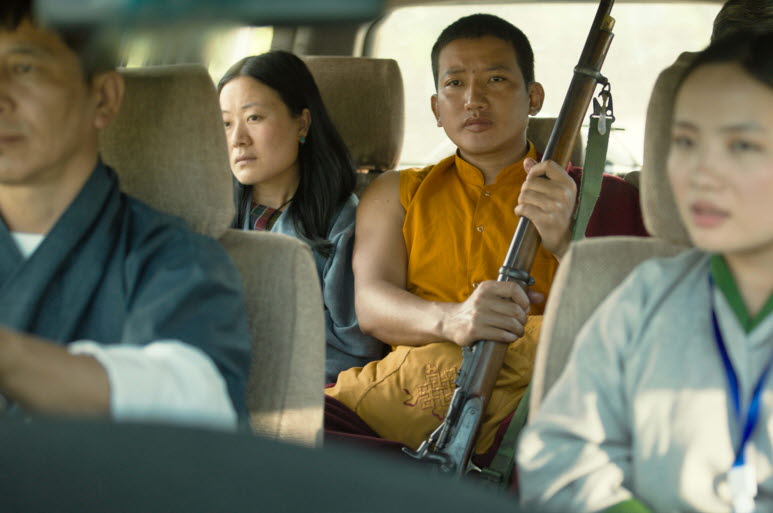
“The Monk and the Gun”, which was the Bhutanese entry for Best International Film Oscar in last year (It was included in the shortlist around the end of last year, by the way), takes its time for its little deadpan human comedy about the democratization in Bhutan during the late 2000s. Yes, as told to us at the beginning of the film, the country and its people came to have the first democratic election only after its king willingly abdicated his in 2006, and the movie gives us a series of small hilarious moments before eventually culminating to the sublime finale which shows some hope and optimism for Bhutan and its people.
The story is set in a remote rural village located somewhere outside Thimphu. As the whole country is about to prepare for the first democratic election, many people in the village feel rather confused about this sudden social/political change, and that is why several government officials come to the village for some enlightenment. They are going to preside over a mock election for everyone in the village, and they hope that this may help the villagers experience and then understand democracy a bit more than before.
However, not so surprisingly, their work turns out to be much more challenging than expected. While many villagers do know about the upcoming election thanks to a few TVs in the village, most of them do not know that much about how to vote, let alone what and how to prepare in advance for voting. For example, many of them do not know well what is actually necessary for the voter registration process, and this certainly frustrates the government officials a lot right from the beginning.

We also observe how things recently get quite complicated for one certain male villager and his family due to the upcoming election. While many of his neighbors and family members are going to vote for one of the two candidates in their area, he is pretty vocal about supporting the other candidate for a little understandable personal reason, and this naturally causes some conflict between him and others. As a matter of fact, his little daughter is often bullied and ostracized at her local school due to her father’s political stance, and his wife, who is incidentally tasked with assisting those government officials, is not so pleased about this situation to say the least.
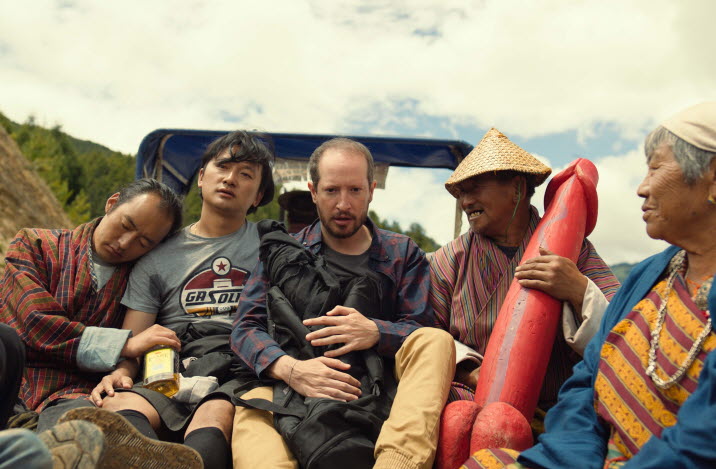
In the meantime, the movie also pays attention to one American visitor and his local guide, who come together for buying one old gun from one of the villagers. Regardless of how valuable it actually is, this American guy is ready to pay as much as possible for the gun, and the guide is willing to take some risk just because this illegal purchase will benefit him a lot, even though the local police are already looking for them.
When the American dude and his guide finally arrive in the villager and then meet their seller, the movie gives us one of its funniest moments as they are quite flabbergasted by the absurd outcome of their attempt to make a reasonable deal with their seller. I will not go into details here, but I can tell you instead that the movie simply lets this comic situation get developed step and step, and you will be certainly tickled by what happens in the end.
This moment subsequently leads to a funnier circumstance thanks to a respectable old Buddhist monk living in a nearby temple. After hearing about the upcoming election via his old little radio, the monk instructs one of his apprentices to get two guns for him within a few days before the full moon, and his apprentice dutifully follows his master’s instruction. After looking here and there around the village, the apprentice eventually comes to some guy’s house, and, what do you know, that guy is the owner of that old gun.
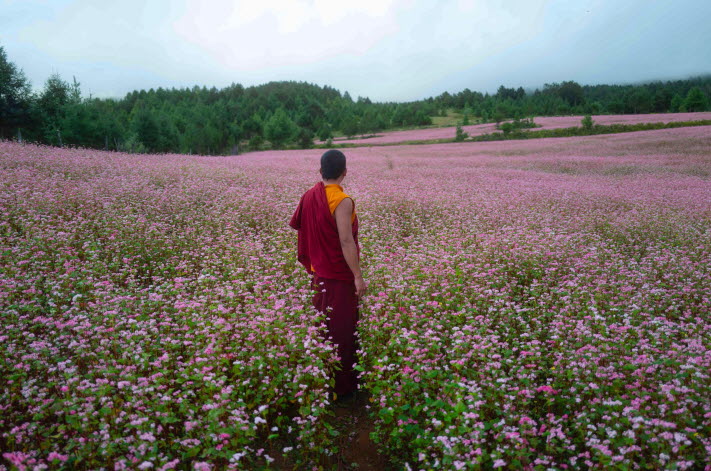
For avoiding spoiling any fun for you, I will just tell you instead that I admire how the screenplay by director/writer/co-producer Pawo Choyning Dorji, who previously drew some attention due to garnering a surprise Oscar nomination for his first feature film “Lunana: A Yak in the Classroom” (2019), patiently rolls its multiple narratives together without hurrying itself at all. As cinematographer Jigme Tenzing, who previously collaborated with Dorji in “Lunana: A Yak in the Classroom”, vividly presents a number of lovely mountainous landscapes, we become more immersed in the daily life of the villagers in the film, and we are alternatively amused and fascinated with their human responses to more modernization coming into their environment. Even when the story eventually reaches to the climatic part where we come to see why the old monk wants two guns, the movie firmly sticks to its slow narrative pacing despite generating some suspense around that point, and this leads to another funny moment, which comes with not only ironic absurdity and poetic justice but also a certain symbolic object which will definitely induce some good laughs from you.
In conclusion, “The Monk and the Gun” is modest but genuinely funny and engaging for how it handles the specific aspects of the story and characters with humor and respect. With this charming little film, Dorji succeeds in advancing further from what was admirably achieved in his previous work, and I will surely look forward to watching whatever he may do next after the well-deserved critical success of his first two feature films. Yes, this is one of those “slow movies”, but it is also a wonderful crowd-pleaser in my humble opinion, and you should not miss a chance to watch it.


 Seongyong's Private Place
Pingback: 10 movies of 2024– and more: Part 2 | Seongyong's Private Place