

“Banel & Adama”, which was chosen as the official submission to Best International Film Oscar by Senegal in last year, is a sad story about a young rural woman getting dried and suffocated by the harsh reality of her isolated world. While she tries to be defiant as much as she can, it seems that she cannot stop the inevitability of her grim situation, and even her passionate love cannot help her much in the end.
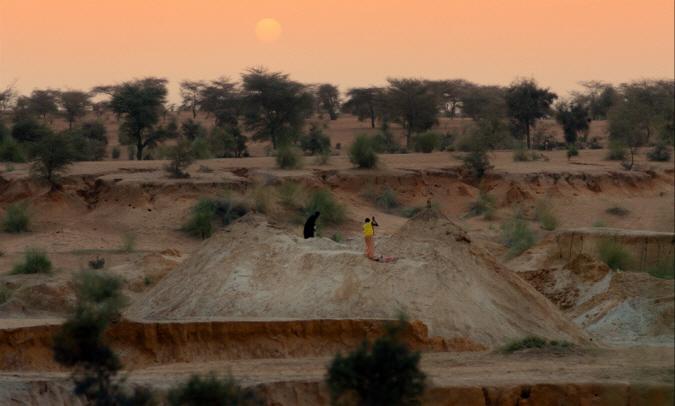
At the beginning, everything looks fine for Banel (Khady Mane). She and her young husband Adama (Mamadou Diallo), who is incidentally the younger brother of her first husband who died not so long ago, are a lucky couple who has really loved each other, and they also have been planning to live outside their little rural village just because, well, they want more freedom and privacy. Whenever they have some free time, they go outside to dig up an abandoned house buried deep inside a mound of sand, and they do not care that much about whether it is really cursed as others in their village have said.
We also get to know a bit about the conflict between Adama and several town elders including his mother. Because he is the only surviving son of his father due to his older brother’s recent death, he has been expected to succeed his father as the new village chief, but Adama does not want that role at all even though he prepared for that role for some time, because he has felt rather burdened by this expectation.

Meanwhile, the movie slowly lets us feel how things are getting gloomy for everyone in the village due to the ongoing drought. As they suffer more and more due to the serious lack of water and food, Adama and other men in the town naturally come to spend more time on how to maintain the village, and Banel is not so pleased about this change to say the least. Her dear husband becomes more like many other guys in the village as being frequently absent around her, and we observe how much she feels alone for refusing to conform to the patriarchy system of her village. Unlike the other young women in the village, she is determined not to become a mere wife and mother, and it is even suggested to us later in the film that she did something terrible for getting real love and freedom for her.
However, just like many others including her husband, she begins to wonder whether she and others in the village are cursed due to her and her husband’s little transgression. There are a series of brief but unnerving moments as her mind sometimes gets disturbed by some ominous vibe around her, and the circumstance becomes more despairing for her as her husband, who also experiences one very disturbing incident around that point, comes to bend himself under more pressure from his mother and others in the village. Although Adama still cares a lot about his wife, he and Banel become more distant to each other than before, and Banel consequently gets more frustrated than before as reminded again that she may eventually end up being stuck in a traditional role expected to be filled by her right from when she was born.
Vividly conveying to us its heroine’s growing desperation and frustration along the story, the movie emphasizes more of how much the village is isolated in the middle of its vast remote area, and cinematographer Amin Berrada skillfully captures the stark beauty of the dried landscapes surrounding the village and its people. With any sign of rain to come, the village gradually feels static and lifeless as its residents become more restless and exhausted, and we are not so surprised as Banel looks more like being under some influence.
I wish the screenplay by director/writer Ramata-Toulaye Sy fleshes out the story and characters for more interest and understanding, but she did a solid job of immersing the audiences into a small, isolated background inhabited by its main characters, while never losing the focus on Banel and her increasingly deteriorating state of mind. Although you may get baffled by the rather ambiguous finale, this ending somehow makes sense considering what has been steadily built up to that point, and we all can agree that Banel comes to have some peace of mind regardless of what really happens to her in the end.
Sy also draws the good performances from her main cast members, most of whom are evidently non-professional performers as shown from their unadorned natural acting. As the center of the movie, Khady Mane is often heartbreaking as her character is driven more into despair and anxiety along the story, and she and her co-star Mamadou Diallo are convincing in the slow but inevitable implosion of their characters’ supposedly strong relationship. In case of the supporting performers, they simply seem to come and go around Mane and Diallo at first, but they look believable with a real sense of life nonetheless, and that is one of the main reasons why the movie kept holding my attention despite its decidedly slow and opaque storytelling.
In conclusion, “Banel & Adama” is a modest but interesting debut work from Sy, who previously made several short films before making a feature film debut here in this film. Although it will require some patience from you at the beginning, the movie is filled with the mood and details to be appreciated thanks to Sy’s competent direction, and it will be interesting to see what may come next from this promising African female filmmaker.


 Seongyong's Private Place