

Jean-Luc Godard was at the height of his artistic creativity when he was young and bold in the 1960s. After making a huge milestone spot in the cinema history with his great film “Breathless” (1960), he gave us a number of other interesting films including “Vivre sa vie” (1962) and “Weekend” (1967), but then, alas, he began to go down around the 1970s as becoming less cool than before, and the rest of his filmmaking career was filled with deliberately impenetrable experiments such as “Film Socialisme” (2010).
I still remember how much I was frustrated with Godard’s two last works “Goodbye to Language” (2014) and “The Image Books” (2018), so it is rather heartening to observe the lightweight charm and style of “Band of Outsiders”. Here, Godard was just a young ambitious filmmaker who simply tried something new and different while being less serious about himself compared to what he eventually became later in his career and life, and I was delighted by its several charming moments before being a bit saddened by the inevitable ending waiting for its main characters.
The story, which is an adaptation of the 1958 novel “Fools’ Gold” by American author Dolores Hitchens, mainly revolves around three young people who happen to get involved with each other via an English class they have attended for a while. The opening scene introduces us to Franz (Sami Frey) and Arthur (Claude Brasseur), and we come to gather that these two lads are planning something criminal because, well, they are just bored with their uneventful daily life.
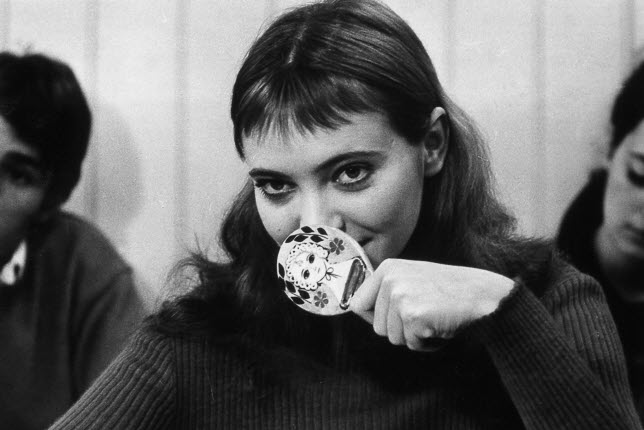
Their target is a certain house located somewhere in Paris, which belongs to some rich man who may have lots of cash inside his house. This rich man in question lives with his wife and his wife’s young niece, and that young niece, Odile (Anna Karina), is the one attending the English class attended by Franz and Arthur. During another lesson time for them and several other students, Arthur attempts to seduce her a bit without getting noticed by their teacher, and it looks like Odile is also drawn to him even though her beautiful face does not signify much on the surface.
Anyway, Odile lets herself get more involved with Franz and Arthur after the class, because she is also frustrated with the ennui of her daily life just like them. She willingly looks for any cash in the house later as requested by them, and, what do you know, she does discover a considerable amount of cash hidden in a certain room. How the cash is hidden will probably remind you of that famous short mystery story by Edgar Allen Poe, which is incidentally mentioned in the middle of the film.
As these three young people prepare a bit for their little act of crime, the movie sticks to its dry and distant attitude with Godard’s frequently phlegmatic narration, while also often upending the expected genre clichés and conventions. They do not plan much about how they are going to steal the cash from the beginning, so there is not much tension around their rather simple plan, and the movie simply rolls along with them as they spend their time together in one way or another. At one point, they suddenly decide to dance a bit together at a local cafe, and, as many of you know, this impromptu moment of fun has been quite iconic while influencing a number of notable films including Quentin Tarantino’s “Pulp Fiction” (1994). Yes, that famous dance scene between John Travolta and Uma Thurman is an indirect homage to this scene, and Tarantino even named his production company after the title of the movie.

Of course, there comes a point later in the story where the situation becomes far less fun for Odile and her two friends, and this eventually culminates to the finale filled with some bitter irony. In my humble opinion, the following epilogue feels rather artificial, but Godard does not lose any of his wit at all even during this part, as closing the film with his sarcastic narration.
While revisiting the movie, which happens to be re-released in South Korean theaters in this week (It is probably for its 60th anniversary, I guess), I noticed how the movie overlaps with François Truffaut’s “Jule and Jim” (1962) to some degree, another notable work of the French New Wave during the 1960s. Like the heroine of “Jule and Jim”, Odile’s heart often seems to go back and forth between the two different men she happens to be associated with, and we are frequently uncertain about her thoughts and feelings. Yes, she looks like enjoying her time with Arthur and Franz, and she seems to be more drawn to Arthur, but she looks like being also attracted to Franz, though she never clarifies that to him or herself even when they happen to be together without Arthur. As Sami Frey and Claude Brasseur steadily hold the ground for her, Anna Karina, who was Godard’s first wife and also his frequent leading actress during the 1960s, fills her archetype role with enough charm and beauty, and the constant romantic tension generated between her and her two co-stars steadily holds our attention even though the movie remains dry and distant as usual even during the finale.
Overall, “Band of Outsiders” may not be as great as “Breathless” or “Vivre sa vie”, but it is packed with enough style and charm as well as some youthful energy to be cherished. To be frank with you, I usually prefer Truffaut’s films to Godard’s, but I admire a lot many of Godard’s early works nonetheless, and “Band of Outsiders” reminds me again that there was indeed a time when Godard and his movies were really cool.


 Seongyong's Private Place