
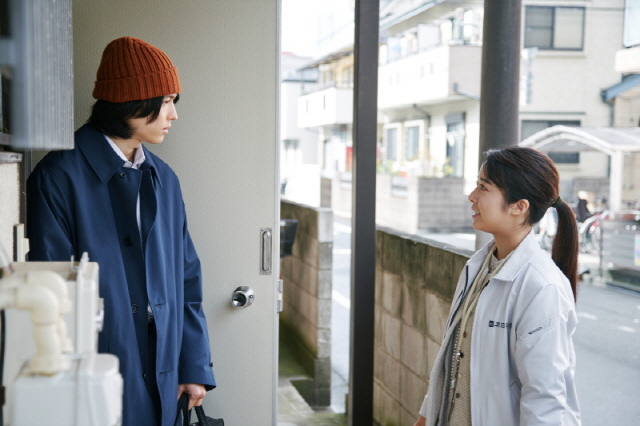
Japanese filmmaker Shô Miyake’s latest film “All the Long Nights” is a calm and somber character drama between two different troubled people who come to help and support each other more than expected. Although it feels predictable at times, the movie leisurely takes its time in building up its main characters along the story with considerable sensitivity and realism, and it surely earns a little sign of hope and optimism around the end of the story.
At the beginning, we are introduced to a young woman named Misa Fujisawa (Mone Kamishiraishi), and we get to know a bit about her longtime medical problem. Since her adolescence period, Misa has often suffered Premenstrual Syndrome (PMS), and the opening part shows us how she becomes quite stressed out due another severe incident of PMS. At least, she has received considerable support from her caring mother for years, but things still do not get better at all despite her efforts, and she eventually quits her new job as getting stigmatized for the troubles caused by her medical problem.
Five years later, Misa is now working at a little company which manufactures a number of scientific instruments for kids, and she seems a bit more well-adjusted than before. While she still suffers PMS from time to time, she is mostly on good terms with her co-workers, and they surely appreciate her generosity when she hands out sweets to them.

However, one particular employee does not respond that much to her generosity. That person in question is a lad named Takatoshi Yamazoe (Hokuto Matsumura), and we observe how distant he is to others at the workplace. Although he is a fairly nice employee who works as much as required just like others around him, but he is usually quiet and introverted, and Misa becomes more curious about him especially after a rather awkward interaction between them.
It soon turns out that Takatoshi has a really serious problem behind his back just like Misa. He has often had a serious bout of panic attack for a while, and we come to learn that he quit his previous job mainly because of that. While his former boss and co-workers are willing to take him back at any time, his panic attack problem has not been alleviated at all, and he has an embarrassing moment in front of others when he happens to be overwhelmed by another incident of panic attack.
After getting to know more about Takatoshi’s panic attack problem, Misa comes to care more about him as a person who has had a fair share of difficulties due to a medical condition beyond control. As approaching to him with more care and empathy, she comes to show more of herself to him, and he appreciates that while also giving some valuable help to her PSM problem. When she happens to have another bout of PSM on one day, he takes her outside, and that is followed by an unexpectedly calm moment between them as they focus on doing something together for a while.
Now this sounds like the setup for a typical romance tale, but the screenplay by Miyake and his co-writer Kiyohito Wada, which is based on the novel of the same name by Maiko Seo, does not force its two main characters into a romantic relationship at all, while simply adding more human details to the story as its two main characters try to go on day by day. We observe how Misa tries to remain close to her mother as before despite her mother’s recent illness, and there is a little touching moment when her mother gives Misa a little gift she made for herself. In case of Takatoshi, he is visited by a young woman who is also a former co-worker of his, and we see how much she still cares about him even though there is now considerable distance between them due to his current medical problem.

We also get more engaged in the mundane daily business of Misa and Takatoshi’s workplace, which later happens to be enlivened a little by two local kids occasionally visiting the company for a little school project of theirs. During the interviews conducted by these two kids, Misa and her co-workers have to explain a bit about their work, and that naturally leads to a few humorous moments to tickle us.
As they interact more with each other as well as others around them, Misa and Takatoshi slowly come out of their respective shells. Later in the story, they actively participate in a local event planned by their company, and we get a lovely sequence where Misa eagerly gives a bunch of people a little presentation on the constellations in the night sky. Although we can only see the faces of Misa and others around her in dim light for a while, the mood is surprisingly soothing nonetheless, and we cannot help but notice how much Misa looks and feels different compared to how troubled she was around the beginning of the story.
Ably complementing each other throughout the film, Mone Kamishiraishi and Hokuto Matsumura diligently carry the film together, and they are also supported well by a number of good supporting performers in the film. They all look convincing in their unadorned natural acting, and that is particularly evident from what is casually but touchingly shown around the end of the film. The camera simply watches from the distance, but we are quite touched nonetheless, as watching the characters going through another day as usual.
Overall, “All the Long Nights” is another interesting work from Miyake, who previously drew my attention for “Small, Slow But Steady” (2022). Although it is relatively milder compared to his previous film, the result is still realistic and intimate enough to impress us, and I guess I can have more expectation on his promising filmmaking career.


 Seongyong's Private Place
Pingback: 10 movies of 2024– and more: Part 2 | Seongyong's Private Place