

It is always fascinating for me to observe different people and lives via good movies, and “Sing Sing” is one of such terrific films. Although most of its main characters are quite different from me in many aspects, I observed their collective artistic efforts with considerable interest and fascination, and I was touched a lot by how they try to endure and prevail under their imprisoned status – and how the movie illustrates their little drama with a lot of human understanding and empathy.
The main background of the story is Sing Sing Maximum Security Prison, which is located in the New York state of US. At the beginning, we see John “Divine G” Whitfield (Colman Domingo) and his fellow inmates doing a little stage performance together as the members of Rehabilitation Through the Arts (RTA) program, and they all are delighted and excited as they finish their latest project pretty well on the whole, though they will soon have to go back to their respective cells after taking off those stage costumes and then wearing their prison uniforms.
Anyway, Divine G and his fellow RTA members are already ready for another show to come while supervised by their civilian director Brent Buell (Paul Raci) as usual, and we are a bit amused as they discuss about what they will do next. After some heated discussion, it is eventually decided that they are going to do something more lightweight, and Buell is willing to provide a little comic science fiction play he wrote some time ago.

What follows next is how Divine G and the other RTA members prepare for their new show during next several days. After reading Buell’s play (It is titled “Breakin’ the Mummy’s Code”, by the way), Divine G, Buell, and several other RTA members hold the audition, and we watch each of their colleagues trying their best for getting the roles they respectively want to play.
One of the RTA members going through the audition is Clarence “Divine Eye” Maclin, who incidentally plays himself here just like many of the cast members of the film. Although he did not seem that interested in acting when he was recruited by Divine G, Divine Eye gradually comes to show more interest and passion as being often encouraged more by Divine G and the other RTA members, and he eventually gets himself cast as a certain key character in Buell’s play, though Divine G is not that pleased with that for an understandable reason.
Nonetheless, Divine G keeps things rolling for the group along with Buell, who may be a little annoyed at times but still respects Divine G’s leadership. Whenever Divine Eye struggles in one way or another, Divine G and the other RTA members are always willing to help and support Divine Eye, and there is a little poignant moment when one of them shows more of himself to cool down Divine Eye a bit in the middle of their rehearsal.

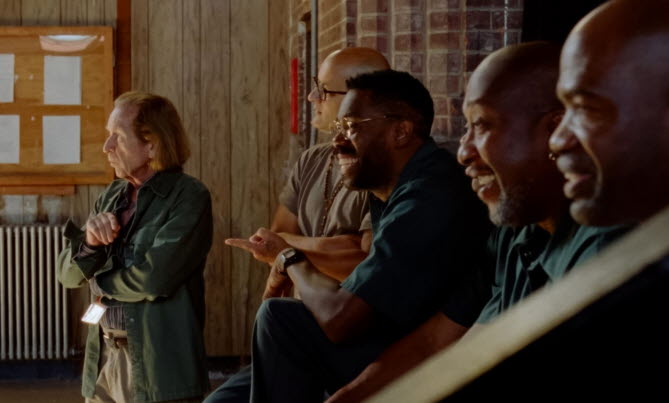
And we also observe more of why Divine G and his colleagues have been so passionate about their theater program for years. Most of them have been incarcerated for many years without much hope for getting released from the prison someday, and we come to understand that their artistic activities have been a sort of personal therapy process for themselves. Plainly but vividly conveying to us their despairing status of imprisonment throughout the film, the cinematography by Pat Scola, who shot the movie on the 16mm film in 1.66:1 ratio, sometimes sticks very close to the main cast members of the movie, and we come to pay more attention to their expressive faces, which often give us the glimpses of their life stories even when they do not seem to signify that much on the surface.
It goes without saying that the movie depends a lot on its main cast members, and director/co-writer/co-producer Greg Kwedar, who wrote the screenplay with co-producer Clint Bently (It was developed from the story written by them, Maclin, and Whitfield himself, which is based on Buell’s aforementioned play and John H. Richardson’s 2005 Esquire article “The Sing Sing Follies”), draws stellar natural performances from his cast members. Needless to say, Colman Domingo, who has been more prominent thanks to his recent Oscar-nominated performance in Netflix film “Rustin” (2022), surely draws our attention first with another superlative performance to watch, but he does not overshadow at all his fellow cast members, who are all convincing as filing their respective parts with enough life and personality to observe. Maclin, who is a definite standout in the bunch, and his fellow RTA members click well together whenever they pull or push each other during a number of key scenes among them, and Paul Raci, who has been more notable thanks to the well-deserved Oscar nomination for his wonderful supporting turn in “Sound of Metal” (2020), and Sean San José flawlessly get themselves mingled into the ensemble even though they are professional actors just like Domingo.
Overall, “Sing Sing” is one of the most impressive movies of this year due to its considerable emotional power, and it will move you a lot while also making you reflect more on that transformative power of art – especially when it shows a series of archival footage clips of the various stage performances from Whitfield, Maclin, and their fellow RTA members. To be frank with you, I have no idea on how much the movie itself is close to their real-life stories, but it sublimates their real-life stories into something quite memorable mainly thanks to their active joint participation in its production, and it is surely something you should check it out as soon as possible.


 Seongyong's Private Place
Pingback: 10 movies of 2024– and more: Part 1 | Seongyong's Private Place
Pingback: My Prediction on the 97th Academy Awards | Seongyong's Private Place