
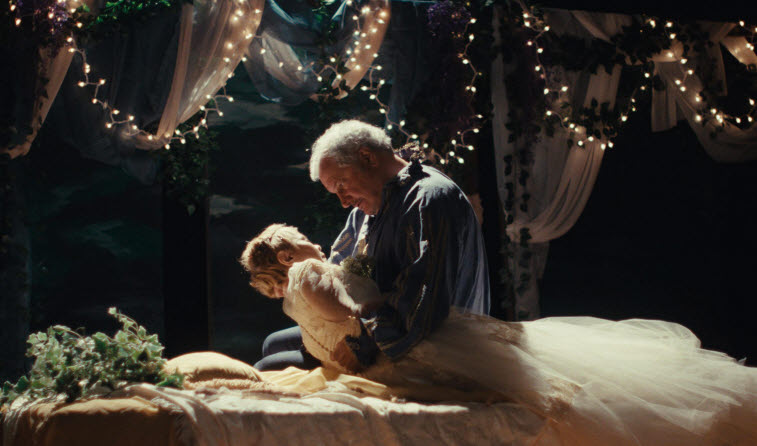
“Ghostlight” is a modest but extraordinary human drama about the surprising healing power of art. Mainly revolving around one plain man’s struggle to understand and process his anger and grief via one unlikely artistic opportunity, the movie comes to show a lot of compassion and understanding to not only him but also several other characters in the story, and we are eventually touched a lot as observing how much he gets better around the end of the movie.
At the beginning, the movie slowly and subtly establishes how things have been quite depressing for a construction worker named Dan Mueller (Keith Kupferer). He and his wife Sharon (Tara Mallen, who is incidentally Kupferer’s real-life wife) have been estranged from each other for a certain issue to be revealed later in the story, and we also come to gather that this certain issue in question also puts a lot of strain on his relationship with his adolescent daughter Daisy (Katherine Mallen Kupferer, who is, yes, Kupferer and Mallen’s real-life daughter).
On one day, Mueller happens to have a little clash with some very rude driver when he is working outside, and then he is approached by an actress named Rita (Dolly de Leon, who looks quite different from her breakthrough supporting turn in Ruben Östlund’s Oscar-nominated film “Triangle of Sadness” (2022)). She and several other performers are preparing for a little local stage production of William Shakespeare’s “Romeo and Juliet”, and, after seeing what has just happened to Mueller, Rita thinks he needs some positive influence for dealing with whatever he is struggling with.

All Mueller has to do is reading a few lines for Rita, who is going to play Juliet, and her fellow performers, but then he finds himself getting involved into their stage production much more than expected. He comes to show more interest in acting, and he even asks a bit about that to his daughter, who incidentally has a fair amount of stage experience due to the extracurricular activity in her school. Thanks to his daughter, he come to learn about how to memorize lines efficiently, and he also comes to learn from his new colleagues that acting is much more than memorizing lines.
When the actor who is going to play Romeo suddenly quits due to his petty problem with looking intimate with Rita, that leads to an unexpected breakout for Mueller. After he shows much more of the personal grief behind his taciturn attitude, Rita and her colleagues console him a lot, and then he finds himself being cast as the new Romeo for their stage production.
Meanwhile, Sharon and Daisy come to suspect that something fishy is going on behind him, especially after they happen to witness and then misunderstand a little private moment between him and Rita. Fortunately, the screenplay by directors Kelly O’Sullivan and Alex Thompson, who previously collaborated with each other as the lead actress/writer and the director in “Saint Frances” (2019), is too thoughtful to resort to “Idiot Plot”, a term popularized by my late friend/mentor Roger Ebert. Instead of wasting its running time on any contrived situation of misunderstanding and obliviousness between Mueller and his wife and daughter, the story goes straight to a quick moment of resolution among them, and we get a bit more amused as his wife and daughter provide more help and support than expected.
However, the movie never overlooks their lingering anger and grief associated with their big personal loss. I will not go into details here, but there is a good reason why “Romeo and Juliet” resonates a lot with Mueller’s grieving mind, and we are not so surprised when Muller finds it quite difficult to do the rehearsal on that famous climactic scene of “Romeo and Juliet”.

As the quiet but ultimately harrowing center of the story, Keith Kupferer is particularly good when his character struggles to hold himself for what is supposed to be a very important moment for himself and his family later in the story. As Mueller is trying to depict what is probably the most painful moment in his whole life, Kupferer is dexterous in his character’s dynamic emotional shifts, and the result is devastating to say the least. Considering that he has been relatively unknown despite starting his movie acting career 20 years ago, the movie is certainly Kupferer’s big breakthrough moment, and his superb performance here in this film may led to better things to come in his career.
Around Kupferer, O’Sullivan and Thompson assemble a number of engaging performers to watch. While Tara Mallen and Katherine Mallen Kupferer always click well with Kupferer in their interactions on the screen, their unadorned natural supporting performance is another crucial factor in the dramatic effectiveness of the climactic part of the film. Dolly de Leon and several other performers playing Rita’s colleagues are believable in their occasional moments of collective positive vibe, and they certainly make a good counterpart to the dark emotional issues surrounding Muller and his family.
On the whole, “Ghostlight”, whose title refers to a theatrical tradition that calls for a single bulb to remain lit on a stage even when the rest of the theater is literally (and figuratively) dark, is an earnest but powerful piece of work which distinguishes itself a lot via its sensitive and thoughtful handling of story and characters, and its somber but moving final shot, which subtly suggests a bit of hope and optimism, will linger on your mind for a while after it is over. In my inconsequential opinion, this little precious gem is really too good to be overlooked, and I assure you that you will agree that it is also one of the best films of this year.



 Seongyong's Private Place
Pingback: 10 movies of 2024– and more: Part 1 | Seongyong's Private Place