
South Korean independent film “By the Stream”, which is another film from Hong Sang-soo during this year after “A Traveler’s Needs” (2023), sadly did not engage me much as frequently feeling rather thin and vague in terms of story and character. While it is a bit interesting for being Hong’s another notable work mainly driven by female characters, the movie merely plods from one moment to another without much intrigue or amusement for me, and it only ends up being a disappointing misfire compared to the lightweight charm of “A Traveler’s Needs”.
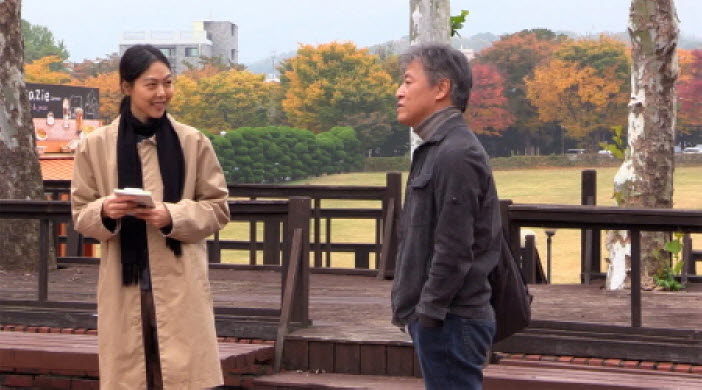
At first, we are introduced to a young female college lecturer named Jeon-im (Kim Min-hee) and her middle-aged uncle. Jeon-im’s several female students have been preparing for a little skit for the upcoming skit competition in their college, but the guy supervising her students had to be let go due to his inappropriate behavior with some of her students. Because only 10 days are left at present, Jeon-im needs anyone who can supervise her students instead, and she requests her visiting uncle to do the job mainly because he was once quite famous as an actor/director before getting blacklisted for some unspecified reason.
Fortunately, Jeon-im’s uncle is willing to take the job, and we see how he works along with Jeon-im’s female students, who are all eager to work under him even though what they are going to do will be quite different from what they have prepared up to that point. He quickly comes to click well with these students, and Jeon-im is certainly relieved to see how her students enthusiastically collaborate with her uncle.
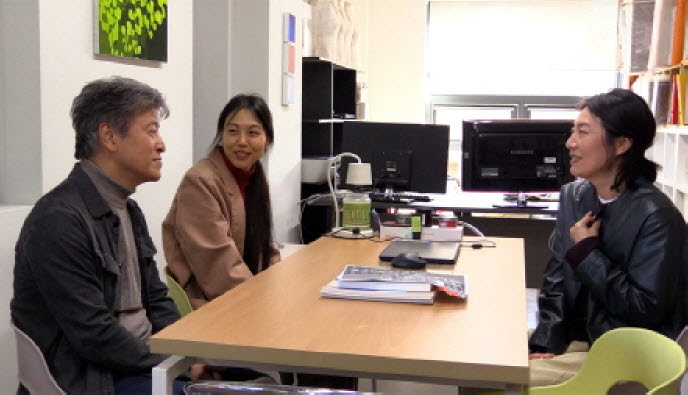
Meanwhile, Jeon-im introduces her uncle to Professor Jeong (Jo Yoon-hee) mainly because Professor Jeong turns out to be a big fan of his works. When Jeon-im and her uncle come to her office, Professor Jeong cannot help but show more admiration to him, but she and Jeon-im’s uncle somehow never delve much into how he became blacklisted at that time (It is only said that he made some very sensitive comments which must have angered many influential figures in his field).
Anyway, they all eventually go to a little nearby restaurant which happens to be located by a local stream, and, like many of Hong’s movie characters, they drink and talk a lot for a while. Although their conversation often feels a bit too superficial without revealing that much about themselves, the performers fill this conversation with considerable spontaneity at least, and you may wonder whether they actually drank during the shooting just like many performers allegedly did during the shooting of Hong’s films.
On the next day, Jeon-im comes across that guy fired by her, and we are accordingly served with a comic moment of pettiness you can expect from Hong’s works. As he attempts to get employed again by Jeon-im, he keeps trying to avoid his responsibility for whatever happened between him and some of her female students, and, not so surprisingly, there comes a point where Jeon-im comes to draw the line between her and this pathetic dude.
While the situation becomes a bit more absurd when this guy appears again later in the story, the new skit by Jeon-im’s uncle goes through its short but smooth preparation. Although the movie is adamantly very ambiguous about what his skit is really about, Hong’s camera simply watches Jeon-im’s female students performing together on the stage without any interruption, and I must say that this is surely something we do not usually get from Hong’s movies.

However, Hong’s screenplay sadly fails to develop these young female characters more along the story. When one of them turns out to be quite close to the aforementioned dude, this moment looks so dim in its nocturnal background that we are not very sure about which of these young ladies is the one associated with him. Around the last act of the film, Jeon-im’s uncle encourages them to express their respective feelings about themselves at their little celebration party, but their words mostly feel bland and perfunctory, and we still remain distant to them despite the earnest efforts from the four good actresses playing them (They are Kang So-yi, Park Han-bit-na-ra, Oh Yoon-soo, and Park Mi-so, by the way).
In case of several other main cast members, who are incidentally Hong’s usual collaborators, they have more materials to handle in comparison. Kwon Hae-hyo, who has virtually been Hong’s alter ago as appearing in a number of Hong’s recent films including “Walk Up” (2022), is effortless in his several comic moments in the film, and he and Jo Yoon-hee, who previously appeared along with Kwon in “A Traveler’s Need”, did a good job of suggesting whatever is being exchange between their characters beneath the surface. Kim Min-hee, who received the Best Performance Award when the movie was shown at the Locarno Film Festival in last month, ably fills her rather broad role with her own charm and presence, and I wish the movie explored more of her character’s modest but intriguing artistic activity, which is incidentally associated with the title of the film to some degree.
In conclusion, “By the Stream” is not as enjoyable as “A Traveler’s Need”, and that reminds me again of how I have become relatively less engaged in Hong’s works during last several years. It is admirable that he continues to try new stuffs, but the result feels rather shallow to me like “In Water” (2023) or “In Our Day” (2023), and I am already quite ready to move onto whatever he will give us in the next year.


 Seongyong's Private Place
Hong’s early films were very entertaining, but in recent years they have become more and more insubstantial (though I’ll probably continue making the trip into Seoul to see them). This one seems to be set in an alternative Korea in which female college students can put away industrial quantities of soju and can survive for the duration of the film (long by Hong’s standards) without so much as touching their phones.
SC: Yes, the depiction of female college students in the film is indeed not so realistic.