
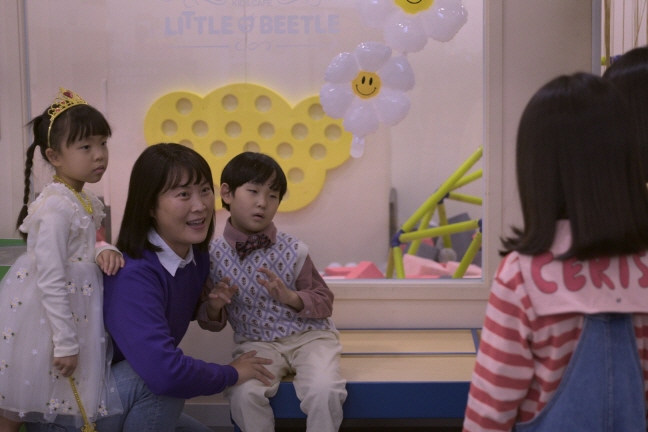
South Korean film “Blesser” vividly shows how life can be like a sheer hell for a woman who happens to have an autistic kid. While it will surely try to pull your heartstrings via one personal hardship after another unfolded along the story, the movie holds our attention via its earnest storytelling and strong lead performance, and it certainly earns a little moment of hope and optimism around the end of the story.
When she is having a honeymoon week in 2008, Sang-yeon (Kim Jae-hwa) seems to have everything in order. She is a promising young political reporter of some prominent newspaper, and she is confident that her married life will not affect her professional career much even though she is going to take some break after getting pregnant with the twin babies. As a matter of fact, her boss is willing to take her back once her maternal vacation period is over, and her husband is also ready to support her as much as possible during next several years.
However, things unfortunately do not go as well as Sang-yeon hoped. When she eventually gives birth to her two kids, everything looks okay on the surface, but then she and her husband begin to notice something odd about one of their two kids a few years later. While their daughter grows up to become your average plucky little girl, their son looks rather slow in terms of mental development, and then Sang-yeong and her husband belatedly come to learn that their son actually has a serious case of developmental disability involved with autism.

Quite shocked and devastated by this unexpected news, Sang-yeon tries to deal with her son’s disability as much as possible, but she only finds herself saddled with more despair and frustration day by day, and the movie shows us more of how hard it really is to raise a kid with developmental disability. As time goes by, her son becomes more and more difficult to handle, and her resulting stress and exhaustion naturally affect her relationship with her husband and their other kid. While her husband feels pressured a lot as he has to provide more for supporting his wife and their son, their daughter already feels quite neglected as her mother is usually occupied with handling her brother.
At least, the situation turns out to be not entirely hopeless for Sang-yeon. She approaches to an old school senior of hers who also has a kid with serious developmental disability, and her senior gladly gives her a number of valuable advices including the one on his education issues. To make him a bit more socially adjusted, Sang-yeon must try a lot of things on her son, and one of the things is sending him to a local elementary school, where he may learn social skills to some degree before eventually being transferred to a special school for kids with developmental disability like him.
Of course, as many of you already expected, this also turns out to be quite challenging for Sang-yeon right from the very first day. While quite concerned about her son’s condition, she also must be on good terms with the parents of the classmates of her son, and this seems to work fairly well for Sang-yeon and her son for a while – before she later come to learn more about the social prejudice against her son’s disability.

While struggling with one hardship after another, Sang-yeon feels more like being against the wall, and we are accordingly served with a series of heart-wrenching moments, but the screenplay by director Lee Sang-cheol and his co-writer Shin A-ga, which is inspired by the memoir written by a former newspaper reporter not so different from Sang-yeon, thankfully does not resort to wallowing in pity and despair like your average misery porn. Yes, Sang-yeon is surely driven to the edge more than once throughout the film, but she somehow regains her strength via her problematic but ultimately strong relationship with her son. Sure, he is frequently quite distant and impossible to say the least, but he shows some affection to his mother at times, and there is a little poignant moment when he unexpectedly gives a little mental support to his mother when she is at another bottom of desperation.
I wish the movie delved more into how Sang-yeon and many other similar mothers try hard for fighting against the social prejudice against their dear kids, and a subplot involved with one smarmy politician who casually throws an empty promise to Sang-yeon and her fellow mothers is rather half-baked in my inconsequential opinion. Nevertheless, the movie still engages and then touches us via its strong heroine and her numerous struggles along the story, and Kim Jae-hwa, who looks and feels quite different here compared to her hysterical comic turn in “Extreme Festival” (2022), is often heartbreaking as ably conveying to us many ups and downs in her character’s story. There are several scenes where she is required to be quite melodramatic, but Kim brings enough sincerity and realism to these emotionally heightened moments, and we come to care and empathize with Sang-yeong’s struggle more instead of merely pitying her.
Overall, “Blesser” may feel like a public service movie at times, but its heart is right in the place because of its sincere and thoughtful storytelling as well as Kim’s solid lead performance. I had a pretty good idea on what and how it is about before the movie began, and it does not do anything particularly unexpected on the whole, but, as a guy on the mild range of autistic spectrum, I must admit that I could not help but become quite emotional during my viewing. If it could melt the heart of a seasoned autistic moviegoer like me, it can surely appeal to any other decent audience out there, and I sincerely hope that it will be watched by many local audiences during this Chinese Thanksgiving holiday week in South Korea.


 Seongyong's Private Place