

South Korean independent film “House of the Seasons” clicked so well with me right from the beginning, and I was all the more amazed by how it never lost its grip on me after that. At first, it looks like another typical Korean family drama, but then it carefully establishes its main characters with big and small details to be observed during its first act, and I found myself much more engaged than expected during the rest of the movie.
The first act of the film mainly revolves around an ancestral rite of one big family led by an old man named Seung-pil (Woo Sang-jeon) and his wife Mal-nyeo (Son Sook). For many years, they and their family have run a modest but fairly successful tofu factory in a little country town outside Daegu, and the opening scene shows how several family members of theirs including Seung-pil and Mal-nyeo’s daughter-in-law Hye-sook (Cha Mi-kyung) work along with their employees at the factory.
We subsequently see Mal-nyeo and several other female family members preparing the dishes to be presented during the ancestral rite, and this certainly made me a bit nostalgic. Yes, I still remember well how my mother often did the same thing along with her family members including my grandmother, and I also have some regret on not being that helpful to them except setting up tables and wiping out a heap of tableware as clean as possible.

And then we see the arrival of some other family members including Hye-sook’s eldest son Seong-jin (Kang Seung-ho), who has incidentally been struggling in his acting career for a while. Although his grandparents have expected him to join the family business someday just like his parents did around the time of their wedding, Seong-jin still wants to pursue his acting career as much as possible, and that certainly causes some personal friction between him and her mother later, who still often regards him as a little boy who needs to grow up more.
Nevertheless, the mood among the family members feels mostly pleasant as they ready themselves for the ancestral rite. Under Seung-pil’s solemn supervision, everyone in the house gathers to honor and remember Seung-pil’s dead parents who incidentally passed away around the beginning of the Korean War in 1950, but there comes a brief humorous moment among Hye-sook and several other female family members, and the mood gets more lightened up when the family later has a big dinner together.
However, we gradually come to sense old bitter feelings among the family members, especially when Hye-sook’s husband Tae-geun (Oh Man-seok), the eldest son of Seung-pil and Mal-nyeo, becomes quite petty and pathetic as he drinks more or more. He eventually clashes with his father, so the mood naturally becomes quite nervous around everyone, and then Seong-jin tells everyone that he does not want to join the family business at all.
Now this looks like your average dysfunctional family story, but the screenplay by director/writer/co-producer Oh Jung-min, who made a feature film debut here after making several short films, surprises us as regarding its main characters with more insight and empathy along the story. For example, we later get to know a bit about the past of Seung-pil and Tae-guen, who respectively turn out to be the victims of the darkest times of the South Korean history during the 20th century. We also come to see more of how Mal-nyeo has been the one holding the family together, and there is a brief but quietly touching moment between her and her grandson, who still cares about his grandmother despite being much less close to her than before.
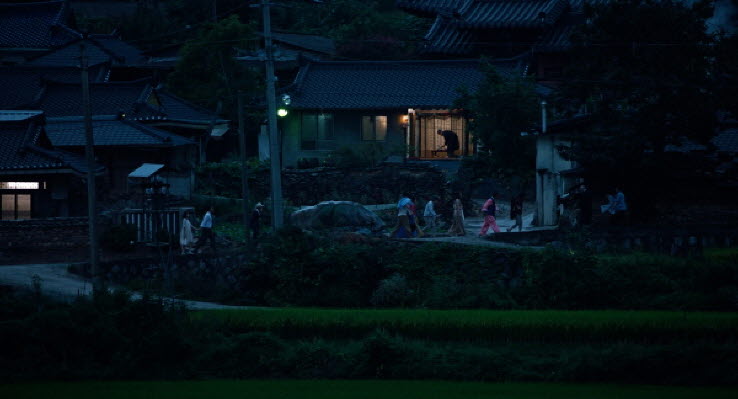
After fully establishing its main characters, the movie simply observes what happens among them as time goes by along with seasonal changes, and Oh and his crew members did a splendid job of filling the screen with a calm and reflective mood coupled with some lovely landscape shots. Although the camera usually observes the main characters from the distance, several key scenes of theirs in the film are presented with palpable emotional intensity, and we are often saddened as they become more distant to each other for understandable human reasons despite being quite devastated by their common personal loss in the middle of the story.
Oh also draws the solid ensemble performance from its main cast members, who are all believable in their respective roles in addition to ably conveying to us the old history among their characters. While Kang Seung-ho dutifully occupies the center, the other cast members in the film including Woo Sang-jeon, Cha Mi-kyung, and Oh Man-seok have each own moment to shine one by one along the story, and the special mention must go to Son Sook, who constantly hovers around the story even during her absence.
Overall, “House of the Seasons”, which is incidentally released in South Korea as “Jang-son” on this Wednesday (It means the eldest grandson by the first-born son in Korean, by the way), is a small but sublime family drama to be cherished for many good reasons including its effortlessly engaging mood and narrative, and I particularly appreciate how it subtly pulls out an almost perfect poetic moment around the end of the story. Yes, many things remain unresolved for its main characters, but life will still go on for them anyway, before their respective closing times eventually come, of course.


 Seongyong's Private Place
Pingback: 10 movies of 2024– and more: Part 3 | Seongyong's Private Place