

“Didi” is a coming-of-age tale which feels both specific and universal. While its adolescent hero and his family background are quite specific, but his emotional struggles with not only his family but also himself are universal to say the least, and the movie closely observes him and several other figures around him with a lot of care and empathy.
The titular character of the film is Chris Wang (Izaac Wang), a 13-year-old Taiwanese American boy who is often called “Didi” in his family (It means “younger brother” in Chinese, by the way). His father has been absent for years due to his job in Taiwan, but he has earned enough at least for his wife Chungsing (Joan Chen) to live in a nice Californian suburban neighborhood along with their two kids and his aging mother, and Chungsing is naturally the one who has to take care of all those domestic things for her two kids and mother-in-law.
The story is incidentally set during the summer of 2008, and we see how Chris and his older sister Vivian (Shirley Chen) frequently clash with each other in their house. Although she is soon going to leave the house for her college education, Chris often irritates his older sister, and Vivian does not tolerate her willful younger brother at all. No matter how much Chungsing tries, Chris and Vivian still do not get along with each other well, and that certainly frustrates their mother as well as their grandmother, who often criticizes her daughter-in-law everyday.
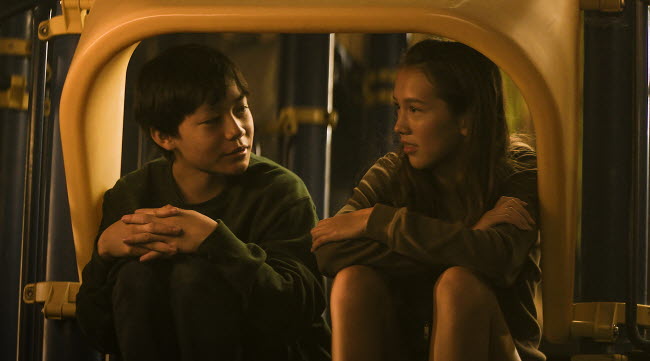
Like many other kids around his age, Chris usually go outside for more fun and freedom to have before his upcoming middle school graduation, and we see him hanging around with his several neighborhood friends. At one point, they are invited to a pool party held at the house belonging to one of their schoolmates, and that is how he comes to befriend a pretty girl. They come to interact more with each other via Facebook, and some of you may be amused by some little period details, which will definitely remind you of how much digital technology has been advanced during last 16 years.
In the end, Chris comes to have a sort of date with her during one evening, He tries to make himself look cool as much as possible, but it eventually turns out that she is actually more matured and experienced than him, and that leads to a rather amusing moment when he becomes quite nervous and embarrassed due to a little active action of hers.
He also gets more interested in making video clips after encountering a trio of older boys who happen to need someone to shoot their skateboarding. Although he does not know that much about how to handle a video camera, Chris attempts to teach himself bit by bit, and it looks like he seems to make some progress as shooting his new friends in one way or another.
Meanwhile, there comes more conflict between Chris and his mother, who turns out to have a fair share of discontent and disappointment behind her usually calm façade. As her kids have grown up nearly enough, Chungsing tries to go for her old artistic passion, but her efforts are not recognized much by others including Chris, who simply regards her latest painting without much care.

Although this expectedly leads to a big melodramatic moment later in the story, the screenplay by Sean Wang, who was Oscar-nominated for his deeply personal short film “Nǎi Nai & Wài Pó” (2023) before making a feature film debut here, sticks to its somberly observant attitude as showing more compassion and understanding to Chris and several other characters. While Chris is sometimes quite annoying as your average rebellious teenager, we can sense his confusion and frustration nonetheless, and we also come to care about his family members, who gradually come to as understandable human characters with each own issue to deal with.
Under Wang’s competent direction, the main cast members are solid in their respective parts. Although his character is more or less than a plain ground for more colorful characters in the story, young performer Izaac Wang diligently carries the film with his earnest performance, and Shirley Chen has a surprisingly heartfelt moment when Vivian shows some real care to her older brother in one particular scene. While Chang Li Hua is also solid as Chris and Vivian’s grandmother, Joan Chen, a Chinese American actress who has steadily worked for more than 35 years since her breakout performance in Bernardo Bertolucci’s Oscar-winning film “The Last Emperor” (1987), gives one of the best performances in her long acting career, and she is particularly excellent when her character comes to show more of her feelings and thoughts to Chris around the end of the story.
Overall “Didi”, which won not only the Audience Award but also the Special Jury Award for its ensemble cast when it was premiered at the Sundance Film Festival early in this year, is a small but likable film which distinguishes itself enough in terms of story and characters. Although I think it could be improvised a bit more (A subplot involved with Chris’ several friends feels rather underdeveloped, for example), the movie is still fairly engaging on the whole, and Wang surely makes a good start for whatever may come from him next in the future. In short, this is another interesting debut feature film of this year, and I think you should give it a chance someday.


 Seongyong's Private Place
Pingback: 10 movies of 2024– and more: Part 2 | Seongyong's Private Place