

“Breaking” is a small but tense drama about one desperate man who resorts to a drastic measure as driven to the breaking point. Inspired by a tragic real-life incident which did happen in Marietta, Atlanta in 2017, the movie patiently builds up the story and characters with increasing suspense and despair, and we come to care more even while the eventual outcome becomes more apparent to us minute by minute.
The early point of the film succinctly establishes how things have been very despairing for an ex-marine named Brian Brown-Easley (John Boyega). Shortly after divorcing his ex-wife, Brown-Easley has tried to support himself as well as his dear little daughter who is currently under his ex-wife’s care, but, unfortunately, he has been on the verge of becoming homeless at any point, and he cannot even receive the disability check from the Department of Veterans Affairs due to some absurd bureaucratic reason.
Becoming more despaired and frustrated than ever, Brown-Easley eventually gets quite determined to take care of his situation by any means necessary. On one day, he goes inside a local bank, and then he writes to one of the bank clerks that he has a bomb ready to be detonated at any point. While shocked a lot by this sudden emergency, the clerk and her supervisor tactfully handle the circumstance. Once they quietly get the others in the bank leave as soon as possible, they are held by Brown-Easley as his hostages, and then they try to reason with him as much as possible.
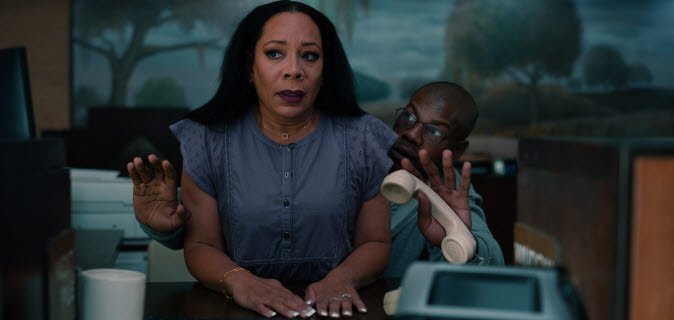
However, while he simply wants to receive a rather modest amount of money from the Department of Veterans Affairs, Brown-Easley also tries to draw more attention from the public. While the police have already come along with a bunch of local TV reporters outside the bank building, he wants to get his desperate story known more to many people out there, and he seems quite ready for the worst situation.
Around that narrative point, the screenplay by director Abi Damaris Corbin and his co-writer Kwame Kwei-Armah, which is based on the 2018 Task & Purpose article “They Didn’t Have to Kill Him” by Aaron Gell, also focuses on what is going on outside the bank building. As Brown-Easley demands, a negotiator comes, but there are also a bunch of snipers ready to pull the trigger at any chance, and the negotiator does not approve of that much, though he knows well how dangerous Brown-Easley can be as a man cornered more and more with a very few options remaining to him.
What follows next is how the negotiator carefully tries to deescalate the tension between his police team and Brown-Easley. As being also an ex-marine, he can easily talk with Brown-Easley within the first few minutes, but he is also reminded that how volatile Brown-Easley can be due to his occasional temper problem, which is probably associated with the post-traumatic stress disorder from his military tour in Iraq. As the circumstance becomes more desperate for him, he cannot help but lose his temper, and that certainly scares his two unfortunate hostages, who come to sympathize a bit with him as getting to know him more but are still trying to find any possible way out for them.
The movie loses some of its narrative momentum as occasionally interrupted by several flashback scenes. While one scene later in the film tells us how Brown-Easley was not allowed to receive the disability check, it does not delve more into how its hero is driven toward such an extreme action, and then it becomes a bit too mellow after the story reaches to its inevitable conclusion.

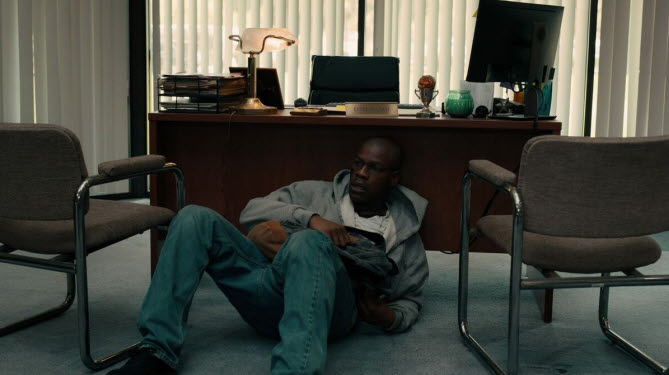
Nevertheless, the movie keeps holding our attention mainly thanks to the intense lead performance by John Boyega, who has shown more of his considerable talent since his electrifying breakthrough turn in “Attack the Block” (2011). Deftly conveying to us his increasingly unstable character’s tragic implosion along the story, Boyega is captivating at every minute of his in the film, and we come to have more understanding and empathy on his character’s accumulating desperation and frustration.
Around Boyega, a numbe of main cast members of the film hold each own place while coming to us believable human characters. Selena Leyva, who was one of the main characters in Netflix TV series “Orange Is the New Black”, and Nicole Beharie, who was previously memorable in “Miss Juneteenth” (2020), have a few moments to shine as their characters nervously try to deal with their dangerous circumstance in one way or other, and Connie Britton is also fine as a local TV news producer who happens to interact with Brown-Easley on the phone for a while. As the no-nonsense negotiator in the story, Michael K. Williams, who sadly passed away not long before the movie came out in 2022, reminds us again that he was one of the most dependable character actors in our time, and his calm presence complements well Boyega’s acting during their several key scenes in the movie.
On the whole, “Breaking” may feel rather plain compared to many other similar films such as “Dog Day Afternoon” (1975), but it is fairly tense and engaging due to its good direction and several solid performances to watch. I wonder whether it could be tauter and more economic, but the result is recommendable enough at least, so I will not grumble for now.


 Seongyong's Private Place