
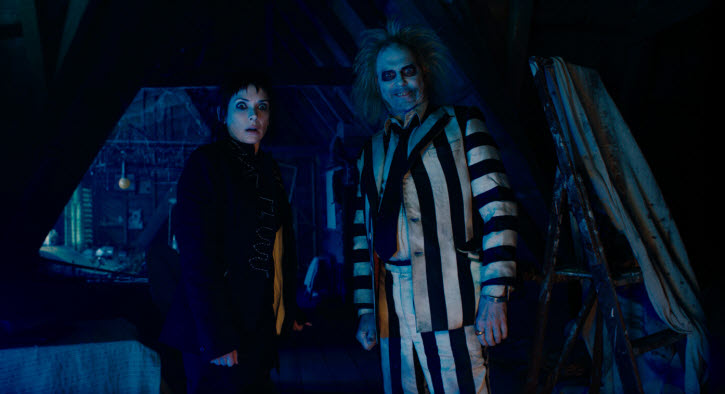
Tim Burton’s new film “Beetlejuice Beetlejuice” is as quintessential as you can expect from Burton. The story itself is more or less than a mere ground for many odd, quirky, and grotesque stuffs to be presented here and there, but it is clear that Burton and his cast and crew have a spirited fun together for making this movie, and you may overlook its many flaws including those blatantly nostalgic touches if you have some soft heart for its 1988 predecessor.
The story is set in 36 years after what happened in “Beetlejuice” (1988). Lydia Deetz (Winona Ryder) is now a weary and seasoned adult woman in contrast to that gloomy high school girl in the 1988 movie, and the opening scene shows her shooting her TV show which has promoted her psychic talent, though nobody believes that much even though she can really see dead people like that young kid in “The Sixth Sense” (1999).
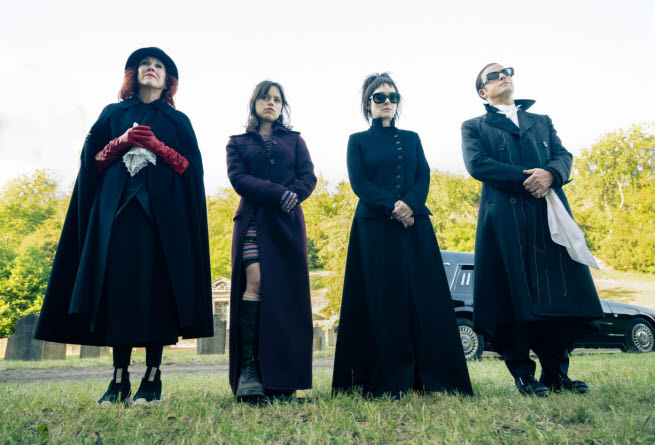
The early part of the movie quickly establishes how things have been messy for Lydia during several recent years. While her stepmother Delia (Catherine O’Hara) is mostly occupied with her self-absorbed artistic activities, she has also been estranged from her adolescent daughter Astrid (Jenna Ortega) since her environmentalist husband’s death, and then there comes the shocking news of her father’s death (Her father was played by Jeffrey Jones in the 1988 film, and, probably due to Jones’ current criminal status, the movie chooses a rather amusing way for presenting his character’s gruesomely unfortunate demise and the following afterlife condition of his).
And there is also a sudden supernatural issue involved with, yes, Betelgeuse (Michael Keaton), a ghoulish demonic entity who is still quite eager to approach to Lydia as before. This amusingly putrid dude is now running a little bio-exorcism agency in the realm of afterlife, but then he finds himself in a big trouble due to when a certain fearsome entity returns to threaten not only him but also the whole realm of afterlife.
While busily juggling a lot of these and other things, the screenplay by Alfred Gough and Miles Millar, which is developed from the story they wrote with Seth Grahame-Smith, often loses its narrative focus and momentum, but Burton and his crew members including cinematographer Haris Zambarloukos and composer Danny Elfman, who was always dependable as working in almost all of Burton’s films, keep things bouncing from one weirdly funny moment to another. Just like its 1988 predecessor, the film is packed with lots of style and detail to be cherished, and Burton wields more of his own distinctive touches here than he did during last 12 years since his Oscar-nominated animation film “Frankenweenie” (2012). Although the realm of afterlife does not feel that fresh while often looking like being stuck in the 1970s or 1980s, you may chuckle a bit as observing a number of inspired moments such as the one which is clearly influenced by a certain famous American musical variety television show from the 1970s.
Above all, the movie has several engaging characters we can actually care about. While the relationships among Lydia and her surviving family members are problematic to the core, they eventually stick together when Astrid inadvertently gets herself involved with the realm of afterlife later in the story, and her and her mother’s eventual reunion with a certain key figure in the story turns out to be more sincere than expected, even though we cannot help but get tickled by this figure’s current afterlife status.
While the movie comes a bit too late in my humble opinion, it surely comes to Winona Ryder at the right moment at least. Although she had to endure a pretty low point in her career in the early 2000s, Ryder’s career was unexpectedly boosted by her wonderful supporting turn in recent Netflix drama series “Stranger Things”, and she is clearly enjoying herself as imbuing her familiar character with neurotic weariness. On the opposite, Catherine O’Hara and Jenny Ortega, who is no stranger to looking moody thanks to her lead performance in recent Netflix comedy series “Wednesday”, complement Ryder in each own way, and O’Hara delightfully chews every moment of hers as making her narcissistic character somehow quite endearing.

Above all, the movie is always energized by Michael Keaton, who willingly throws himself into his very unpleasant and wacky character with sheer gusto as he did in the 1988 film. Whenever Keaton appears on the screen, Burton does not hesitate to pull out all the stops, and he and Keaton do not disappoint us at all during the climactic sequence, which is quite overstuffed to say the least but also undeniably entertaining for its shamelessly zany and rambunctious qualities.
In case of several other cast members of the film, they are rather under-utilized while leaving an impression to some degree. Although her villain character is not that memorable, Monica Bellucci has a few moments to shine at least. Danny DeVito, Justin Theroux, Burn Gorman, and Willem Dafoe are well-cast in their respective supporting parts, and Dafoe and DeVito certainly feel right at home with Burton’s gothic sensibility.
On the whole, “Beetlejuice Beetlejuice” does not surpass its predecessor much, but its redundant aspects are compensated by the genuine spirit felt from the good efforts from Burton and its cast and crew members. Although he seems behind his prime from time to time, Burton shows here that he has not lost his artistic energy and creativity yet, and that is certainly a nice thing to watch.


 Seongyong's Private Place