
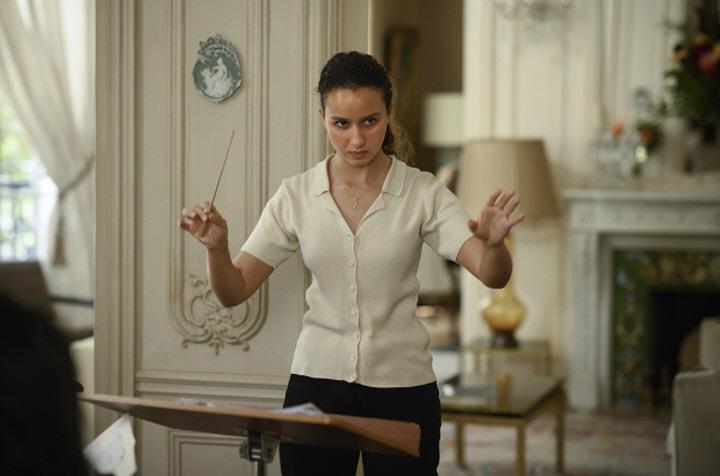
French film “Divertimento” is a competent feel-good drama film inspired by one remarkable real-life story. While there are some expected conventional moments, the movie casually flows along with its ambitious young heroine as she struggles to find her own personality and strength as a future orchestra conductor, and the overall result is engaging enough to hold our attention while surely earning its lovely finale.
The story is about the early years of Zahia Ziouali (Oulaya Amamra), who, as shown to us around the end of the film, has been well-known as one of few female orchestra conductors in France (and the world, of course). Even when she was very young, she was quite interested in music, and her Arab immigrant parents gladly encouraged her and her younger twin sister Fettouma (Lina El Arabi) to pursue their growing interest in music.
When they become 17, Zahia and Fettouma are ready to go further as beginning to practice their respective musical skills at some prestigious conservatory in Paris, but, of course, things are not easy for them at all from the very first day. Besides going back and forth between Paris and their little local city outside Paris everyday, they instantly feel the social/economic gap between them and many others at the conservatory, most of whom regard them in rather condescending ways.

Furthermore, Zahia finds herself more disregarded and ridiculed by others due to her ambition for becoming a first-class professional orchestra conductor someday. Many of other students are not so serious about her even when she is allowed to practice in front of others, and she becomes quite frustrated to find herself being pushed aside for her male competitor due to sexism.
And then, what do you know, there comes an unexpected chance for her on one day. She and other students happen to attend a lecture by one legendary conductor, and this famous conductor, Sergiu Celibidache (Niels Arestrup), happens to take a notice of Zahia when she boldly presents her conducting skill in front of Celibidache and others. Although she is not that good enough in his standard, Celibidache instinctively discerns her considerable raw skill and potential, and, to her delight, he promptly decides to teach her.
Of course, Celibidache is alternatively demanding and encouraging right from her first day with him, and that certainly frustrates her a lot at times. Nevertheless, Zahia keeps trying to improve her natural skill with more principle and style under Celibidache’s guidance, and she even comes to decides to assemble a little local orchestra for herself and several other enthusiastic colleagues of hers, which is named, yes, “Divertimento”
Again, Zahia comes upon one obstacle after another along the story, but the screenplay by director Marie-Castille Mention-Schaar and her co-writer Clara Bourreau thankfully avoids being too melodramatic about its heroine’s small and big struggles in the story. While her parents and other family members including Fettouma are supportive as usual, her colleagues come to show more comradeship to her, and Celibidache continues to impart his wisdom to his promising pupil even though he can be very strict to her from time to time.
Regardless of how much the movie is actually close to its real-life story, there are a number of individual moments which will touch you in one way or another. While I particularly like a small moment when Zahia finds a way to teach one mentally disabled kid how to play a musical instrument, I assure you that you will be quite touched by an unexpected moment of reconciliation which Zahia arranges for one of her orchestra members and his estranged father, and you will also come to cheer for her a lot when she eventually discovers what is absolutely necessary for moving her talent and career up to the next level.

The movie is constantly fueled by its heroine’s growing determination about her future professional career, and her spirit and personality are vividly conveyed to us via the earnest performance of Oulaya Amamra. Besides looking quite committed during several key scenes where her character conducts an orchestra, Amamra is also believable in her character’s artistic struggles, and we can actually sense her character’s gradual artistic growth along the story.
Around Amamra, several other main cast members play each own part well without overshadowing her at all. While Lina El Arabi has her few moments to shine as her character goes through her own artistic struggles, Zinedine Soualem and Nadia Kaci bring some warmth to the story as Zahia’s caring parents, and Niels Arestrup, whom I still remember well for his unforgettable supporting turn in Jacques Audiard’s great film “A Prophet” (2009), provides the movie a touch of class as required.
In conclusion, “Divertimento” handles its conventional elements better than expected, and it also did a splendid job in case of the soundtrack, which is packed with many different classic pieces including a certain famous work by Maurice Ravel. Although it does not exceed my expectation, the movie achieves as much as intended with enough heart and skill, so I will give it a good grade without much complain.


 Seongyong's Private Place