

Alice Rohrwacher’s second feature film “The Wonder”, which was somehow released in South Korean theaters a few days ago, is a small but intimate drama of one rural family to observe. While we do not get to know everything about the family in the film, they come to us as vivid and interesting persons nonetheless, and you will be impressed by the considerable realism on the screen.
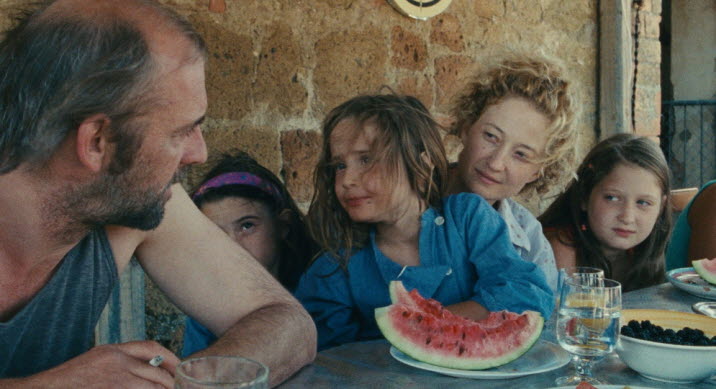
In the beginning, the movie gradually introduces us to a German guy named Wolfgang (Sam Louwyck) and his several family members including his wife Angelica (Alba Rohrwacher, who is incidentally the director’s older sister). They live in a shabby house at a remote spot located in the middle of some rural region of Italy, and Wolfgang and Angelica have been trying to earn their living via their modest farm business, though they have also struggled a lot with their constant financial problem.
Wolfgang and Angelica have four young daughters, and the eldest one, Gelsomina (Alexandra Maria Lungu), is naturally expected to handle a lot of domestic stuffs, especially when she is alone with her younger sisters. For example, she often has to help her father’s beekeeping work, and the movie accordingly presents a series of realistic moments as she and her father work together on those thousands of honeybees day by day.

And then there comes two small changes into Gelsomina and her family’s daily life. When she and her younger sisters are having a fun time along with their father at a nearby lakeside spot, their innocuous playtime is interrupted by the sudden appearance of a stranger approaching them. This person in question happens to be one of the crew members of some popular TV show focusing on “most traditional families”, and Gelsomina and her younger sisters cannot help but become fascinated with the female host of this TV show, who instantly mesmerizes them with her graceful beauty accentuated further by her lovely costume. Because it seems her and her family can be good candidates, Gelsomina come to consider making her family participating in this TV show, but her father does not approve of that at all as a stubborn guy who does not welcome any interference to his little farm business.
However, due to his ongoing financial problem, he has no choice but to compromise a bit. Without telling his wife at all in advance, he decided to let a juvenile delinquent named Martin (Luis Huilca Logrono) stay in their house for getting some money. Although she is not so pleased about her husband’s decision, Anglica eventually agrees to his decision because they really need money now, and then we see Martin gradually becoming a part of their household even though being not so communicative from the beginning.
Leisurely rolling its main characters along the story, the movie slowly immerses us into their daily life, and the resulting verisimilitude is often impressive to say the least. While it is a bit too frustrating as we do not get much background information on its main characters, what they feel and think are clearly conveyed to us even when they do not talk much, and that is particularly evident when Martin begins to ignite some sexual curiosity from the girls in the house. While still quiet and reticent as before, he comes to draw more attention from them as days go by, and we are not so surprised by what happens later between him and one of the girls in the middle of one night.
In the end, the story reaches to a sort of climax when the family luckily get a chance to appear in the TV show (Is this a spoiler?), but, again, the movie takes its time for vividly capturing the emotional undercurrents among its main characters. This may require more patience from you, but it is still a rewarding experience to be appreciated, and I especially like how the ending is touchingly presented with a bit of magic realism.
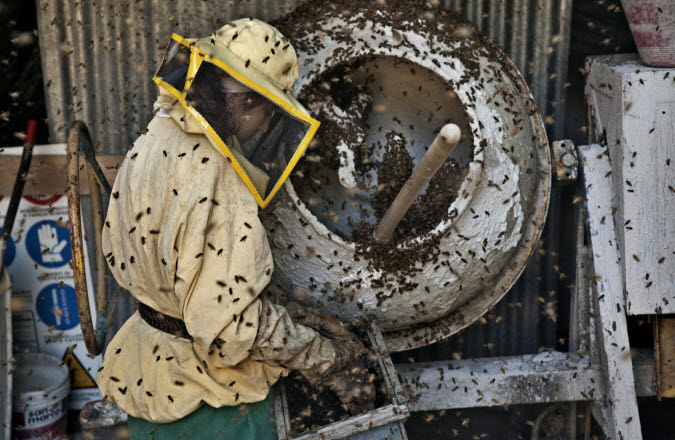
These and many other lovely moments in the film are skillfully presented on the screen with a substantial amount of unadorned beauty. Rohrwacher and her cinematographer Hélène Louvart, who would collaborate with Rohrwacher more in “Happy as Lazzaro” (2018) and “La chimera” (2023), shot the movie on 16mm film, and the result is quite admirable for the natural poetic qualities. While it often feels raw and rough on the surface, the movie is constantly tinged with enough sensitivity and lyricism, and we are drawn more to the mood and details even though the movie trudges a bit from time to time.
Rohrwacher also draws the solid performances from its main cast members. While young performers Alexandra Maria Lungu gradually takes the center of the movie with her earnest acting, several other main cast members including Sam Louwyck, Alba Rohrwacher, Sabine Timoteo, Agnese Graziani, and Luis Huilca Logrono are also excellent in their respective parts, and Monica Bellucci is perfectly cast as that beautiful TV show host.
In conclusion, “The Wonder”, which won the Grand Prix award when it was shown at the Cannes Film Festival in 2014, is worthwhile to watch for its thoughtful handling of mood, story, and characters, and it also reminds us of how far Rohrwatcher has advanced after it came out. Although it is relatively less impressive than “Happy as Lazzaro” or “La chimera”, it is still interesting enough to recommend, and I am certainly glad to get a chance to watch it on a big screen.


 Seongyong's Private Place