
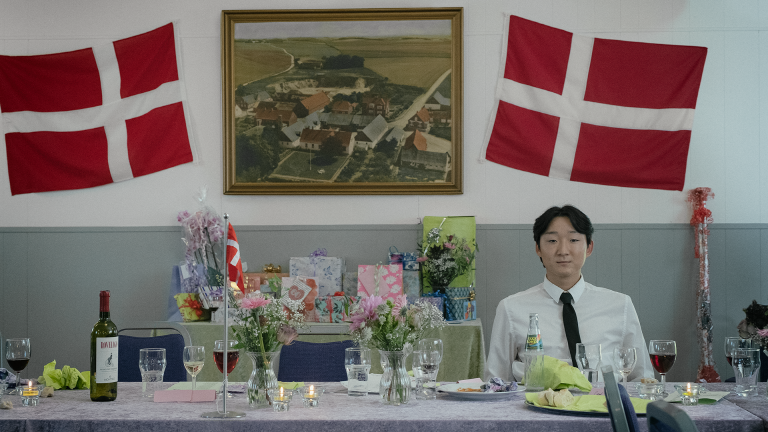
To be frank with you, Danish film “The Quiet Migration” is alternatively interesting and frustrating to me. On one hand, the movie phlegmatically examines the inner conflict of its Korean adoptee hero who has always felt like an outsider in his surrounding environment, and it works best whenever it subtly conveys to us his confusion and frustration with his racial identity. On the other hand, the movie also is a bit too heavy-handed at times, and its finale feels rather contrived instead of dramatically impactful.
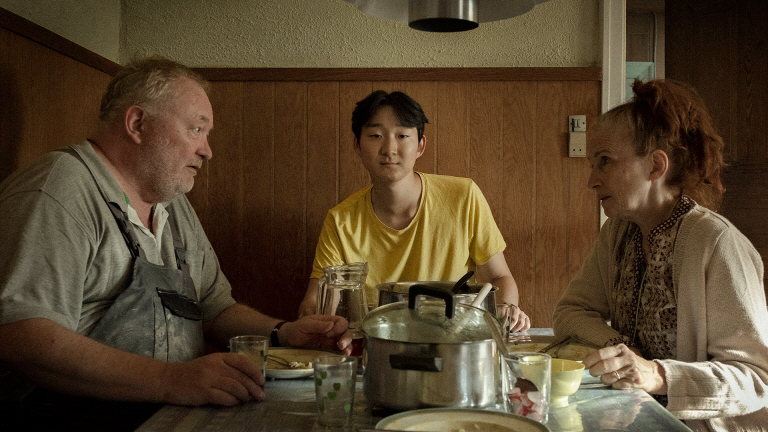
After the opening shot which looks around the vast pasture of one Danish rural area for a while before something odd suddenly occurs, the movie gradually establishes the current status of Carl (Cornelius Won Riedel-Clausen), a Korean lad who was adopted by a decent couple running a big dairy farm in that country region. He returns to his family farm after the end of his boarding school education period, and then we observe how he goes through the daily routines along with his foster parents and some foreign guy hired by them.
Needless to say, Carl is expected to run the farm someday instead of his foster father when his foster father becomes too old and ill to run the farm for himself, but he is not so sure about what he should do for his future. While dutifully working along with his foster father in the farm, he is not particularly interested in the farm business, but he is not also willing to tell his foster father about his growing disinterest.
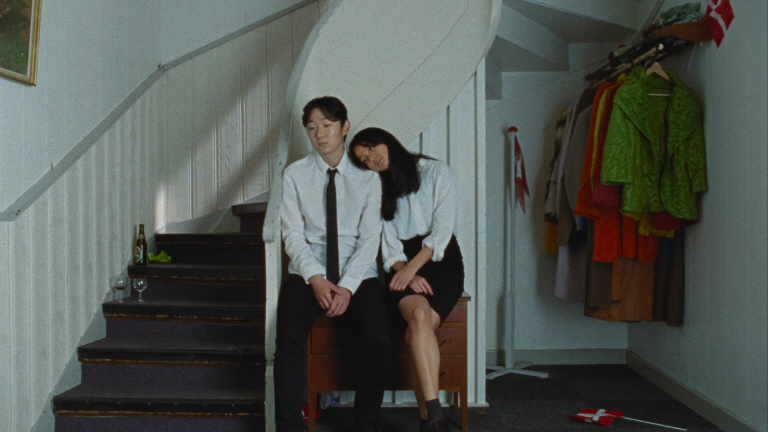
And we see how Carl often copes with his constant position as a racial outsider. At one point, he enters a local gymnasium alone for playing basketball alone by himself, but then he quickly hides in a corner when a bunch of local boys come for a basketball game. When he happens to attend the birthday party of some relative of his foster parents, he surely feels quite isolated as the only Asian man in the room, and he even experiences a casual racist remark from some family member in the middle of the party. Not so surprisingly, he later comes to have a brief but precious moment of emotional bonding with a young Asian woman who is incidentally one of the service employees hired for the party, and this makes him more aware of his racial background than before.
Not long after this little special moment of his, Carl begins the search on his past. After rummaging a bunch of old family stuffs, he found the documents on his adoption, but the documents do not help him much except showing his birthplace in South Korea and original Korean name. Nonetheless, he becomes more interested in Korea, and he eventually expresses his wish to go there when his foster parents later ask him about where he wants to travel.
Now this sounds like your typical adoptee melodrama, but the screenplay by director/co-editor Malene Choi and her co-writer Sissel Dalsgaard Thomsen goes for a more meditative mood coupled. Under Choi’s competent direction, her crew members including cinematographer Louise McLaughlin effectively establish a subtle sense of uneasiness around the screen, and we come to sense more of Carl’s growing inner conflict, even though the camera usually observes him and few other characters around him from the distance.
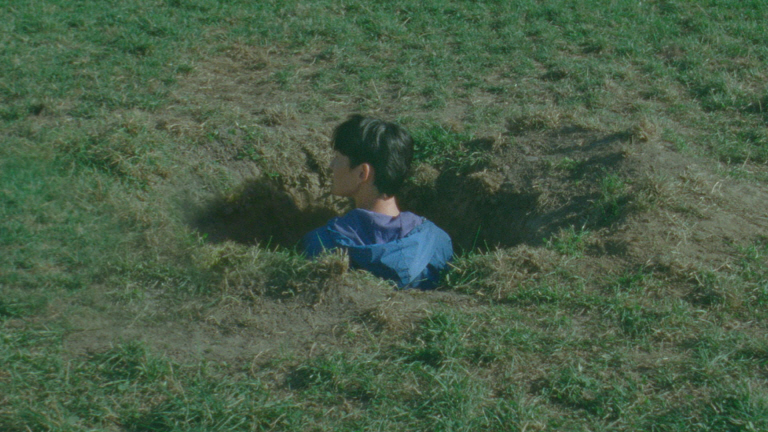
However, the movie unfortunately stumbles more than once during its final act. Carl’s foster parents subsequently turn out to have several big personal problems besides the increasing economic difficulties in their farm business, but the movie only ends up delving not much into their personal issues, which feel more like an artificial plot element to put more conflict between Carl and his foster parents. When Carl experiences another case of racism from one of his foster father’s close associates, this moment is so blatant and clumsy that I got more distracted instead of more engaged to Carl’s emotional drama, which eventually culminates to a sudden change of mood and place around the end of the story. Sadly, this supposedly dramatic part, which is associated with that odd happening at the beginning of the movie, does not mesh that well the rest of the film, and what follows next may be too anti-climactic to you.
Anyway, Choi draws the commendable performances from her three main cast members. Newcomer Cornelius Won Riedel-Clausen, who incidentally never had a movie acting experience before, carries the film well with his rather passive but mostly effective low-key acting, and he and his co-stars Bodil Jørgensen and Bjarne Henriksen did a credible job of conveying to us the constant emotional gap between Carl and his foster parents even during their warmest moments in the film. Sure, they do love and care a lot about their adopted son, but Carl’s foster parents also do not wholly understand him at times, as reflected by when they celebrate his birthday at a local Chinese restaurant. That is why it is poignant to see how they come to open up themselves to Carl with more love and understanding later in the story.
In conclusion, “The Quiet Migration” does not engage me enough to my little dissatisfaction, but its several good parts make me more interested in Choi, who was also born in South Korea and then grew up in Denmark. I have not watched her first feature film “The Return” (2018) yet, but “The Quiet Migration” shows Choi’s considerable potential as a promising filmmaker despite some glaring shortcomings, and I will certainly check out whatever will come next from her in the future.


 Seongyong's Private Place