
Yorgos Lanthimos’ latest film “Poor Things” is another idiosyncratic fun to be savored. While it is as darkly absurd as his recent films such as “The Lobster” (2015) and “The Killing of a Sacred Deer” (2017), it is also as deliciously funny as “The Favourite” (2018), and it is equipped with a number of saucy goodies including one of the best movie performances of last year.
The movie, which is set the fantasy version of the 19th century Europe, begins with the grotesque daily life of Dr. Godwin Baxter (Willem Dafoe). While he has been a prominent medical doctor with the vast and peerless knowledge on human anatomy, he is also your average mad scientist, and his heavily damaged physical status, which was resulted from his doctor father who was as demented as him, functions as a hilarious running gag throughout the film just like Lloyd Bridges’ goofy supporting character in “Hot Shots!” (1991).
Dr. Baxter’s house, which is incidentally located somewhere in the middle of London, is full of the bizarre results of his loony experiments, but none of them can possibly top his latest scientific project. Just like the mad scientist hero of that famous classic SF horror novel by Mary Shelley, he successfully created a life from some dead body, and his creature, called Bella (Emma Stone), often shows extremely childish behaviors as swinging back and forth between willful innocence and embarrassing barbarity.

Anyway, Bella has shown some progress in terms of manner and communication, and that is where Dr. Baxter, whom she often calls, of course, “God”, recruits Max McCandles (Ramy Youssef), who is one of his students and certainly eager to do anything for impressing his mentor more. Along with Dr. Baxter, Max attempts to improve Bella with more knowledge and sophistication, and we are accordingly served with a series of silly but undeniably amusing moments tinged with some savage sense of black humor.
Consequently getting a lot more matured and sophisticated than before, Bella naturally becomes curious about the world outside, and Dr. Baxter tries to hold her via marrying her to Max, but this plan of his backfires when his lawyer Duncan Wedderburn (Mark Ruffalo) comes to his house for preparing the marital contract for Bella and Max. As your average lothario, Duncan quickly becomes quite interested in getting closer to Bella, and Bella willingly goes along with that when he promises to her that he will show more of the world besides lots of a certain R-rated pleasure which she recently discovered to her surprise and delight.
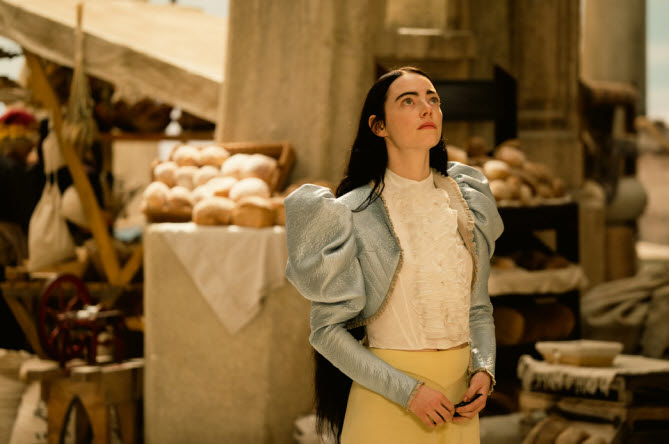
After Dr. Baxter, who turns out to be more soft-hearted than expected, lets her leave in the end, Bella embarks on her first experience of the world outside as accompanied with Duncan, and Lanthimos and his first-rate crew members, some of whom recently received Oscar nominations along with Lanthimos and his screenplay writer Tony McNamara, has a lot of fun as decorating the screen with small and big details to enrich the fantasy background surrounding Bella and several other main characters. While the cinematography by Robbie Ryan, which switches from black and white to color at this point, often emphasizes the warped reality of the main characters mainly via wide angle lenses, production designers James Price and Shona Heath and costume designer Holly Waddington have a field day as vividly creating the deliberately unrealistic version of the 19th century European on the screen, and the decidedly unconventional score by Jerskin Fendrix constantly keeps us on the edge with its sheer unpredictability just like our odd heroine.
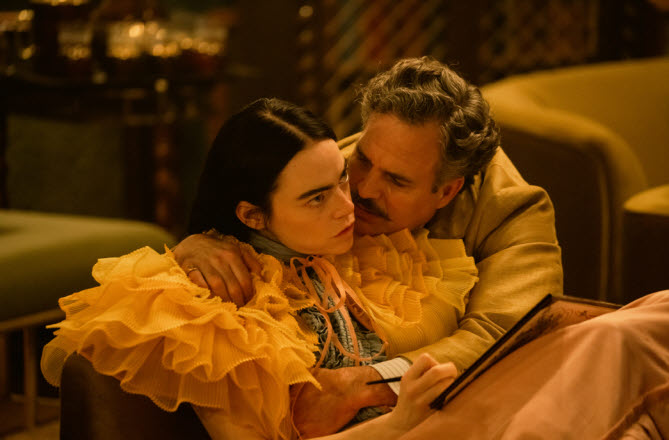
Above all, the movie, which is based on the novel of the same name by Alasdair Gray, is steadily fueled by the comically manic spirit of Emma Stone’s absolutely fearless performance, which deservedly garnered a Best Actress Oscar nomination. As she previously did in “The Favourite”. Stone takes no prisoner at all as willingly throwing herself into many challenging moments which will definitely make you wince or laugh, and she is not only engaging but also strangely touching in her bizarre character’s bumpy journey toward more liberation and maturation in terms of both body and mind.
The other main cast members surrounding Stone dutifully support her baroque lead performance. While Mark Ruffalo received an Oscar nomination for his dynamically comic supporting turn, Willem Dafoe, who is no stranger to playing weird and grotesque roles at all, deftly balances his character between horror and comedy, and Ramy Youssef is effective in his low-key acting as the most sensible person in the story. Christopher Abbott and Jerrod Carmichael, who incidentally appeared together in Carmichael’s debut feature film “On the Count of Three” (2021), add extra dark cynicism to the film during their respective brief appearances, and Kathryn Hunter, Hanna Schygulla, Vicki Pepperdine, Suzy Bemba, and Margaret Qualley hold each own small place well as the substantial female supporting characters in the story.
Although his earlier works felt like an acquired taste to me, Lanthimos has kept advancing in his own artistic field which has eventually become a bit more accessible and enjoyable to me and others, and “Poor Things” is surely another highlight to cherish after “The Favourite”. Sure, it may be a little too weird and crazy to be your cup of tea, but, folks, this is definitely not something you can see everyday, and I assure you that you will never forget your experience with this strikingly weird masterwork.


 Seongyong's Private Place
Pingback: My Prediction on the 96th Academy Awards | Seongyong's Private Place
Pingback: 10 movies of 2024– and more: Part 2 | Seongyong's Private Place