
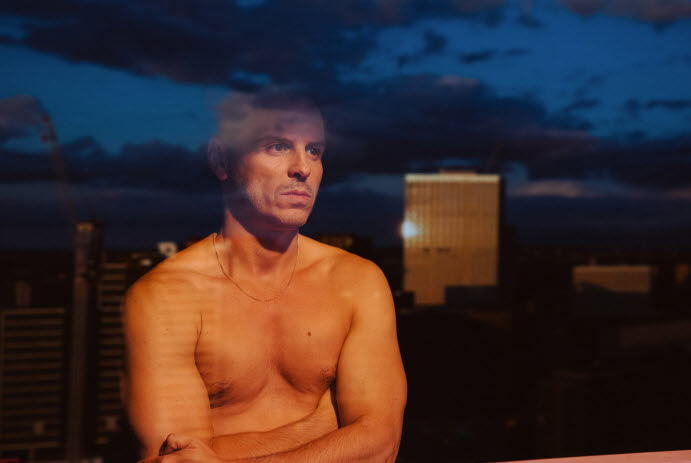
Andrew Haigh’s latest film “All of Us Strangers” is a gentle and intimate personal ghost story about loss, grief, loneliness, and love. Starting with a supernatural story premise, the movie gradually delves into the troubled state of mind of its lonely hero via its delicate mood and loving details, and it is quite touching to see how its hero comes to deal with his longtime emotional issues along the story.
At the beginning, the movie succinctly establishes the lonely and isolated daily life of Adam (Andrew Scott), a TV writer who has been going nowhere in writing a new screenplay. While he is struggling during another day without much progress at his small flat in London, a little incident suddenly happens, and that is how he encountered a guy named Harry (Paul Mescal), a lad who incidentally resides on the sixth floor of their apartment building. While it is clear that there is some instant attraction between them, Adam hesitates even though Harry is virtually flirting with him, mainly because he is more occupied with finishing whatever he is going to write.
It seems that Adam’s new screenplay is inspired by the childhood memories of his deceased parents, who unfortunately died when he was only 12. Probably for getting some more inspiration, he decides to go to their old suburban neighborhood, and we see him visiting several familiar places including the house where he and his parents once lived together.
And then something strange occurs to him. At a neighborhood park, Adam notices someone quite familiar to him, and he soon follows after this figure, who willingly invites Adam to where he lives with his wife. It turns out that this figure and his wife are none other than Adam’s father and mother, and it goes without saying that they are not living people at all, because they still look as young as they were at the time of their unfortunate death in addition to living in that house as before.

Despite the spooky aspects of this inexplicable happening of his, Adam chooses to spend some time with his dead parents because he has really missed them a lot for many years, and his ghost parents are glad to see how much their son has grown up since their death. To them, Adam is still a little son they raised together, and Adam is happy to experience their loving affection again regardless of whether his ghost parents are real or imagined.
Not so surprisingly, Adam’s homosexuality becomes an issue to talk about between him and his ghost parents, who have some struggle in accepting that their son is actually a gay even though they are aware of how things have changed during last several decades. At one point, Adam’s mother inadvertently hurts her son’s feelings a bit during their private conversation, and that reminds me of when my mother, who is still in the denial of my homosexuality, often tells me that I will be quite lonely without marrying a girl someday.
In case of Adam’s father, who evidently loves and cares about Adam as much as his wife, he comes to have a honest conversation with Adam about not only Adam’s homosexuality but also some emotional distance between him and Adam. Admitting that he was not always there for his young son who often needed his support during that time, Adam’s father sincerely opens more of himself to Adam, and I must say that I envied Adam a lot as because I have never had a really honest conversation with my father, who will probably never accept my homosexuality for the rest of his remaining life.
Feeling much happier than before, Adam becomes more active about his own private life. When he comes across Harry again, he lets Harry into his flat, and they soon move onto the next logical step once they clearly discern their growing mutual attraction. As he did in his little breakout film “Weekend” (2011), Haigh depicts the sexuality of his main characters with considerable realism and intimacy, and I was amused a bit by a little sticky detail during one particularly after-sex scene, while wondering whether Haigh used the same material he previously utilized in “Weekend”.

Haigh’s screenplay is based on Japanese writer Taichi Yamada’s 1987 novel “Strangers”, which was already adapted into Nobuhiko Obayashi’s “The Discarnates” (1988). If you have ever read Yamada’s novel or watched the 1988 film (I only watched the latter, by the way), you will surely know a substantial moment of surprise waiting around the end of the story, and Haigh and his crew members including cinematographer Jamie D. Ramsay pull that off with lots of emotional resonance coupled with some phantasmagorical qualities. While we come to look back on what we have observed from Adam and a few main characters around him, we also come to know and feel more of his sadness and loneliness, and the quiet but sensitive emotional moments during the last act will move you more than expected.
The four main cast members are pitch-perfect in their nuanced acting. While Andrew Scott, who received the Best Actor award from the National Society of Film Critics for this film in last month, ably holds the ground as the heart and soul of the film, Jamie Bell and Claire Foy are simply fabulous as Adam’s ghost parents, and Paul Mescal, who has become one of the new interesting actors to watch since his recent breakthrough Oscar-nominated turn in Charlotte Wells’ exceptional film “Aftersun” (2022), brings genuine tenderness to his seemingly thankless part in addition to clicking well with Scott throughout the film.
Overall, “All of Us Strangers” is another powerful work from Haigh, who has steadily advanced during last 13 years after drawing our attention with “Weekend”. Like “45 Years” (2015) and “Lean on Pete” (2017), the movie shows Haigh’s considerable talent in intimate character drama, and it is certainly one of the main highlights of last year.


 Seongyong's Private Place