

Jonathan Glazer’s new film “The Zone of Interest”, which recently received the five Oscar nominations including the ones for Best Picture and Best International Film, is utterly chilling in its clinically uncompromising presentation of the banality of evil. Although lots of unspeakable things are happening beyond their little comfortable world everday, the main characters of the movie simply go through their plain daily routines without much concern or guilty at all, and we are all the more horrified as being more aware of whatever is going on beyond their world.
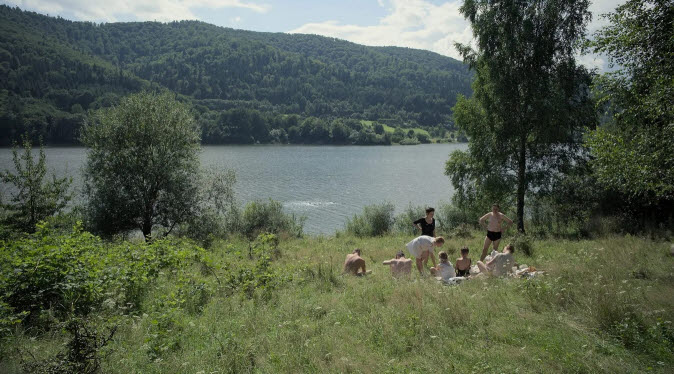
After the ominous main title sets the tone along with Mica Levi’s discomforting score, the movie gradually establishes its limited main background. At first, the camera simply and distantly observes a bunch of people enjoying one bright summer day in a riverside forest, and nothing seems particularly wrong on the surface as these people cheerfully spend their pleasant afternoon together for a while.
However, as they leave the spot, the movie, which is mainly set in Poland, 1943, slowly reveals how many of these people are actually associated with one of the most atrocious horrors of the World War II. In case of a married woman named Hedwig (Sandra Hüller), she is actually the wife of Rudolf Höss (Christian Friedel), who was, as some of you know well, the commandant of the Auschwitz concentration camp during that time.
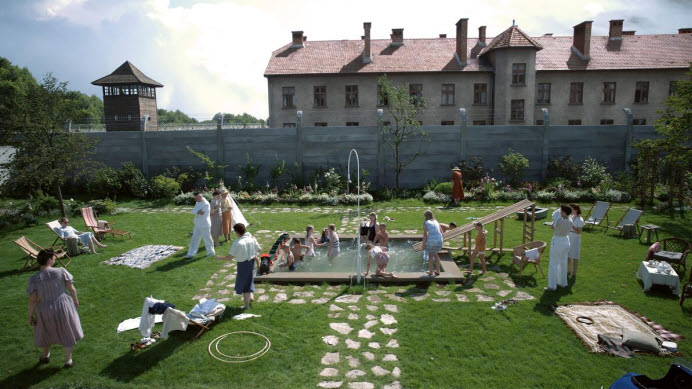
The movie closely observes how Höss and his family live right next to Auschwitz day by day, and we often get chilled by the banality of their daily existence. While Höss is often absent for doing his jobs outside, his wife and children comfortably spend their time in their big house, and Mrs. Höss is usually occupied with taking care of her big garden outside the house whenever she is not handling those domestic matters in the house.
Everything is fine and well on the surface for these people, but the movie slowly lets us sense more of the evil and horror outside this private area of theirs. We see a bunch of Nazi soldiers gathering for Höss’ birthday. We notice a few prisoners working inside and outside his house. Above all, we frequently hear the sounds coming from the concentration camp over the big fence surrounding the house.
The sound design of the movie is crucial in constantly reminding us more and more of whatever is happening outside Höss’ house. Early in the film, we just hear the distant sounds of shouting man or barking dog, but then the movie steadily adds more and more horrific aural details on the soundtrack along the story. While we frequently hear the arrivals of trains from the distance, we also become more aware of screams and gunshots heard over the fence, which are more than enough for us to fill the blanks for ourselves.
These and other aural details are often strikingly juxtaposed with the supposedly plain but clinically composed visual moments courtesy of cinematographer Łukasz Żal, who was previously Oscar-nominated for Paweł Pawlikowski’s “Ida” (2014) and “Cold War” (2018). Mostly sticking to its static position, Żal’s camera observes the characters and their surrounding environment from the distance, and we come to focus more on how horribly superficial their existence is. At one point later in the film, Mrs. Höss is not so pleased when her husband later notifies to her that he will be soon transferred, and we are more horrified as she casually talks about how much she likes to live along with her children right next to the concentration camp as usual.
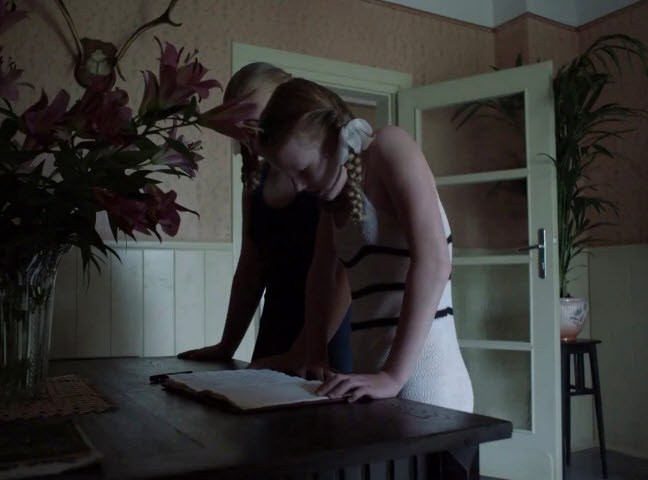
The performers of the film tune their acting well to the overall mood of the film. While Christian Friedel is often frightening as his character flatly handles many matters of the concentration camp including developing and building a more efficient crematorium (He even suggests that they should apply for a patent, for Christ’s sake), Sandra Hüller, who has another stellar year thanks to this film and Justine Triet’s Oscar-nominated film “Anatomy of a Fall” (2023) in last year, is equally impressive as phlegmatically giving us an increasingly nauseating example of the banality of evil. Several other main cast members are also effective in their respective supporting parts, and Imogen Kogge is particularly good as Mrs. Höss’ visiting mother who gradually comes to face the horror beyond her supposedly comfortable staying place.
Overall, “The Zone of Interest”, which is based on the novel of the same name by Martin Amis, is another wonderful work from Glazer, who deservedly received the Grand Prix when the movie was premiered at the Cannes Film Festival early in last year (It also received the FIPRESCI Prize, by the way). Since he made a feature film debut with “Sexy Beast” (2000), Glazer only made “Birth” (2004) and “Under the Skin” (2013) before “The Zone of Interest”, but all of these four works are interesting and distinctive in each own way, and “The Zone of Interest” shows him at the top of his filmmaking mastery.
Yes, the movie is deeply uncomfortable to watch to say the least, but it is unforgettable for the skillfully effective handling of its very dark subject which surely feels all the more relevant these days, and, above all, it does not merely depict the banality of evil in the Holocaust. Around the end of the film, Glazer eventually reveals a bit of his attitude and feeling toward its main subject without never interrupting the overall tone at all, and that is quite enough for us in my inconsequential opinion.


 Seongyong's Private Place
Pingback: My Prediction on the 96th Academy Awards | Seongyong's Private Place
Pingback: 10 movies of 2024– and more: Part 2 | Seongyong's Private Place