
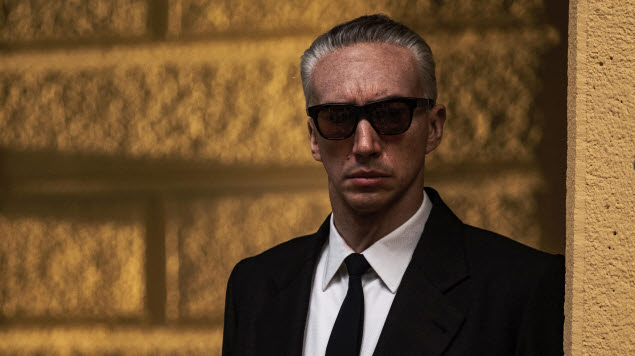
Michael Mann’s new film “Ferrari” is calm and detached just like its hero, who builds a wall around whatever he feels and thinks inside as he says at one point in the story. As a sort of antithesis to James Mangold’s “Ford v Ferrari” (2019), the movie is more like a distant character study rather than an exciting sports drama movie, and it fortunately has enough style and personality to hold our attention despite a number of narrative deficiencies.
Adam Driver, who has been one of the most interesting new American actors as appearing in a number of acclaimed films such as Jim Jarmusch’s “Patterson” (2016), plays Enzo Ferrari, who founded the Italian car manufacturer Ferrari S.p.A. in 1947 along with his wife. The story, which is set in the middle of the summer of 1957, opens with Ferrari quietly waking up and then leaving for his work, and the movie subsequently observes him and his associates paying attention to a certain important event associated with their main competitor while attending a Catholic mass along with many others as required.
Once their main competitor succeeds with a new record via their latest sports car, Ferrari and his associates instantly embark on beating their main competitor as soon as possible, but things do not look that good for Ferrari and his company. Besides losing its top racer due to an unfortunate accident, his company has been mired in a serious financial trouble despite the diligent efforts of his wife/business partner Laura (Penélope Cruz), and it is undeniable that the company needs a considerable amount of capital to avoid the possible bankruptcy right now.
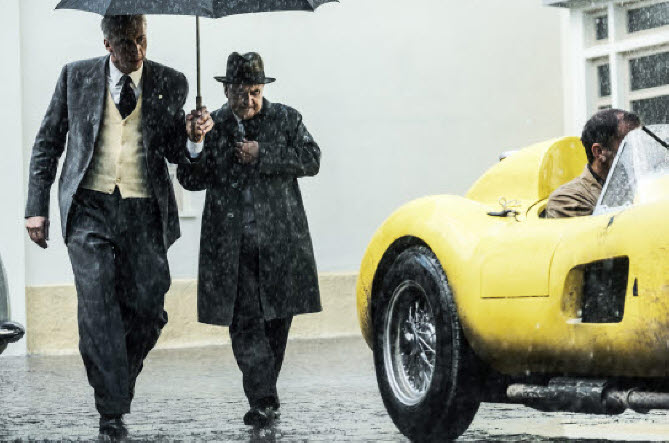
Of course, drawing more capital for the company requires more promotion via winning at those prestigious car races, and Ferrari is certainly well aware of that. While ridiculed and criticized by the media for a series of recent unlucky events striking his company, he is more determined to beat his main competitor at the 1957 Mille Miglia because that will draw more attention from those possible financial backers out there. Everyone around him naturally worries about this risky business gamble, but he remains calm and focused as before, and we later get a quietly intense moment when he coldly criticizes his racers for not having enough grit and determination compared to the racers of his main competitor.
Meanwhile, Ferrari also has to handle a big private matter in his life. Although he is technically married to his wife, they have been quite distant to each other mainly due to their grief on the recent death of their only son, and Laura does not mind him having affairs behind his back as long as he keeps his appearance in front of her and his old mother. However, Ferrari has been deeply involved with a woman named Lina Lardi (Shailene Woodley) for more than 10 years, and he is hiding from his wife that there is a young son between him and Lardi. While Linda has no problem with leading a secret private life with him, she wants him to acknowledge his son officially, but he hesitates as becoming more occupied with saving his company from its current crisis.
This is surely another typical tale of a flawed but brilliant and ambitious male figure, but Mann and his screenplay writer Troy Kennedy Martin keep the distance from the hero of their movie without making any cheap excuse, and so does Driver’s phlegmatically unflappable acting. While not often signifying much on the surface, Driver subtly depicts a man who has experienced enough for not caring too much as going all the way for being on the top of his business field, and we come to pay more attention to whenever Ferrari happens to show a bit of his feelings and thoughts along the story.
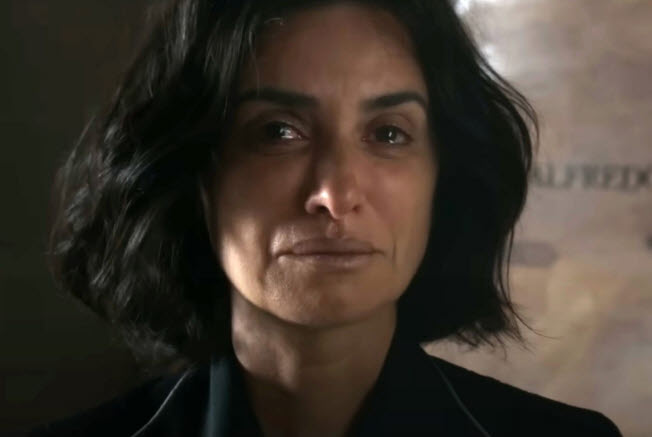
Driver’s solid performance is complemented well by his co-star’s more passionate supporting acting. Whenever they share the screen together, Penélope Cruz brings considerable intensity as a strong-willed woman who has not just put up with her husband’s many flaws, and she and Driver are convincing in their characters’ complicated personal/business relationship. In contrast, Shailene Woodley is limited by a thankless role which only demands her to look generous and supportive, and many other notable cast members in the film including Jack O’Connell and Patrick Dempsey are also under-utilized due to their flat supporting characters.
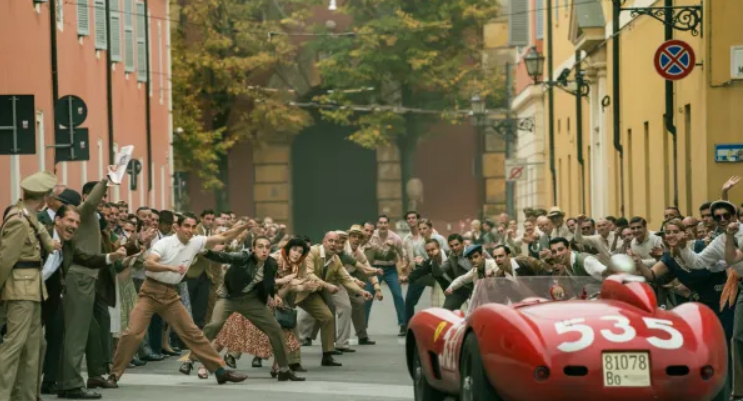
In case of those car race sequences in the film, Mann and his crew members including cinematographer Erik Messerschmidt and editor Pietro Scalia did a competent job on the whole, but I must point out that these sequences are one or two steps down from the sheer intensity of “Ford v Ferrari”. While mostly looking as realistic as required, they sometimes show the heavy-handed utilization of CGI to our distraction, and, most of all, the movie stumbles a lot in developing Ferrari’s racers into figures we can really care more about. Around the end of the story, the movie looks around the devastating human cost Ferrari comes to face for his business goal, but he simply moves on in the end, and so does the movie.
In conclusion, “Ferrari” is not entirely without flaws, but it will probably make a nice double feature show with “Ford v Ferrari”, considering how their respective stories overlap with each other to some degree. Although his prime time may have passes, it is nice to see that Mann is still a master filmmaker to watch despite being rather silent for several years since his previous film “Blackhat” (2015), and I sincerely hope that he will keep going for a while at least.


 Seongyong's Private Place