

Japanese film “Sayonara, Girls”, which is released as “Girls Don’t Graduate” in South Korea as it was in Japan a few months ago, is so gentle and vanilla that I quickly lost my patience during my viewing. Probably because I do not have much nostalgia on my high school years full of ups and downs, I could not connect that well with its gently clean-cut presentation of high school life from the beginning, and I was also disappointed with its rather thin storytelling and flat characterization.
The main background of the movie is an old rural high school which is going to be closed after its last graduation ceremony. Now only one day is left before their eventual graduation, many of senior students in the school are quite excited to say the least, and the first half of the film is mainly about how their last school day slowly passes by.
During its opening part, we are introduced to its four main female characters one by one. First, we meet a quiet girl supposed to deliver a speech on the behalf of her fellow senior students during the upcoming graduation ceremony. From her rather silent appearance, we gradually gather that she has some serious emotional issue behind her back, but then she is brightened up a little when she later has a little private time with a certain male student. As observing their affectionate interactions, we clearly sense how much they love and care about each other, though she does not tell much about her little romantic relationship to others.
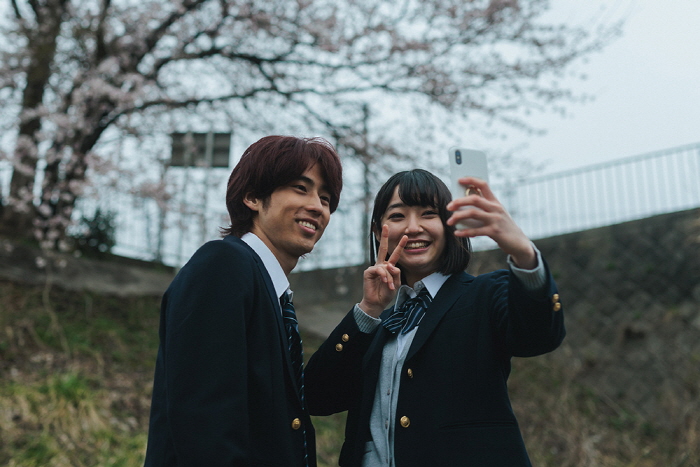
In case of a no-nonsense girl who has incidentally managed a musician circle in the school, she must handle a tricky matter involved with a concert to be held right after the graduation ceremony. Her musician circle consists of three bands, and all of them are expected to perform on the stage, but one of them, which is your average mediocre heavy metal rock band, turns out to be a very big problem. First, all of its band members do not know how to play their instruments at all, and they have not even prepared for the concert at all. As a matter of fact, they have usually done a lip-syncing to pre-recorded music, and they are surely aware of that they will be bound to become a butt of joke once they try to ‘perform’ on the stage. Mainly because she has been secretly fond of the band leader since their middle school years, the girl tries her best for helping his band, but, not so surprisingly, there soon come several setbacks in front of them, so there is some suspense on whether they can actually succeed in the end.
The movie also focuses on the complicated situation between one ex-couple in the school. Because she has aspired to pursue her dream more in Tokyo, the girl will soon leave the town right after the graduation, and the boy, who decides to stay and then study for being a teacher in the town, is naturally not so happy about that. The girl sincerely tries to tell him that her feeling toward him remains same as before, but the boy is not particularly willing to talk with her for now, and that makes her frustrated at times.
Another part of the film involves with a nerdy female student who still cannot confide her longtime romantic feeling to the supervisor teacher of the school library. As her time at the school is being over, she feels more urged to get closer to her favorite teacher, but she also knows well how inappropriate it will be for both her and that teacher, who incidentally turns out to be happily married.
Leisurely rolling these four plotlines, the movie soaks the screen with its warm and mild ambiance mainly represented by those beautiful blossoms of cherry trees, and we get to know a bit more about its main characters. In case of the girl preparing for the graduation ceremony speech, we eventually come to learn that she has been constantly haunted by something quite traumatic which occurred some time ago, and we are not so surprised by a little twist involved with her boyfriend later in the story. In case of that nerdy girl, she clumsily tries to be a little more active around her classmates as advised by her favorite teacher, and you may be amused a little when a certain classic high school horror film is mentioned at one point.
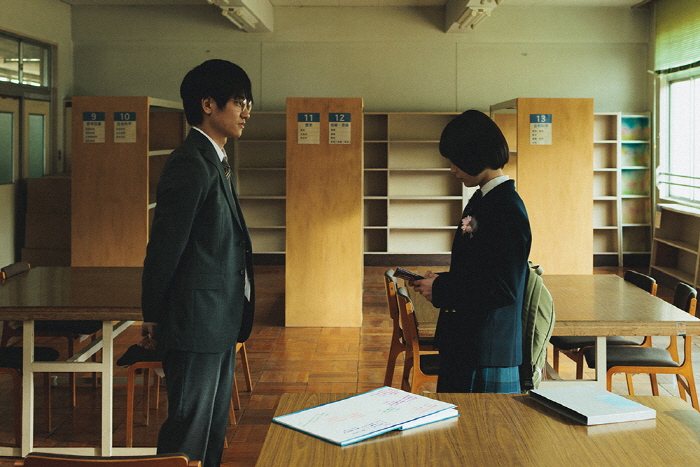
However, the screenplay by Shun Nakagawa somehow fails to bring more life and personality to its main characters, who remain rather plain and boring archetypes instead of becoming real human figures to touch or interest us. Furthermore, all of the four main plotlines arrive at their respective expected endings without much surprise or revelation for us, and I can only admire how it tactfully handles the risky emotional circumstance between that nerdy girl and her favorite teacher at least.
Nevertheless, the four lead actresses of the film acquit themselves on the whole. While Yuumi Kawai, who was memorable in another Japanese high school drama film “It’s a Summer Film!” (2020), surely draws more attention, Rina Ono, Rina Komiyama, and Tomo Nakai are equally solid, and the movie could utilize their considerable talent more in my inconsequential opinion.
Overall, “Sayonara, Girls” attempts to be a sincere and intimate adolescent drama film, but it does not succeed as much as intended as lacking enough personality and substance to distinguish itself. While you may enjoy it more than me for its casual gentle quality, I have to point out that there more interesting Japanese adolescent drama films including “It’s a Summer Film!”, and I am already considering revisiting “It’s a Summer Film!” for appreciating its undeniable charm and spirit more.


 Seongyong's Private Place