
What French film “Between Two Worlds” is about is important and relevant to say the least, but I also found it problematic for how it is about. Mainly driven via a privileged observer with no stake at all, the movie often undermines its supposedly sincere exploration of the hard and difficult reality of working-class people often crushed by their menial temporary jobs, and it does not even know how to handle its considerable contradiction despite often openly recognizing that.
During the opening scene, the movie, which is set in the northern port region of France, looks promising as following a young woman in one desperate situation. As a single mother trying to raise three kids alone besides trying to earn a living for her and her kids, this young woman surely depends a lot on social welfare, but, alas, there seems to be some mistake in handling her submitted documents, and she really has to meet and talk with a civil servant who might help her a bit.
Not so surprisingly, her desperate plea is promptly ignored right from her arrival at the civil service office, but the center of the story is not her but a woman who happens to be there for some other reason. On the surface, Marianne Winckler (Juliet Binoche) is simply a middle-aged woman who really needs to earn her living for herself right now, but it soon turns out that she is actually a Parisian journalist who goes undercover for getting enough materials for her upcoming book on the world of the working-class people struggling in their demanding menial temporary jobs day by day. After managing to deceive that civil servant during the following interview, Marianne soon begins to delve into the main subject of her book, and it goes without saying that what she will witness and record is not very pretty to say the least.

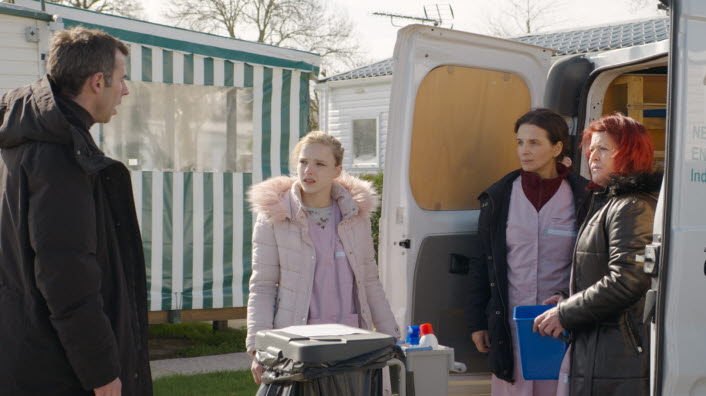
As she vividly experiences the daily life of those poor and desperate working-class people, Marianne gradually befriends several persons willing to help her more without knowing anything about her true purpose, and one of them is incidentally that desperate young woman she encountered during the opening scene. Things have been fortunately less desperate for Christèle (Hélène Lambert) since their accidental encounter, but she still works hard in her latest job while not getting paid enough day by day, and Marianne decides to help Christèle a bit. She luckily borrowed a shabby old car via one of her new ‘friends’, so she offers her driving service to Christèle in exchange of getting her hired at where Christèle is working at present.
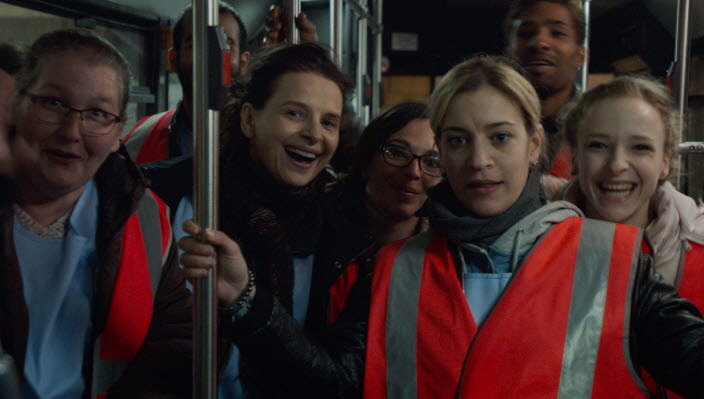
Once they make a deal, Christèle immediately gets Marianne employed at her current workplace, which is a big ship going back and forth between France and UK several times every day. Whenever the ship arrives at the pier, Christèle and Marianne and several other employees must be fully ready for their quite demanding tasks including cleaning more than 200 cabins in the ship within less 2 hours, and Marianne surely comes to experience much more than whatever she expected at first.
As she gets accustomed to her new job day by day, Marianne comes to befriend more not only Christèle but also several other employees. In case of a young plucky girl named Marilou (Léa Carne), she often brightens up the mood among her co-workers while looking less weary compared to Christèle and other employees. At one point later in the story, these two ladies happen to be stuck in the ship along with Marianne, and that leads to a little fun moment for them even though they are well aware of the considerable risk of getting fired at any chance.
However, we are also often reminded that Marianne remains in her privileged position no matter how things often get very hard and difficult for her. While she is probably sincere and passionate in her supposedly good-willed intention, she is virtually a tourist to the hardships of her “friends”, and this troubling aspect is already quite clear to us when her deception is exposed a bit early in the story. As one supporting character sharply points out, she is actually taking away the job opportunity from whoever needs much more than her right now, but the screenplay by director Emmanuel Carrère and her co-writer Hélène Devynck, which is loosely based on Florence Aubenas’ nonfiction book “The Night Cleaner”, usually steps back from many inherent ethical questions in the story without really confronting them at all.
Furthermore, the movie also suffers from its thin characterization. While Juliette Binoche tries to fill her character with life and personality as much as she can, her character remains a blank figure who does not interest us a lot, and the movie unfortunately comes to focus more on her character’s writing process along the story. In the end, what Marianne did for her book looks opportunistic and exploitative to us, and we are more reminded of how she should have not crossed the ethical lines from the very beginning.
At least, the movie shows some genuine sense of life around the fringe of its story thanks to the good supporting performances from Hélène Lambert and Léa Carne. Their characters are actually far more interesting than Binoche’s superficial lead character, and I wonder whether the movie should have simply put their realistic characters at the center instead of Marianne.
In conclusion, “Between Two Worlds” is surely well-intentional, but it is sadly hampered by its several inherent flaws including its ethically questionable lead character, and I can think right now of several better French films which handle its important social issues in much better ways. If you have not seen “The Measure of a Man” (2015) or “Full Time” (2021) yet, I sincerely recommend you to watch either of them instead, and I assure you that you will be more satisfied with some enlightenment.


 Seongyong's Private Place