
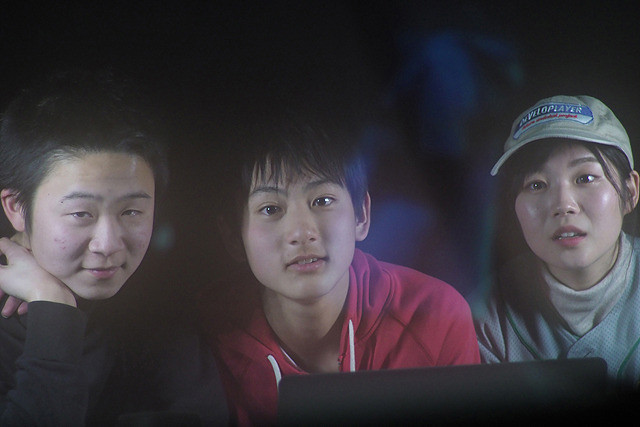
Japanese film “Wild Tour” is a small early work from Shô Miyake, who recently drew my attention for his latest film “Small, Slow but Steady” (2022). While it occasionally feels like a short film extended a bit to long, “Wild Tour” is engaging to some degree as slowly revealing the emotional undercurrents beneath the surface, and it was also a little amusing for me at times due to its main subject incidentally associated a bit with my academic background.
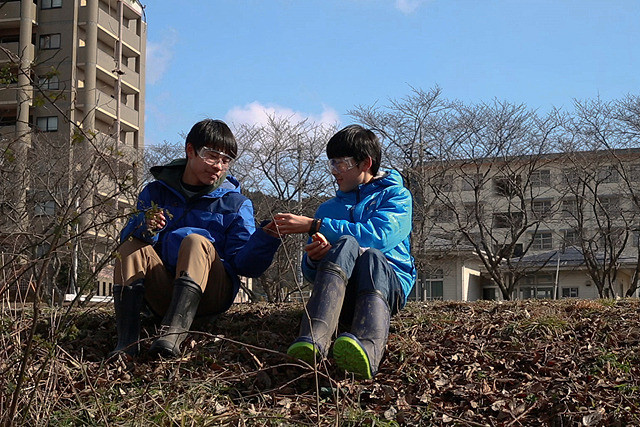
The story mainly revolves around a little scientific workshop program at the media and art center of one small Japanese city. Under the guidance of two university students, its middle school student participants are going to examine the wildlife botany of the city, and they are instructed to sample and record biological specimens to be analyzed via DNA sequencing. At one point in the film, the movie shows a bit of how a DNA sample is extracted from one collected specimen, and I must tell you that I felt quite nostalgic as a guy who studied biology for more than 10 years as an undergraduate and graduate student of Korean Advanced Institute of Science and Technology.
Anyway, the movie mostly focuses on Ume (Honoka Ito), a young woman who is one of the two university students guiding the participants of the workshop program. Once the brief orientation of the workshop program is over, she cheerfully approaches to two adolescent boys who are going to work along with her outside, and we soon observe how they work outside. As they simply go around here and there inside and outside the city, their work process is constantly recorded by their smartphones, and the two boys under Ume’s guidance are willing to do the job as much as possible while often driven by Ume’s genuine charm and enthusiasm.
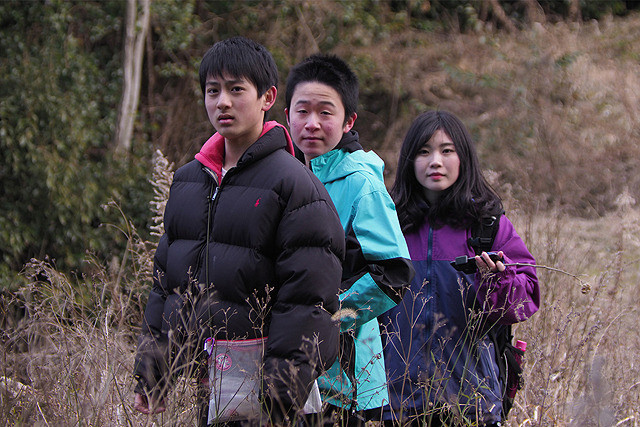
It gradually becomes more apparent to us that both of these two boys are interested in getting a bit closer to Ume even though they are well aware of the considerable age gap between them and her. Regardless of whether she is actually aware of what is going on between her and them, it turns out later that there is some past with Ume and her male colleague, and the most interesting moment in the film comes from when they happen to have a little private moment between them without knowing at all that their conversation is being heard by one of the two boys.
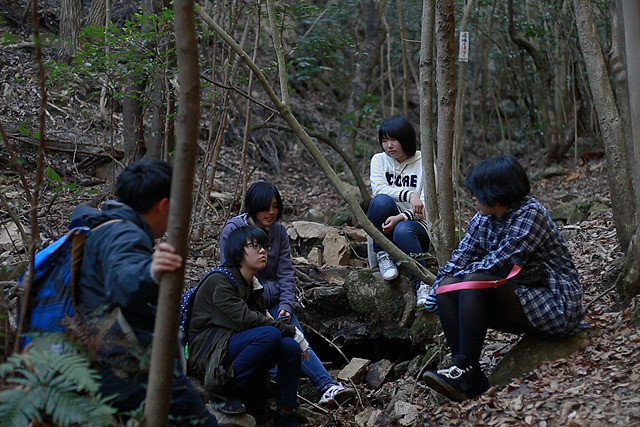
Meanwhile, the workshop program is being continued day by day as before, and the movie goes astray a little when it comes to pay attention to Ume’s male colleague and several teenage girls under his guidance. This sequence is vivacious as these young girls joyously do their job in the forest of a nearby mountain, and their guide becomes quite interested when one of the young girls comes across a specimen curious enough to be examined and analyzed later.
Eventually, Miyake’s screenplay eventually goes back to the developing triangle relationship among Ume and the two boys. We get to know a bit more about one of these two boys when he happens to have a brief meeting with one of his female schoolmates, who is clearly interested in becoming his girlfriend someday. We are amused a bit when the other boy takes some advantage of his friend’s sincere confession to him. And we get some bittersweet feeling when neither of them succeeds in winning Ume’s heart in the end.
However, as adamantly sticking to its detached docudrama approach, the movie often fails to develop its main characters enough to make us care more about them. While Ume is mainly defined by her casual charm, the boys under her guidance mostly remain as mere story elements, and the same thing can be said about several other substantial characters including Ume’s male colleague, who may have more personal story to tell behind his back.
Despite this glaring flow, the movie is not entirely without interesting stuffs to be appreciated, and you may be impressed by its considerable realism on the screen. Although it frequently looks like a mere promotional film for the media and art center in the film (As shown from the end credit accompanied with the excerpts from various DNA sequencing results, this center really exists in that city, by the way), there is an ample amount of palpable verisimilitude at least, and the characters in the film really feel like real people even though most of them are rather underdeveloped in my inconsequential opinion.
The three main performers at the center of the movie are effective in their unadorned natural acting. While Honoka Ito always lightens up the mood whenever she appears on the screen, young performers Ryutaro Yasumitsu and Osuke Kuribayashi hold each own place around their adult co-star, and it is a shame that the movie does not roll their characters further for more interesting story development.
Overall, “Wild Tour” is not exactly a satisfying experience due to its rather thin storytelling, but it shows its director’s considerable potential to be developed during next several years. Since the movie was released in 2019, Miyake worked in two local TV miniseries and then moved onto “Small, Slow but Steady”, and that movie was certainly one of the more interesting films I watched during last year. With several short and feature films on his belt, he is definitely ready to advance more, and I think I will probably be more impressed by whatever he will make next.


 Seongyong's Private Place