

“Wonka” is a sweet lightweight piece of entertainment which made me less cranky than usual. Sure, this is another redundant character origin story like “Joker” (2019) and “Cruella” (2021), but it is packaged with enough humor, spirit, and heart, and I found it fairly likable even though I think its existence is not exactly necessary from the beginning.
The story is about how Willy Wonka (Timothée Chalamet), who is incientally one of the most memorable characters created by Roald Dahl, started his business many years before he sadistically punishes those spoiled kids in Dahl’s novel “Charlie and the Chocolate Factory”. In contrast to Gene Wilder in “Willy Wonka & the Chocolate Factory” (1971) or Johnny Deep in “Charlie and the Chocolate Factory” (2005), Chalamet plays the titular role as a charmingly idealistic lad full of hope, dream, and imagination, and it does not take much time for us to root for his sincere aspiration as he jubilantly sings during his arrival at one big city.
However, his naïve ambition soon faces a series of considerable obstacles right from his first day in the city. As he does not have much money at present, Wonka comes to stay in a cheap boarding house run by Mrs. Scrubitt (Olivia Colman), and, what do you know, he soon finds himself thrown into Dickensian slavery just like several other unfortunate boarders of Mrs. Scrubitt, all of whom made a certain small but serious mistake just like he did. In addition, his modest chocolate business is quickly stomped by the venal police chief and three powerful chocolate businessmen, who are surely as nasty and ruthless as those three mean farmers in Dahl’s another famous novel “Fantastic Mr. Fox”.
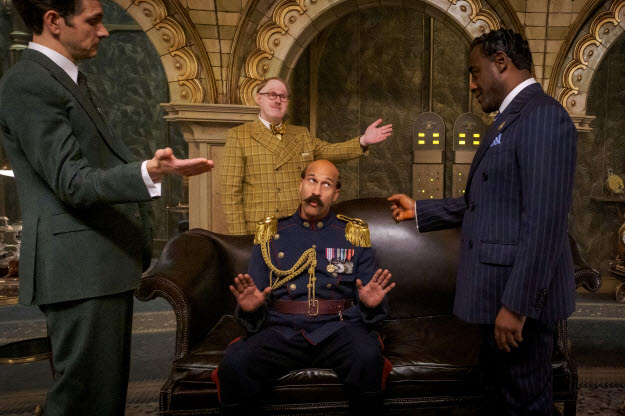
Nonetheless, Wonka is not daunted at all. Mainly assisted by an orphan girl who is also a captive of Mrs. Scrubitt just like Wonka and other boarders, he gradually finds a way to continue his chocolate business whenever he and they can evade Mrs. Scrubitt’s watchful eyes, and, not so surprisingly, he soon gets more and more attention in the city because of his wondrous chocolate products such as the one which can make people float in the air.
As Wonka’s chocolate business is thriving day by day, the movie continues to drop one nice musical sequence after another for our amusement. While Joby Talbot’s score freely quotes the two famous songs from “Willy Wonka & the Chocolate Factory” (1971) throughout the film, the original songs by Neil Harmon are fun and witty enough to make you make hum some of them after the movie is over. As a matter of fact, I was particularly tickled by “Scrub Scrub”, which is about how Wonka and other boarders have to work a lot every day as demanded by their diabolical boardinghouse owner.
In addition, the movie has enough charm and wonder to make us put aside our reservation for a while. Sure, Wonka is more like a wizard than an entrepreneur, but the movie is unabashedly unrealistic with its numerous fantasy elements, so we do not ask too much about the details on how he can make those magical chocolate so easily everyday – or where he did get that magical hat which seems to contain a lot of stuffs.
Above all, just like director/co-writer Paul King’s two previous films “Paddington” (2014) and its 2017 sequel, the movie is gently and cheerfully driven by good will and optimism, both of which we surely need for going through these hard and disturbing days. While we may get another origin story on how Wonka becomes less gentle and innocent later, he is simply decent and caring here in this film, and it is touching to see how his good will and optimism affect several other characters around him. They have been jaded and cynical in one way or another, but they eventually find themselves enlivened a lot by Wonka’s irrepressible spirit, and they come to stick together around him when he becomes more determined not to step back at all later in the story.

Timothée Chalamet, whom we will see again in “Dune: Part Two” (2024) several months later, demonstrates here that he is a good singer who can ably handle several key songs such as “A Hatful of Dreams”. While his performance is less edgy than his two notable predecessors, Chalamet brings considerable youthful energy and sweetness to the titular role as doing his own things to be appreciated, and his resulting performance becomes quite endearing like the titular bear character of “Paddington”.
Around Chalamet, the movie assembles a bunch of notable performers such as Olivia Colman, Sally Hawkins, Jim Carter, Rowan Atkinson, Keegan-Michael Key, and Hugh Grant. While Colman and Key have lots of fun with their respective villain roles, Grant plays his literally colorful supporting character with gusto in addition to singing well the two variations of that catchy song from “Willy Wonka & the Chocolate Factory”, and newcomer Calah Lane holds her own place well besides Chalamet while having her own little moment to shine.
On the whole, “Wonka” may not remain that long in our mine compared to “Willy Wonka & the Chocolate Factory”, but it is entertaining enough for recommendation because of the enthusiastic efforts from its cast and crew members. After having another busy day at my workplace, I was a bit tired when I came to the screening room in the previous evening, but then my eyes and ears were entertained by all those nice things in the film, so I will not grumble for now at least.


 Seongyong's Private Place