

“Il Buco”, which means “the Hole” in Italian, is surprisingly compelling in its dry and distant approach to its main subject. Simply following the discovery and exploration of a certain deep hole in the cave region of Pollino in Southern Italy in August 1961, the movie slowly rolls from one moment to another without much explanation for us, but the result is a very fascinating meditation on nature and human life, and its many haunting images will linger on your mind for a long time after it is over.
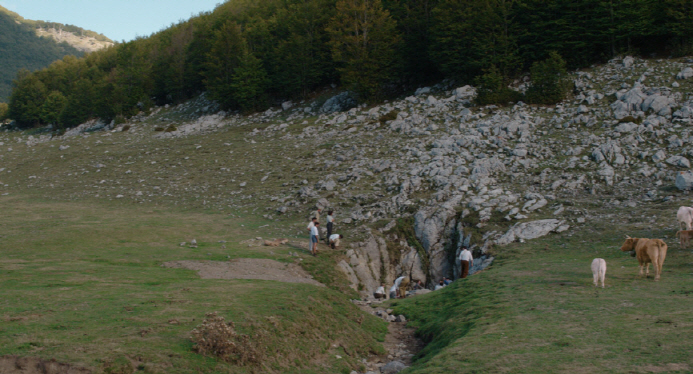
At first, the movie gradually sets its main background bit by bit. As the camera of cinematographer Renato Berta quietly looks around the landscapes of one little rural village near the cave region of Pollino, we observe the villagers and their surrounding area, and there is an interesting moment when their rather old-fashioned daily life is contrasted with what many of them watch from a small black and white TV outside a local bar in every evening. At one point early in the film, the TV shows a modern skyscraper built in Milano, and we can palpably sense the villagers’ wonder and curiosity to some degree even when the camera focuses on the TV screen for a while.
In the meantime, the movie also observes the arrival of a bunch of speleologists at the village. They arrive at a nearby train station at one night, and their arrival in the village on the next day certainly draws some attention from the villagers. After staying at the storage room of the local church for a while, they go outside the village for exploring a certain spot located in the aforementioned cave region, and, what do you know, this spot in question turns out to be much more interesting than expected.

The movie patiently follows their following exploration process step by step. At first, they carefully examine the opening part of a big hole which would be named “Abisso del Bifurto” (Bifurto Abyss), and they are marveled by how deep this hole really is. As they go down and down during next several days, there seems to be no bottom to reach, and that makes them more motivated about their unexpected academic discovery.
While there are a number of minor dialogue scenes throughout the film, director/co-writer Michelangelo Frammartino, who previously impressed me a lot with “Le Quattro Volte” (2010), deliberately does not provide the subtitle for non-Italian audiences. To our little surprise, this actually does not hinder us at all, because everything we need to observe and understand is clearly conveyed to us under Frammartino’s masterful direction. For example, one particular scene merely observes a plain conversation among old local farmers, and we do not need any subtitle at all because we can somehow sense whatever they are talking about on the screen.
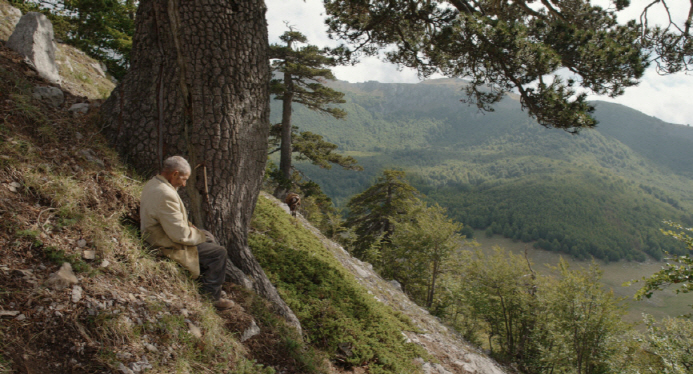
The movie comes to focus on one particular old farmer, who is already introduced to us at the beginning of the story. Although he does not say or express much on the surface, his aging face conveys to us a bit of his life history, and we come to wonder more about his thoughts and feelings as he silently regards the landscapes of his little area outside the village. Does he actually sense those inevitable changes coming into the village via modern culture and technology? If so, what does he really feel and think about that?
Meanwhile, the exploration of Bifurto Abyss is continued, and there are a series of wondrous moments which will make you wonder how Frammartino and his crew members shot these exceptional moments. I cannot tell whether they actually shot the film at sets or real locations, but these scenes look quite realistic in my humble opinion, and Frammartino wisely takes his time until the speleologists eventually arrive at the real end of their exploration project. In addition, the film shows some sense of humor at times, and you may be tickled a bit by an early morning scene between one horse and several speleologists sleeping in their tent.
This descending exploration process of theirs is juxtaposed with the increasingly declining physical condition of that old local farmer. After found quite unconscious by his neighbors at one point later in the story, he is immediately taken to his little residence and then examined by a local doctor. It does not take much time for us to perceive that he does not have much time to live, and there is nothing his neighbors can do for him except waiting for his eventual end. As usual, the movie sticks to its detached attitude, but this part is undeniably poignant as we witness how an old way of life is slowly dying.
On the whole, “Il Buco”, which won the Special Jury Prize when it was shown at the Venice International Film Festival in 2021, often feels elusive and distant at times, but it is still a rewarding cinematic experience with which you should take a chance. Despite receiving lots of critical praises on “La Quattro Volte” (It was one of my ten best films of 2011, by the way), Frammartino did not make any feature film for more than 10 years before eventually making “Il Buco”, and “Il Buco” shows that he should be more active for sharing his own distinctive artistic vision and style with us. Although it is rather late in its arrival in South Korea (It will be released here a few days later), I am glad that it gets an opportunity to be shown at local arthouse theaters, and I will certainly recommend it to any serious local moviegoer like me.


 Seongyong's Private Place