
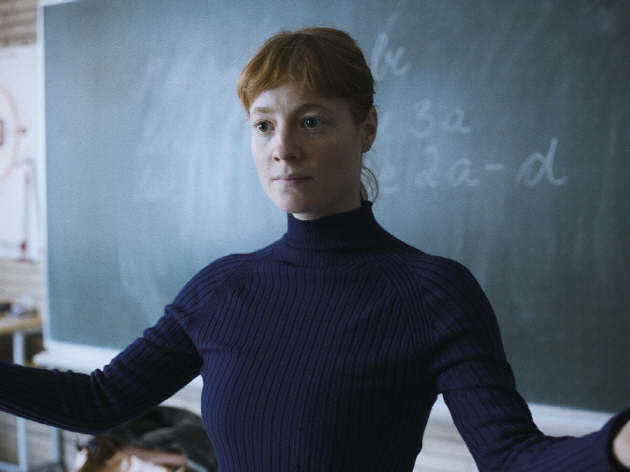
German film “The Teachers’ Lounge”, which was selected as the German submission to Best International Film Oscar then was recently included the shortlist, is a dry but riveting school drama about how one small matter becomes quite complicated for everyone involved with it. No matter much how its good-willed heroine tries her best for handling this increasingly tricky situation, things keep getting messier thanks to not only others but also herself, and we come to brace ourselves as observing the growing tension and pressure around her and others.
At the beginning, the movie gradually lets us know an ongoing circumstance inside one school. There have been a series of theft incidents, and Carla Nowak (Leonie Benesch) and several other teachers come to suspect that one of their students is responsible for these bad incidents, so Carla and the principal have a little private meeting with her two students who might give any information on whoever is behind these bad incidents. Not long after that, Carla’s male students suddenly get their possessions examined in the middle of their lesson, and then one of these male students comes to draw attention for having a substantial amount of money in his possession.
This student in question explains where that money comes from, and his parents, who are incidentally immigrants, confirm their son’s claim. Mainly because she does not want to get this student suspected more, Carla decides to take care of the problem for herself. She sets up a little trap for the culprit at the teachers’ lounge, and then, what do you know, her laptop video camera captures another incident of theft during her absence, though the identity of the culprit remains unknown as before.

Just because of a little detail shown from the video clip, Carla comes to suspect one of the teachers in the school. She later confronts this teacher in question, but this teacher vehemently denies everything, so Carla decides to report to the principal, who promptly takes an action which comes to ignite a chain reaction of unpleasant happenings. It initially seems that the matter will be resolved sooner or later, but, unfortunately, the actions of Carla and several others around her are followed by the serious consequences beyond their control, which also lead to more problems and headaches to everyone in the situation.
One of these consequent problems is involved with the young son of that suspected teacher, who happens to be one of the smarter students in Carla’s classroom. Strongly believing in his mother’s innocence, he embarks on his little campaign against his teacher, and Carla cannot help but more exasperated even while trying to maintain her appearance and authority in front of her students, who come to regard her with more anger and defiance. No matter how much she tries to calm them down in one way or another, things only get worse and worse, and she even finds herself not getting much help or support from many of her fellow teachers.
Steadily dialing up the level of tension on the screen, director İlker Çatak, who also wrote the screenplay with Johannes Duncker, keeps the story and characters rolling under his skillful direction. Shot in the screen ratio of 1.33:1 by cinematographer Judith Kaufmann, the movie effectively builds up the sense of suffocation around its heroine, and we are not so surprised when Carla is eventually driven up to the point where she really needs any kind of mental ventilation. The score by Marvin Miller often feels jarring with deliberate discord, and we get unnerved whenever Miller’s score subtly announces something to happen sooner or later. While mostly sticking to its heroine’s viewpoint, the movie wisely does not vilify any of its main characters, and we come to understand and emphasize more with not only Carla but also several other main characters in the story – even while watching how they often make the situation all the more complicated and exasperating than before.
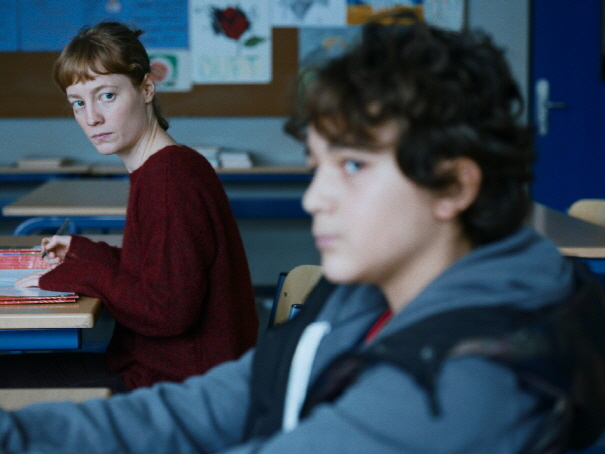
The movie is anchored well the strong performance of its lead performer. Leonie Benesch, a German actress who started her movie acting career in Michael Haneke’s “The White Ribbon” (2009), is compelling as quietly conveying to us whatever is churning behind her character’s doggedly patient attitude, and she is especially fantastic when her character belatedly comes to realize her big error later in the story. I am not that sure about whether this moment is real or imagined, but Benesch is simply devastating as her character is reminded more of the growing trouble inadvertently caused by her.
In case of the other adult main cast members of the film, Michael Klammer, Rafael Stachowiak, Anne-Kathrin Gummich. and Eva Löbau are solid in their respective supporting parts. The special mention goes to a bunch of young performers in the film including Leonard Stettnisch, who are certainly another crucial part of the story. Their good natural performances function well as the counterparts to Benesch’s acting, and that is particularly evident during one tense scene where her character comes to face the growing distance between her and her students.
On the whole, “The Teachers’ Lounge” is often tough to watch, but it holds our attention thanks to its deft storytelling and convincing performance, and you may be relieved a bit when it arrives at an unexpectedly calm but powerful moment to remember. While nothing is certain for everyone even at the end of the story, there is some possibility for hope and harmony as suggested by what is played so harmoniously on the soundtrack during the following end credits – and we can only wish for the best for all of them.


 Seongyong's Private Place
Pingback: My Prediction on the 96th Academy Awards | Seongyong's Private Place
Pingback: 10 movies of 2024– and more: Part 2 | Seongyong's Private Place