

Netflix film “Maestro”, which was released in South Korean theaters a few days ago and then will be available on Netflix a few weeks later, is supposed to be about the life and career of Leonard Bernstein, but he is not exactly the emotional center of the film in fact. It is actually more about his wife, and this may disappoint you, but the movie still holds our attention thanks to not only its competent direction but also the fine performances from its two charismatic lead performers.
After the prologue part showing a bit of Bernstein’s later years, the movie goes back to when young Bernstein got a big breakthrough for his burgeoning career in New York City, 1943. When the principal conductor of the New York Philharmonic becomes suddenly ill, Bernstein, played by director/co-producer/co-writer Bradley Cooper, has to replace him at the very last minute, and, despite not being prepared that much from the beginning, he gives a moment to remember for everyone in Carnegie Hall. From that point, he becomes a rising new musician to watch in the town, and that certainly excites him as well as his notable colleagues such as Jerome Robbins (Michael Urie) and Aaron Copland (Brian Klugman).
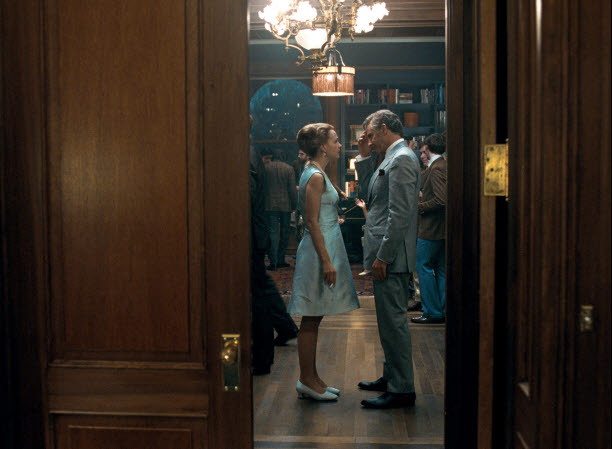
When he later attends an evening party along with his friends and colleagues, Bernstein comes across a young actress named Felicia Montealegre (Carey Mulligan), and something seems to click between them as they come to spend more time together. She later shows him a little special place where she has often pursued her own artistic dream, and Bernstein certainly understands her hope and ambition as a fellow artist.
Eventually, Felicia becomes Mrs. Bernstein, and then she and Bernstein come to have several kids between them, but then we sense more of the constant tension between them. As already shown to us from the beginning, Bernstein was a closeted bisexual, and Felicia knew and accepted this even before marrying him, but she cannot help but annoyed by the remaining emotional gap between them – especially whenever her husband is driven by his sexual desire. During one evening party held at their apartment in New York City, she happens to spot him getting too close with some lad, but she does not make a fuss about that at all, though she coldly reminds her husband that she is not a fool at all (“Fix your hair. You’re getting sloppy.”).
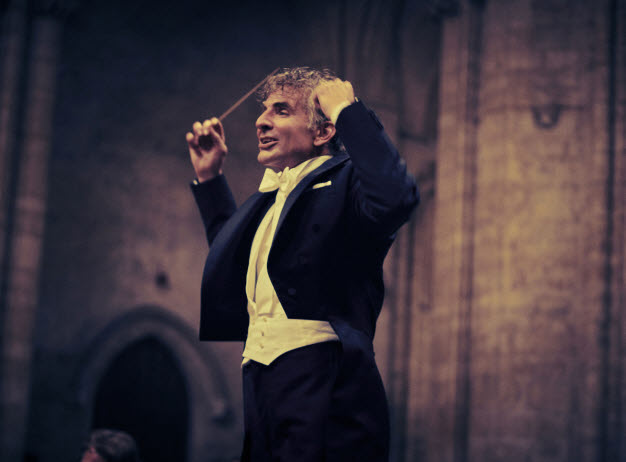
In the meantime, the movie presents a number of high points in Bernstein’s career, and Cooper and his crew members including cinematographer Matthew Libatique put tremendous efforts on the screen for taking us into those moments of artistic ecstasy. While resembling Bernstein enough on the surface via that visible makeup which happened to generate lots of public controversy a few months ago, Cooper is nearly flawless as ably channeling Bernstein’s artistic spirit and mannerism, and he is particularly superlative during one big concert scene unfolded inside a big cathedral. As Libatique’s camera effortlessly moves around in the space for more verisimilitude and excitement, the music dramatically swells to our delight while Cooper drives himself toward full commitment, and the result is certainly one of the highlights of the film.
However, the screenplay by Cooper and his co-writer Josh Singer curiously distances itself from its hero at times, and this ultimately limits Cooper’s fairly competent acting. We never get to know that much about Bernstein except his numerous artistic achievements and his frequently troubled relationship with Felicia, and the movie does not even go that deep into his romantic relationships with several men in his life. They simply come and then go around Bernstein without much impact or impression, and that is all we can get from the movie.

In contrast, Felicia gradually becomes the quiet but strong emotional center along the story as we observe more of the inner struggles with her inherently flawed relationship with her husband. Carey Mulligan, who may get Oscar-nominated along with Cooper early in the next year, did a splendid job of embodying her character’s dynamic emotional journey along the story, and she is especially wonderful whenever Felicia must hold her feelings and thoughts to herself.
Cooper and Singer’s screenplay also often stumbles in its superficial depiction of a number of supporting characters around Bernstein and Fellicia, and one of the weak points of the film is the glaring under-utilization of its several supporting performers. While Matt Bomer, Micheal Urie, Brian Klugman, and Gideon Glick do not have much to do besides filling their respective spots, Maya Hawke is seriously wasted as one of Bernstein’s’ children, and Sarah Silverman, who plays Bernstein’s acerbic sister, slips into her role more effectively than you may expect.
In conclusion, “Maestro” is one or two steps down from Cooper’s acclaimed directorial debut film “A Star Is Born” (2018), but it is still an admirable piece of work which confirms to us again on his considerable ability as a filmmaker. Just like he previously did with Lady Gaga in “A Star Is Born”, he lets Mulligan shine while dutifully doing his job beside her, and he also demonstrates some technical prowess as filling the screen with enough period mood and details. Although I am still not very enthusiastic about it, the movie is still interesting for several good reasons, so I recommend you to give it a chance at movie theater or your home.


 Seongyong's Private Place
Pingback: 10 movies of 2023 – and more: Part 2 | Seongyong's Private Place
Pingback: My Prediction on the 96th Academy Awards | Seongyong's Private Place