

Romanian filmmaker Christian Mungiu has impressed us with his dry but undeniably intense drama films such as “4 Months, 3 Weeks and 2 Days” (2007) and “Beyond the Hill” (2012). Although it is less focused in comparison as attempting to draw a big picture of prejudice and bigotry, his latest film “R.M.N.”, which was premiered at the Cannes Film Festival early in last year, has a number of compelling moments for us, and that is enough to compensate for a number of weak aspects including its occasionally uneven narrative.
After its rather ambiguous prologue scene, the movie begins the story with the problematic situation of a Romanian worker named Matthias (Marin Grigore). We see him working at a factory located somewhere in Germany, and then he causes a serious trouble due to his violent temper. He consequently runs away to his rural village in the Transylvania area of Romania, but there is nothing much he can do there except staying at where his estranged wife and their little son have lived. He surely wants to get a job to support his family as a husband and father, but, unfortunately, the economic status of the village has not been that good to say the least because many able-bodied people already left for better jobs out there, and the only option for him at present is a big bread factory outside the village.
Considering that his ex-lover Csilla (Judith State) works in the management department of that bread factory, Matthias could simply ask for some favor from her, but he is not so willing to work there from the beginning just because the wage proposed by Csilla and her female boss is not high enough for him. As a matter of fact, the amount of the wage does not look that high for anyone else in the village either, no matter how much Csilla advertises for more workers to be employed.
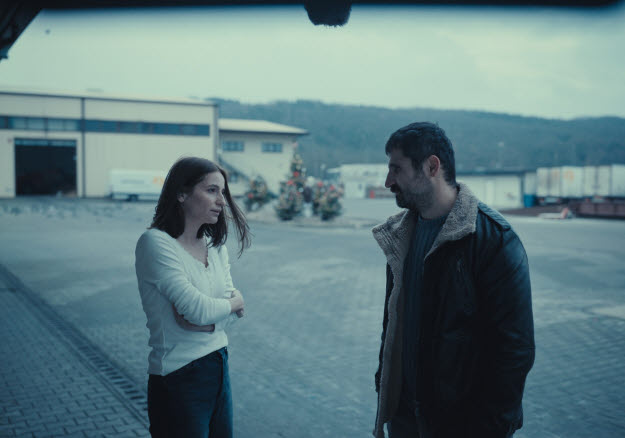
Because the bread factory really needs more employment for getting some necessary EU fund, Csilla eventually considers hiring several foreign workers instead, and two foreign workers from Sri Lanka are soon sent from Bucharest. Although these two foreign workers only can communicate with others in the factory via basic English, they are fairly good at their new job at least, and Csilla and her boss naturally come to consider bring more foreign workers into the factory.
Of course, this sudden change does not look that good to many of villagers. Although they actually have some gaps among themselves due to their multi-cultural background, most of them do not welcome these foreign workers at all while showing more prejudice and bias. In the end, there comes a public petition against hiring foreign workers, and that certainly causes a big headache for both Scilla and her boss.
Mungiu’s screenplay, which is incidentally inspired by the 2020 Ditrău xenophobic incident in Romania, gradually lets us immerse more into the accumulating tension inside the village. Many of villagers become more aggressive and hostile as another Sri Lankan worker is employed, and we are not so surprised when a sudden violent incident occurs later in the story.
Meanwhile, the movie also pays some attention to Matthias’ increasingly messy personal situation. His little son seems to be traumatized by whatever he happened to witness on one day, so he attempts to teach his son on how to be a, uh, man, but that only puts more distance between him and his son and wife. In addition, the physical condition of his ailing father becomes deteriorated day by day, and the recent medical NMR (nuclear magnetic resonance) scanning result on his father’s brain implies that there is something wrong with his aging brain (The title of the movie is a Romanian acronym for NMR, by the way).

Matthias tries to get some consolation from Scilla, but Scilla only gives him pleasure instead of real affection or love. Although she still seems to have some feeling toward him, she can just leave behind everything for any better job out there, and her advantaged status certainly makes a big contrast with how her ex-lover is hopelessly stuck in the village without any possibility for a better life.
As juggling these and many other story elements together, the movie often loses its narrative focus and momentum, but Mungiu and his crew members including cinematographer Tudor Vladimir Panduru continue to hold our attention as doling out a series of impressive scenes to admire and appreciate. In one particularly extended scene, Panduru’s camera steadily observes one chaotic situation from its static position, and it is captivating to watch how things gradually get out of control despite the sensible efforts of Csilla and a few other characters. The following finale is a bit too opaque in my humble opinion, and I felt like missing many local details throughout the film, but the movie keeps us engaged to the end thanks to Mungiu’s deft direction and the effective performances from his cast members.
In conclusion, “R.M.N.” is a flawed but mostly solid work which may make you reflect more on its timely social issues after it is over. Although it is one or two steps down from “4 Months, 3 Weeks and 2 Days” or “Beyond the Hill”, Mungiu, who was not so active during 6 years after his previous film “Graduation” (2016), gives us another interesting film to watch, and I think you should give it a chance someday.


 Seongyong's Private Place
Pingback: 10 movies of 2023 – and more: Part 2 | Seongyong's Private Place