

My hometown Jeonju has a certain area in the middle of its old downtown area, which has been the center of Jeonju International Film Festival for more than 20 years. It surely has several big movie theaters even at present, but many of them were changed into multiplex movie theaters around the beginning of the 21st century, and now the area accordingly looks quite different compared to my personal memories associated with it.
That is why I became a bit nostalgic as watching South Korean independent film “Withstanding and Existing”, which is mainly set in one very old movie theater in Gwangju. Although I have never been there, the interior spaces in this historic theater, which was incidentally built in 1935, evoked my old memories of those old movie theaters of Jeonju in the past, and my mind sometimes got lost in these memories as I enjoyed a series of lovely musical performance scenes in the documentary.
However, the documentary is more about present and future than past. After presenting a very simple historical background of the movie theater in the documentary, the movie has a group of various independent musicians perform their music inside the movie theater one by one, and it also listens to them talking about how they have managed to not only withstand but also exist for years despite their frequent struggles and hardships.
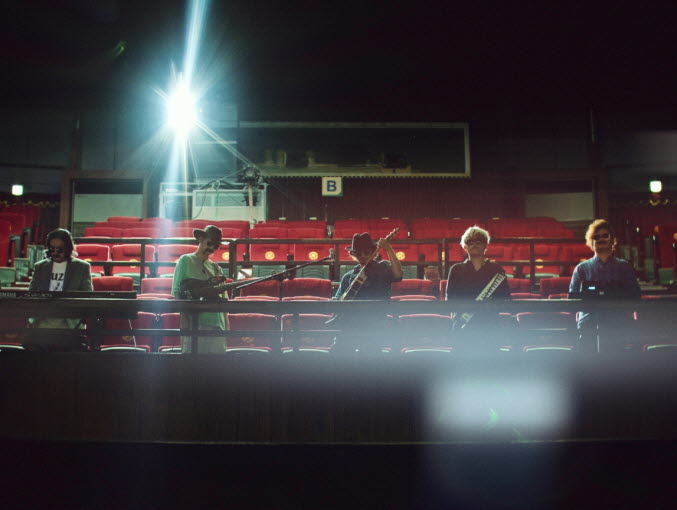
To be frank with you, I do not know anything about these musicians in the documentary, but I can tell you that 1) they are fairly good ones whom you may check out later and 2) they surely know one or two things about how to live while passionately pursuing their artistic passion. In case of one particular band consisting of five dudes, they may look as silly as the Spinal Tap during their little performance in the screening room of the movie theater, but we can sense that they are really bonded together via their common artistic dedication, and you may smile a bit when they frankly reveal how they have managed to endure and prevail together for years despite their considerable personality difference.
In case of one male independent musician, he presents a wonderful opening performance which effectively sets the tone for the other musicians in the documentary. During his musical performance, he simply stands on a corridor inside the movie theater as singing and playing his guitar, but his rather old-fashioned style actually fits well with the shabby ambiance of the movie theater, and he is also engaging as he eagerly talks about his life and career after his musical performance.
I also enjoy the part featuring a female independent musician who presents her modest song about probability. During her interview, she talks mostly about how uncertain life can be for us, and her following musical performance, which is unfolded at the staircase inside the movie theater, somehow made me reflect me on a certain part of my inconsequential private life. So far, I have stumbled again and again as clumsily pursuing any possibility of romance, but I may actually find someone I can really love, right?
To each musician in the documentary, director Gwon Churl throws one interesting question: what is the first movie they saw at movie theater? To my little amusement, their answers are different one by one, while reminding me that most of them belong to the younger generation after mine. Their first movie theater experiences are usually associated with the movies from the 2000s, and this certainly told me that I am really old compared to them. After all, my nostalgic movie theater memories come from many notable movies during the 1990s ranging from “JFK” (1991) to “American Beauty” (1999), and my first active movie theater experience was “Hook” (1991), which is rather flawed but occupies a little special place somewhere in my mind.

Vividly conveying to us the lingering sense of past here and there in the movie theater, the documentary adds some nice visual touches to be appreciated. Besides being shot in the screen ratio of 1.33:1, the deliberately old-fashioned font of its subtitle will definitely delight and amuse anyone who has ever had a movie theater experience during the 1980-90s in South Korea, and the movie theater in the documentary comes to us as a special place where past is casually mingled with present and future.
This interesting aspect is emphasized further by the epilogue part featuring a middle-aged painter who has drawn many promotional stuffs for the movie theater. Although his prime business period is approaching to its closing time, he does not consider quitting at all because he has really been proud of his many different works, and his own commercial art will feel all the more precious to you if you think more about how blandly homogeneous many of movie promotional stuffs have been these days.
On the whole, “Withstanding and Existing” is more about mood and music than information and enlightenment, but it is a delightful experience for anyone who cares a lot about movie theater experience like I and many other moviegoers out there. Although I did not get to know that much about that movie theater, the documentary made me consider going there someday, and that says a lot about how it serves its purpose as much as intended.


 Seongyong's Private Place