

Post-apocalyptic science fiction tales are dime a dozen, but “Vesper” distinguishes itself via its vividly barren and strange background. Although it is rather modest in terms of scope and production budget, the movie did a fairly good job of filling the screen with enough mood and details to engage us, and we gladly follow its young plucky heroine’s story while coming to root for her more.
At first, the movie explains a bit about its post-apocalyptic background. After the global disaster caused by the reckless genetic engineering, all the edible plants are almost wiped out from the Earth along with animals and most of the entire human population. While the majority of human survivors struggle to eat and live day by day in their stark environment, there are special places called “Citadels”, and those privileged people of the Citadels have had the nearly absolute power over the population outside their areas via occasionally selling the precious crop seeds genetically modified for only one harvest.
Vesper (Raffiella Chapman), a 14-year-old girl living alone with her invalid father, has tried to crack the genetic code of those genetically modified seeds for totally being free from the Citadel in her region. When she is not going around here and there outside along with a drone connected with her father’s brain, she usually spends her time at her little shabby laboratory, but there has not been much progress for her yet, and things get more frustrating for her due to a big problem in her residence.
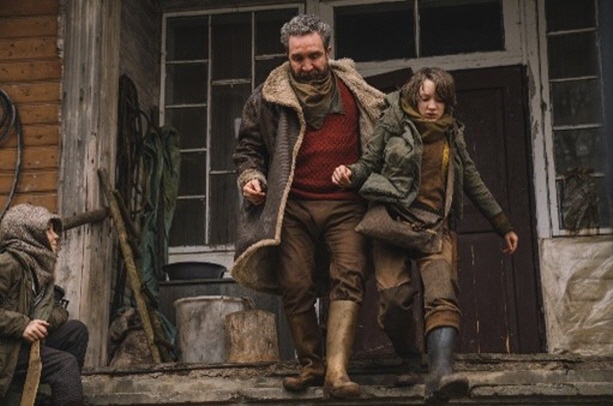
Because of that problem, Vesper has to ask for a little help from her uncle Jonas (Eddie Marsan), who has been the de factor leader of some other survivors in the region. As reflected by his first scene in the film, Jonas is not so kind or generous to anyone at all, and, not so surprisingly, he demands something from Vesper in exchange of a little help. Vesper has no choice but to accept the deal, and there is a brief but disturbing moment between her and her menacing uncle as he regards her with some interest.
Meanwhile, something unexpected occurs in the remote area surrounding Vesper’s house. Not long after a flying ship from the Citadel in her region crashes into the area, she comes across a mysterious woman named Camellia (Raffiella Chapman), who turns out to be one of the two persons in that flying ship. Camellia requests Vesper to help her and her companion who is still in that crashed flying ship, and, because Camellia promises that she will take Vesper and her father to the Citadel, Vesper is determined to help Camellia as much as possible, though her father shows understandable suspicion and skepticism as a guy who once worked for the Citadel before becoming invalid.
The situation becomes more tense when Vesper’s uncle gets involved with the ongoing situation later in the story, but the movie takes its time as before while building up its post-apocalyptic world more. At one point, Vesper shows Camellia a little special place of her own, and the mood becomes a little more relaxed as Camellia appreciates the results of Vesper’s various genetic modification experiments. As a guy with a PhD degree in biological scientist, I found the biological technologies in the film quite preposterous, but the movie is not a realistic science fiction at all from the beginning as being more like a sort of medieval fantasy tale at times instead.

Besides providing enough details for the world inhabited by its few main characters, the screenplay by directors Kristina Buožytė and Bruno Samper and their co-writer Brian Clark also focuses on the human drama surrounding its young heroine. Although Vesper and her father communicate with each other only via his drone, we come to sense more of how much they care about each other, and there is a poignant moment when her father willingly chooses to do what should be done for his dear daughter. While their initial interactions are awkward to say the least, Vesper and Camellia come to open themselves to each other more as time goes by, and it is touching to see when Camellia describes to Vesper a bit about several extinct animals in the past.
The main cast members of the film are believable as embodying their respective archetype characters. As the center of the film, young performer Raffiella Chapman is constantly compelling as her character defiantly struggles with one obstacle after another, and she ably balances her character between vulnerability and resilience while often reminding us of Jennifer Lawrence’s haunting performance in Debra Granik’s “Winter’s Bone” (2010). As Vesper’s invalid father, Richard Blake speaks volumes even his character does not say via that drone, and Rosy McEwen exudes certain alien qualities as required by her role. In case of Eddie Marsan, who has been one of the most dependable character actors since his breakout supporting performance in Mike Leigh’s “Happy-Go-Lucky” (2008), he is effectively seedy and deplorable, and my only complaint is that his character’s eventual comeuppance comes a bit too easily.
In my humble opinion, “Vesper” has a sufficient amount of style and mood to be savored, and its two directors and their crew members including cinematographer Feliksas Abrukauskas skillfully immerse us into its curious futuristic background. Although it requires some patience from you due to its rather slow pacing, the movie is a rewarding experience on the whole, so I recommend you to give this little but impressive genre flick a chance someday. ‘


 Seongyong's Private Place