

Federico Fellini’s “Juliet of the Spirits” baffles me a lot in good ways. When I watched the film for the first in 2005, I felt like not totally understanding how it is about or what it is about, and that impression was not changed much when I revisited it at a local theater during this afternoon. Nevertheless, its many haunting stylish moments linger on my mind as I am struggling to process them even at present, and it is surely another highlight in Fellini’s long and illustrious filmmaking career besides being his first feature film shot in color.
Unlike his two preceding films “La Dolce Vita” (1960) and “8 1/2” (1963), the movie is pretty modest in terms of narrative. Usually sticking to the occasionally unreliable viewpoint of a plainly affluent housewife named Giulietta Boldrini (Giulietta Masina), the movie follows her increasingly confounding personal struggles, and you may not be entirely sure about her reality even when she eventually arrives at the supposedly soothing end of her bumpy emotional journey.
At the beginning, everything feels mostly fine to Giulietta as she prepares for her and her husband’s wedding anniversary party along with her two maids at her big house decorated here and there with a number of colorful stuffs. Although he has been often known for striking images shot in black and white film, Fellini deftly moved onto color film without much difficulty in this film, and he and his Oscar-winning art director/costume designer Piero Gherardi, who deservedly received two Oscar nominations for the movie, surely have a field day here.

While she is enjoying the party along with her husband and a group of guests, Giulietta happens to participate in a séance along with several others just for casual fun, and that leads to something quite unexpected. After experiencing an inexplicable incident, she somehow begins to sense something supernatural hovering around her, and this occasionally makes her mind go astray into the realm of dreams and memories.
Because she does not believe much in mysticism, Giulietta is just mildly annoyed with this sudden happening at first, but then she only finds herself immersed more into dreams and memories along the story, and the movie surely goes all the way for Fellini’s usual idiosyncratic surreal moments. At one point, Giulietta attends a meeting presided by some old mysterious figure as asked by her friend, and that is followed by a series of baffling words associated with mysticism until Giulietta comes to have a little private meeting with that old mysterious figure. As an agnostic atheist, I think this part merely feels like full of mumbo-jumbo at times, but Fellini presents this part with enough style and a playful sense of humor at least.
Meanwhile, Giulietta’s personal memories and many people in the past keep popping out here and there in her mind. One of them is her teacher father who got ostracized simply because of following his heart, and his liberal presence, which is exemplified well by your average Felliniesque circus sequence in the middle of the film, is contrasted with the stern Catholic repression mainly represented by Giulietta’s sour mother, who still exerts considerable influence over Giulietta even at present.
As Giulietta becomes more reflective about her life and herself, it does not take much time for her to realize that her husband has been cheating on her for some younger woman, and that leads her to ask herself on what she really needs or wants. In case of one sequence involved with a tall and handsome foreign guest of her husband, its mood feels so dreamy that you may wonder whether this hunky dude is no more than the projection of her romantic yearning, and you will also be moved to see how her face is more brightened up than before.
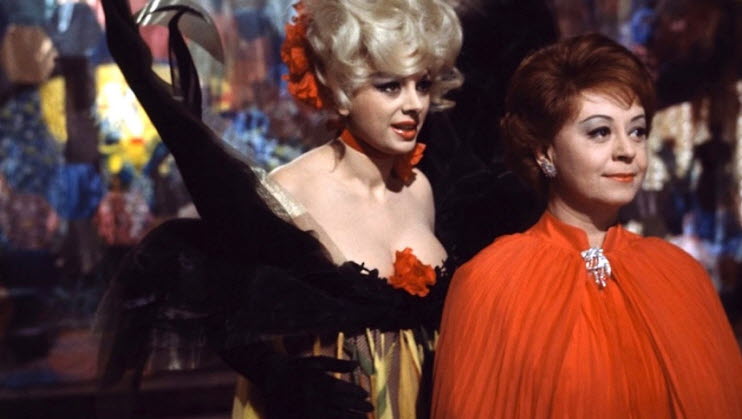
However, she still flinches from the possibility of freedom and desire. Later in the story, Giulietta visits the house of a flamboyant neighbor living next to her house, and then she is caught off guard by a series of odd moments pulsating with sexuality and pleasure. She surely feels tempted, but then she becomes as terrified as a model girl scout would be in the middle of red-light district.
In the end, everything around Giulietta culminates to another big surreal moment which leaves us with some ambiguity about her state of mind. Does she finally free herself via embracing whatever is still speaking to her from somewhere? Or, does she actually become quite delusional after coping so much with her personal issues? To be frank with you, I am not that sure even at present, but I can tell you that Giulietta Masina, who was Fellini’s wife for almost 50 years till his death in 1993 and was also quite unforgettable in her husband’s two early films “La Strada” (1954) and “Nights of Cabiria” (1957), gives another sublime performance as ably anchoring the whole film with her gently sensitive presence. Usually looking docile and passive on the surface, Masina subtly conveys to us her character’s inner turmoil without exaggerating it at all, and Fellini surely handles his wife’s work with lots of care and affection – especially when the movie depends a lot on her beautifully expressive face during its last 20 minutes.
In conclusion, “Juliet of the Spirits” feels like an acquired taste compared to Fellini’s relatively more accessible works such as “Amacord” (1973), but it will come to you as a rewarding cinematic experience if you give it a chance. I mostly admire it instead of enthusiastically loving it, but I think I will soon revisit it someday for more fascination and amusement.


 Seongyong's Private Place