
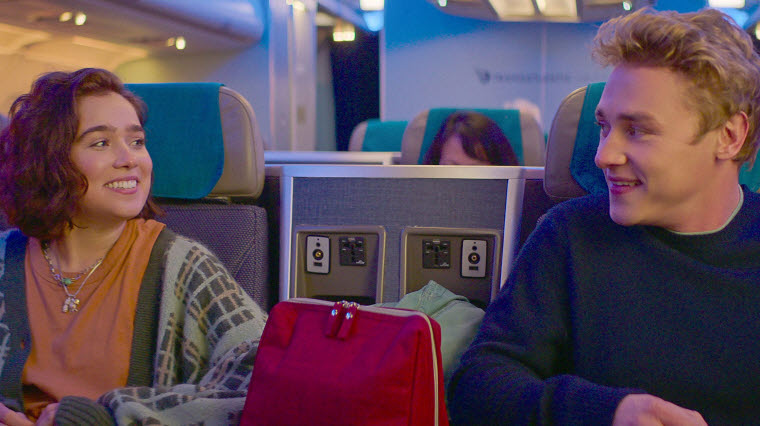
Netflix film “Love at First Sight”, which was released a few days ago, is a joyless experience which made my certain several flight experiences relatively less boring in comparison. Yes, it was sometimes hard for me to endure for more than 10 hours inside an airplane, but I would rather go through that experience again in exchange for not subjecting myself ever again to the 90-minute boredom of this utterly bland Netflix product.
For not boring any seasoned moviegoer like me at any chance, I will simply focus on many annoying genre clichés and conventions instead of merely describing the story and characters. Like many other countless romantic comedy films out there, the movie begins with the Meet Cute moment, and it surely emphasizes on how much its two main characters are different from each other in many aspects. While Hadley Sullivan (Haley Lu Richardson) is your average plucky American girl, Oliver Jones (Ben Hardy) is your typical reserved British lad, and they happen to encounter each other as they have to wait for the same airplane to London at the JFK international airport of New York City. At first, their encounter seems brief as they are going to sit separately in the airplane, but, what do you know, they soon find themselves sitting right next to each other due to a little problem with Oliver’s seat.
You can easily guess what follows next after this point, and even the movie directly confirms us via its snooty narration, which frequently points out how statistically improbable Hadley and Oliver’s encounter is in many aspects. As a matter of fact, Oliver happens to be a statistical mathematician who has been always concerned about risk probability due to his mother’s illness, but the movie does not make much laugh or amusement from this supposedly interesting character detail.
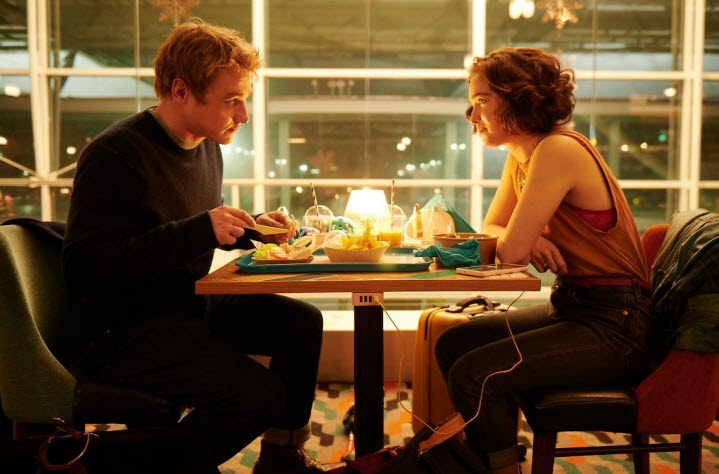
As Hadley and Oliver interact a bit with each other during the next several hours on the airplane, you might hope for something not so different from Richard Linklater’s “Before Sunset” (1995), but, alas, the screenplay by Katie Lovejoy, which is based on Jennifer E. Smith’s 2011 novel “The Statistical Probability of Love at First Sight”, simply meanders while not really knowing what to do with its two main characters except making them saying lots of trite stuffs to each other at times. No matter how much the movie emphasizes that they will eventually fall in love each other, we do not sense any development of romantic chemistry between them, and we are more frustrated to see that there is still one hour to go as the airplane subsequently arrives in London.
After Hadley and Oliver get separated from each other shortly their arrival in London for a rather contrived reason, the movie attempts to develop them more along the story, but both of Hadley and Oliver remain merely plain as before. Hadley has an emotional issue involved with her father’s recent divorce and following second marriage, but this conflict of hers is resolved too conveniently in the end. In case of Oliver, he has been struggling with an important personal matter involved with his dear mother, but the movie does not generate much gravitas while only ending up using this subplot as a sort of comic relief.
It is not much of a spoiler to tell you that Hedley and Oliver come across each other later in the story, but, again, the movie lets us down a lot. Yes, they certainly show more of themselves to each other during their little private moment, but, of course, their supposedly romantic situation is soon ruined by a familiar case of what my late friend/mentor Roger Ebert called “Idiot Plot”. If Hedely and Oliver were as sensible as many of us, they would simply apologize and accept at that point before moving onto the next step of their romance, but, no, the movie still needs more conflict between them, and they conveniently get separated from each other again.
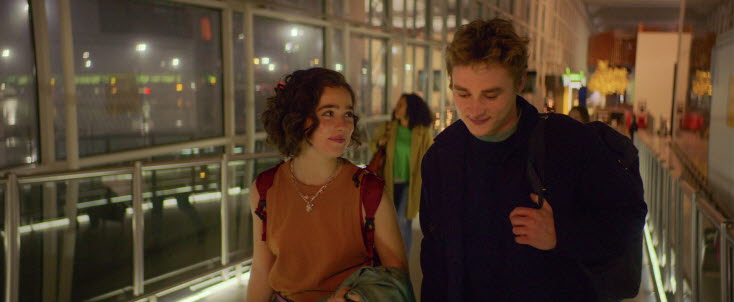
To more of our frustration and disappointment, the movie comes to depend more on plot contrivance during the last act, and this aspect is pretty evident from a curiously ubiquitous figure played by Jameela Jamil, who is also the narrator of the film. Her character often pops out here and there whenever Hedley or Oliver needs to be pushed more along the story, and the movie even resorts to making Jamil do some smug self-conscious gestures right in front of our eyes.
More and more dissatisfied with the overall result of the film, we become more conscious of how much its two lead performers struggle with their respective cardboard figures. As shown from “The Edge of Seventeen” (2016), Haley Lu Richardson can be quite funny and charming, but there is nothing much she can do here, and she and her co-star Ben Hardy simply occupy the screen together without generating any kind of romantic tension between them. As saddened by their futile efforts in the movie, I was reminded of how effortlessly Richardson clicked well with John Cho in Kogonada’s exceptional film “Columbus” (2017), and that certainly made me revisit that little overlooked gem more than before.
In conclusion, “Love at First Sight” is pointless and tedious in addition to not brining anything particularly new to its familiar genre territory, and I also did not like how it thoroughly wastes not only its two lead performers but also several substantial other main cast members including Rob Delaney, Dexter Fletcher, and Sally Phillips, who manage to acquit themselves fairly well despite their thankless supporting parts. In short, this is one of the more forgettable products from Netflix during recent years, and you will not miss anything especially if you have been tired of the growing homogeneity of romantic comedy films in these days.


 Seongyong's Private Place