

Ari Aster’s new film “Beau Is Afraid” often frustrated me even when I appreciated its artistic ambition to some degree. It is deliberately obtuse and baffling as its unstable (and unreliable) hero bounces from one kind of nightmarish setting to another, and it was rather difficult for me to hold onto its decidedly sprawling narrative and any kind of dream logic inside it.
Right from the beginning, we can clearly sense at least that the movie is stuck in its titular hero’s warped reality. It opens with the birth scene which feels as uncomfortable as the similar moment in Gaspar Noé’s “Enter the Void” (2009), and then we look at the latest therapy session between Beau (Joaquin Phoenix) and his psychiatrist. While the psychiatrist gently encourages Beau to tell more about how Beau feels about his mother, Beau is not so willing to tell anything as your typical neurotic mama’s boy, and the therapy session eventually ends with the psychiatrist prescribing a new kind of drug for Beau’s anxious mind.
However, Beau is not so relieved or relaxed at all, because his city is full of violence and dread here and there around him. As watching Beau constantly being menaced by many various bad things outside on streets, I wondered whether Aster actually tries to surpass all those seedy and violent aspects of the Gotham city in Todd Phillips’ “Joker” (2019), though the movie does not have any steep stair where Phoenix, who incidentally won an Oscar for that film, can dance.
Anyway, Beau’s mother issues become more intense when he happens to have a series of problems blocking him from visiting his mother’s residence outside the city. First, somebody in his apartment building makes lots of loud noises to his annoyance, and then someone else keeps sending a note accusing him of making those loud noises. Deprived of any good sleep, he comes to oversleep, so he hurriedly prepares himself for going to a local airport, but, what do you know, there comes another trouble which makes his circumstance worse.
While feeling all the more pressured after his apologetic phone conversation with his mother, Beau becomes more cornered by the outside world step by step. In the end, he finds himself locked out of his apartment while it happens to be filled with a bunch of very unpleasant people, and his newly prescribed drug does not help him much, with the grim possibility of side effects at one point.
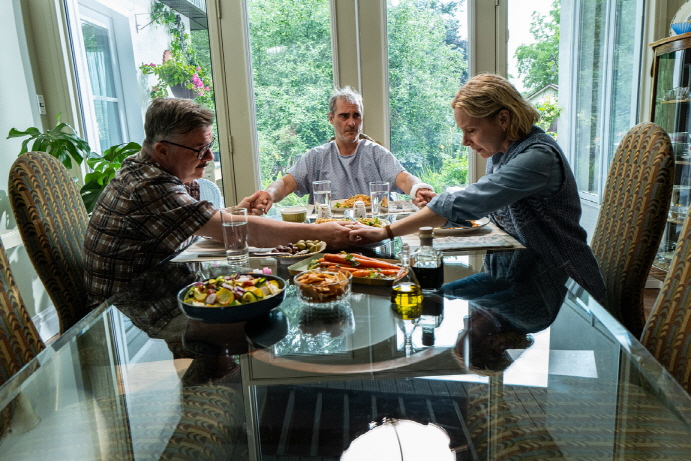
Not so surprisingly, Beau eventually reaches to a sort of mental breakdown after receiving a very bad news for him, but, alas, things do not get better for him even after that point. After subsequently getting knocked out due to an unfortunate accident, he wakes up to find himself under the care of a seemingly generous couple, and this couple looks quite willing to help his recovery as much as possible, but they somehow keep Beau from doing what he needs to right now: going to his mother’s residence.
And the circumstance surrounding Beau gets weirder scene by scene. Inside the couple’s house, there is an angry and sullen teenager daughter of theirs who is not so pleased by Beau’s presence, and there is also a very disturbed war veteran who was once a comrade of the couple’s dead son. Beau naturally gets out of this odd place as soon as possible, but his current physical condition does not allow that, and he becomes more and more baffled because of these very strange people around him.
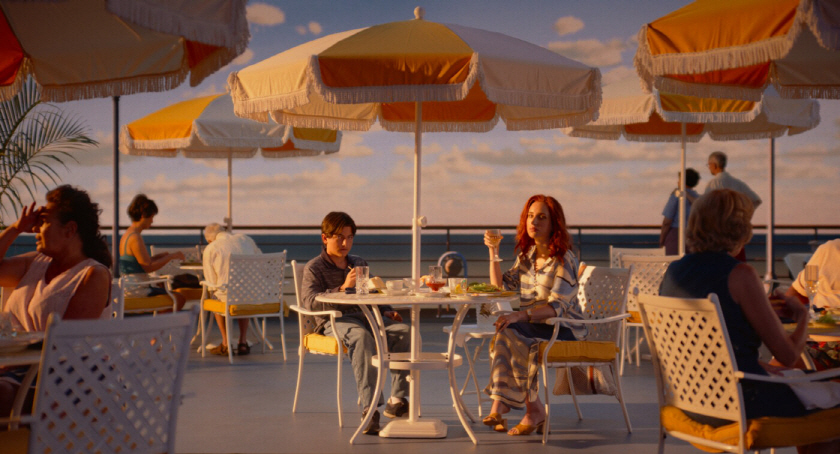
So far, I have only described what I observed from the first half of the film, which feels less confusing than the second half. I will not go into details here, but all I can tell you is that Beau’s state of mind becomes a lot more unstable than before, and we accordingly get a number of truly surreal moments including the sequence where his mind gets immersed in a sort of trance while watching an amateur theater performance in the middle of a remote forest. Although the mood and details are as artificial as your average Wes Anderson film, this sequence is almost hypnotic, and the result is nearly good enough for me to forgive more artistic self-indulgence during the rest of the film.
I admire what Aster and his crew members including cinematographer Pawel Pogorzelski try to achieve here, but Aster’s screenplay fails to establish enough emotional ground to hold our attention amidst all those baffling moments in the movie. Sure, it is clear that the movie wants to go all the way for exploring and indulging in good old mother complex, but the result is merely morbid and opaque on the whole, and we come to observe everything in the film from the distance without much care or attention.
The main cast members of the film try their best with their respective roles. While Joaquin Phoenix gives us another dark performance full of anxiety and disturbance, Nathan Lane and Amy Ryan have some fun with their increasingly grotesque characters, but they are rather under-utilized just like several notable performers including Patti LuPone, Kylie Rogers, Denis Ménochet, Richard Kind, Parker Posey, Hayley Squires, and Stephen McKinley Henderson.
In conclusion, “Beau Is Afraid” is two or three steps from Aster’s two previous films “Hereditary” (2018) and “Midsommar” (2019). Both of these two films are not something you can casually watch on Sunday afternoon, but they left considerable impression on me, and “Beau Is Afraid” lacks their sheer emotional intensity. As I said before, I do not mind being confused and baffled from the beginning to the end (I am a big fan of David Lynch’s “Mulholland Drive” (2001) and Charlie Kaufman’s “Synecdoche, New York” (2008), for instance), but, boy, its bloated artistic self-indulgence during no less than 3 hours is too much for me, and I do not think I will revisit it soon for any more possible understanding or appreciation.


 Seongyong's Private Place