
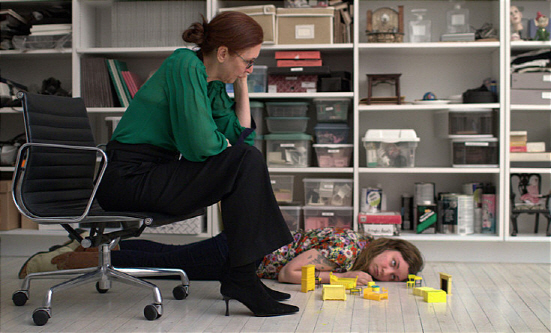
 Although it has the mood and feelings I can understand and appreciate, “Tiny Furniture” somehow kept losing my interest in spite of its admirable achievement on the screen. It virtually has no plot at all and I do not have any objection about its approach, but I constantly had the feeling of being stuck with very superficial persons I do not want to meet again, so I frequently felt bored by them despite its small good moments revealing the new emerging talent behind the camera.
Maybe, as the other reviewers said, I should accept its intended tediousness as the realistic presentation of the unbearable aimlessness of being graduated. Aura, played by the director/writer Lena Dunham, has just graduated from her university in Ohio, and she is coming back to her mother’s apartment in New York when we first meet her. She knows that she has to lead her life as a grown-up, but she has no particular plan about her future except that she does not want to do boring jobs for earning money. She says she will stay at the family home for a while because she has no money to start with, but she may be stuck there forever with her family.
The family home is a nice, clean, and comfortable apartment with modern style in lower Manhattan, but it is not easy for Aura to get along with her detached family. Her mother Siri(Laurie Simmons, Dunham’s real-life mother) is mostly occupied with her work unless she is distracted by her daughter. Aura’s younger sister Nadine(Dunham’s real-life sister Grace Dunham) is a typical case of flat, moody passive aggressiveness. While Aura was absent, Nadine has formed the close relationship with her mother, so Aura frequently feels alienated.
 Her ‘friends’ do not help Aura a lot. When she goes to the party held by one of her friends, Aura meets again her childhood friend Charlotte(Jemima Kirke). Charlotte is a funny but shallow girl who can amuse you for around 5 minutes at the party and then makes you desperately search for others to talk with in the room, but Aura starts to spend the time with Charlotte, probably because there is nothing else to do for her at present. Anyway, she gets a nice job in some fancy restaurant not far from her home. All she has to do is taking reservations before the restaurant is opened.
Meanwhile, two men come into her life, and neither of them can be considered as a good boyfriend. At the party, Aura comes across a guy named Jed(Alex Karpovsky), who has recently gained a short-term fame thank to his goofy YouTube clip called “The Nietzscherian Cowboy”. I have no idea about how such a superficial clip like that(he rides a mechanical horse while quoting Nietzsche with a toy gun) becomes so popular like that on the Internet, but I know anything can be regarded as funny or ‘creative’ on these days. Jed is a pretentious prick who hides his plain status behind his petty rationalized excuses; when he has no place to stay with no money, he deliberately makes Aura allow him into her family apartment, and then he continues to stay there until his presence is not tolerated by Aura’s mother anymore. Despite all of these caddish behaviors, he still behaves as if nothing serious happened.
In case of Keith(David Call), a chef working at the restaurant where Aura works, he is no better than Jed – or worse than him. Aura seems to like him, but she is stood up by him on their first date, and Keith currently has a girlfriend, which is his main excuse for not appearing on that date. You think her circumstance is messy, wait until you see how low it hits the bottom at some unlikely place for having sex during one lonely night. It is really depressing and pathetic to watch two people desperately trying to get what they both want with the absence of the passion in their miserable behavior.
 Though I lost my patience from time to time, I could admire how carefully Dunham made her first film. She makes good use of the places in the movie including her mother’s home, and the urban atmosphere of lower Manhattan is established well around her characters. It shows that the shots in the movie are thoughtfully composed, and the cinematographer Jody Lee Lipes, who briefly appears in the film, does a fine job with Canon EOS 7D HDSLR digital camera. Even though they had little artificial lightning during the production, the movie always looks clean and crisp while watching its characters with cool detachment, and you will be surprised that its production budget was around $50,000 only. This is a good example of the efficient filmmaking.
Though the characters in the movie are unlikable in various degrees, Dunham’s screenplay presents some of them as the understandable people through good dialogues and sharp humor. Though Aura is a self-absorbed lazy girl who keeps making unwise choices, I could see that she is also a nice girl painfully wandering with no direction while searching for love and happiness she wants. It is only a matter of the time until she gets wise up to recognize her reality and think about 1)what she actually can do and 2)what she really wants to do for her life, but when will it happen at last? I have to admit that it is quite frustrating to look at her wandering, probably because I went from the kindergarten straight to the graduate school without any serious stop. Maybe my turn will come when I finally get a doctoral degree and then I am demanded to start leading my life on my own.
 While giving a competent acting, Dunham also succeeds in pulling good realistic performances from most of her co-performers. You may wonder whether the interactions between Dunham and her family members in the film are based on the reality(like her character, Laurie Simmons is a well-known artist in real life), but I heard that Simmons is a lot warmer than her character. Although it is said that the movie is part-autobiographical, this is a work of fiction, after all.
Even with considerable degrees of appreciation, I still remain not so sure about whether I like “Tiny Furniture”. I understand what it is about and how it is about, but I feel distant to its subject and approach. It comes to my mind that the similar thing happened when I saw Michael Tolkin’s “The New Age”(1994) at 2010 Ebertfest. It was another well-made drama about the characters struggling and wandering in their shallow aimlessness, and, though it had some interesting aspects, I was not entertained sufficiently. As one of my friends said to me at that time, the reason might be that I was not particularly thrown to that movie as a non-American audience not so familiar with its subject, and I guess the same thing probably happened while I was watching “Tiny Furniture”. At least, you and I can agree with each other that Lena Dunham is a talent to watch, right?


 Seongyong's Private Place
A ship without destination or compass..that may apply to the film too..nicely nuanced essay..
SC: Thanks for your kind words.
I think Michael described it as a movie about “white people’s problems.” I enjoyed it more than the two of you, but you make valid points about the film.
SC: Michael and I will discuss about that later.