
Here We start with No. 5
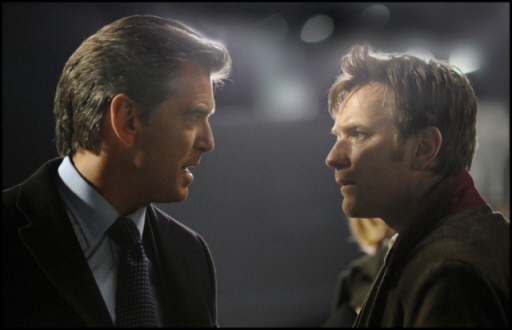
Ewan McGregor plays a man who is smart enough to know what he is going to deal with clearly. His job is a ghost writer, and his new assignment is fixing the problems of the memoir of a former British Prime Minister Adam Lang(Pierce Brosnan), who recently gets in trouble for the international crimes committed during his term. However, his new job more has several warning sign. His predecessor died in a very fishy situation. There is subtle tension between the people in the island beach house where Lange stays with his wife(Olivia William) and his assistant(Kim Kattrall). The memoir written by the predecessor can be easily fixed, but there is something wrong about Lang’s past. Our ghost writer is slowly drawn to the secret that may be hidden in the memoir. It is possible that Lang’s memoir will be the last book ever written by him, if he is not discreet.
This is the thriller of the class style that reminds me of both Hitchcock and those dry, ambiguous political thrillers in the 70’s. While it grips us with the quiet, eerie atmosphere of the beach house on the island, it has several humorous moments to make us relaxed for a while. And there is the feeling of some hidden insidious force behind the screen. The main question is answered as promised, but what about other minor questions, like that mysterious black car or suspicious death in the ominous opening sequence?
Polanski carefully builds the story and its suspense from the opening sequence without hurrying the story, adapted by Polanski and Robert Harris from Harris’ novel “The Ghost”. With the background mainly comprised of the beach house with gray modern interior and desolate winter beach scenery, the suspense is deftly mounted step by step with the quiet but firm direction. Alexandre Desplat’s score with repetitive rhythm is simultaneously alluring and warning. His music is one of the reasons making many spellbinding moments, especially when we see the certain note handed over and over until it reaches to a certain character. With these series of deliberate sequences, Polanski precisely hits the nail for the payoff with a great effect in the end. ”The Ghost Writer” is my first time to watch Polanski’s film in the theater, and I’m glad that he is still the master of claustrophobic/paranoid thriller.
 4. Black Swan
How hard do they try for the perfection on the stage? That must be quite a stressful experience for them. Ballet may look light and fragile, but I heard from my acquaintance about how difficult it is for them on the stage performance – and how more difficult it is for them while they prepare for them. Plus, like other kinds of stage performance groups, there are insecurity, rivalry, jealousy and many other feelings among members.
After the success with “The Wrestler”, Darren Aronofsky again focuses on the character who dedicates her body as well as her mind to a strenuous job, and he adds another knockout to his growing career. This time, the situation is more elegant and sophisticated. Nina, played by possibly Oscar-bound Natalie Portman, is a ballerina in New York City Ballet Company. She is joyous to know that she is chosen as the Swan Queen by the director Thomas(Vincent Cassel), but her joy is soon turned into the anxiety which is very, very dark. Is Lily(Mila Kunis), her fellow ballerina, a rival or a friend? Or, what thoughts does Thomas have in his mind for her? She becomes anxious, neurotic, paranoid, and possibly dangerous to others.
While observing the activities in the ballet company in Nina’s view with the natural style reminiscent of Altman’s “The Company”, the movie takes a realistically controlled attitude as required. And then some weird things start to happen before the eyes of Nina and us. Yes, we’re sure many things are not what they seem to be in her view, but what can be sure about the story?
Never mind. From being realistic under confident control, the movie slowly begins transformation, and it ultimately becomes overblown as demanded to the level of 11 with the tour-de-force finale that powerfully swept my mind. Like Nina, both Aronofsky and Portman do a great job of creating White Swan and Black Swan.
 3. Inception
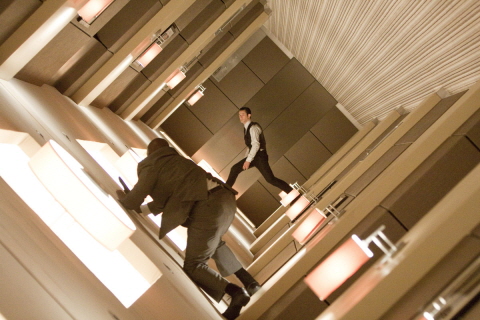
One simple idea that changed everything. The director Christopher Nolan had a simple idea and few rules accompanying it. And then he extends into the complex labyrinth of dream. Many surreal things can happen in Nolan’s dreamworld, but it has strict rules the movie adamantly sticks to no matter what happens, and they become main adversaries to the characters who try to plant some important thought on their target. With firm logics, Nolan creates one of the best action sequences of 2010. It is like looking a clock, small but meticulously made, working minute by minute, second by second, and….
Compared to the hype surrounding it, the movie is surprisingly a small one. It is a basically heist movie, and, after the test-run with his logics in the opening scene, Nolan introduces the various characters usually expected from this genre, including a young architecture named Ariadne. Through her as our guide, we do not just see the dreamworld. We also see the mind of the team’s leader Cobb(Leonardo DiCaprio), who is haunted by his dead wife. While we goes up and up along the layers of dreams, we goes down and down into his mind – to the bottom where the truth he does not want to face is waiting along with the memory of his wife.
Nolan’s dreamworld is not dreamy enough for some, but Nolan makes the most intelligent blockbuster of this year based on that dreamworld. Among the references of classics like “Solaris” or “Citizen Kane”, Nolan makes us to contemplate on the movie as the dream while depicting how broad and deep world the human mind can be. In the end, it jumps from the bottom to remind us that watching movie is like having a dream. And that is all; we do the rest of the job.
 2. A Prophet
My best movie of this year focuses on one fascinating mind who changes the society, and my next choice is about another fascinating mind is changed by the society. Specifically, it is about the formation of an identity through the years of education.
In the closed society, he was nearly an anonymous young man at first. Soon he begins to learn everything he needs to learn. Not only he learns how to read, he also learns lots of things including how to manage his business and how to be a responsible adult to others. When he gets out of that closed society, he is ready to be a respectable citizen – in the world of the criminals.
I forgot to tell you that Jacques Audiard’s long but electrifying movie is about a young man named Malik(Tahar Rahim) who gets incarcerated in the prison. In the world where our ethics cannot apply to, the survival is always important, and that drives Malik beyond the point where he can never go back to in that bloody scene. I still remembered some audience turned their heads from the screen when I watched the movie for the third time at the Music Box theater in Chicago. In this world, it is not easy to have a friend; the best thing about the inmate who is the closest to Malik is that he is dead.
We keep wondering about what he thinks and feels. Tahar Rahim’s performance reveals almost nothing about his character, but, with fascination, we continue to watch him growing day by day, under the tyrannical “tutorship” by Cesar played by fierce Niels Arestrup. In the end, we get a chilling feeling for knowing what Malik is capable of now. Too bad there is no graduation certification for this model student.

Amazingly, the director David Fincher and the screenwriter Aaron Sorkin make a fantastic drama from the subject seemingly not so interesting enough to make into a movie. As a matter of fact, I had been a little cynical about this movie when I watched its trailer in this summer. The story behind Facebook is indeed interesting, but is it possible to make an interesting drama about a famous website with a computer programmer as its hero?
The answer from Fincher and Sorkin is “Yes”, and my answer to whether it is the best movie of the year is also “Yes”. There are lots of things crammed into 2 hours, but, with these fast-talking dialogues reminiscent of screwball comedy, the movie jumps between the main story and two lawsuits with energetic agility. The director Fincher, who has never made a bad-looking movie, effectively leads us into the world inside the Harvard University, like he did with San Francisco in the 1970’s in “Zodiac”, his best work before this movie. Unlike his stylishly flash movies such as “Fight Club” in the past, the movie has a more controlled style serving for Sorkin’s terrific screenplay.
The irony about Zuckerberg(in the fiction, at least) is that he knows how the equations of human relationship can be transformed into the electronic version while never understanding how the variables work into the equations. That makes many people, including his “friend” Severin, very, very angry, but he still does not understand. Even when sandwiched between the lawsuits, he only cares about his work.
I don’t know how much the screenplay is based on the facts, but never mind. After all, Ben Mizrich’s book on which it is based is based on Eduardo Severin’s bitter view on Mark Zuckerberg, and it is well-known that the opening scene is entirely fiction. But the fiction itself is very enjoyable with the riveting drama between the main characters, which are played very well by the talented cast. As a distant but fascinating young mind who may just try to be an asshole, Jesse Eisenberg gives one of the best lead male performances, surrounded by equally good performances from Andrew Garfield and Justin Timberlake.
While concentrating on the conflictions between the characters, the movie leaves some interesting points to us. While watching their success and following ramifications, we also get the glimpse of how the world has been changed by them. The movie does not give any opinion about that for the progress is still going on. What will happen in the end? All I know is, it is far easier to befriend others. And it is also far easier to unfriend others. Maybe the future will be a lot more different than we can imagine; we will probably be able to make “The Social Network 2” with that. Hollywood loves to make sequels, you know.
 Seongyong's Private Place
Ah.
Here we go!
I’ve seen several of these movies!
Personally, I’d pick either “Winter’s Bone” or “Inception” as the year’s best film. “Winter’s Bone” is a masterpiece of low-budget, independent cinema. “Inception” represents the best of Hollywood and proves that with the right script and director, that old city can still work magic.
SC: Yes, indeed.