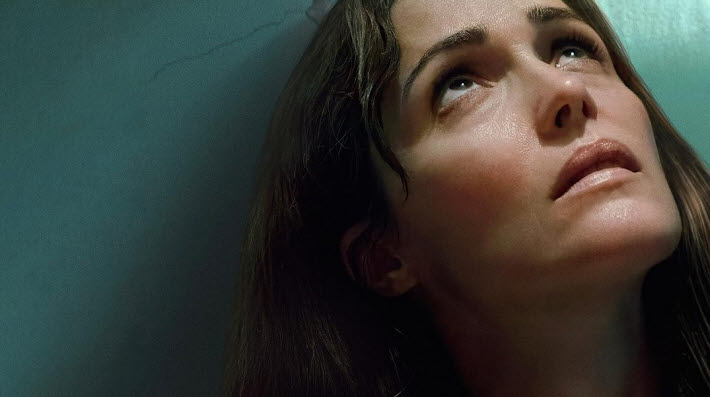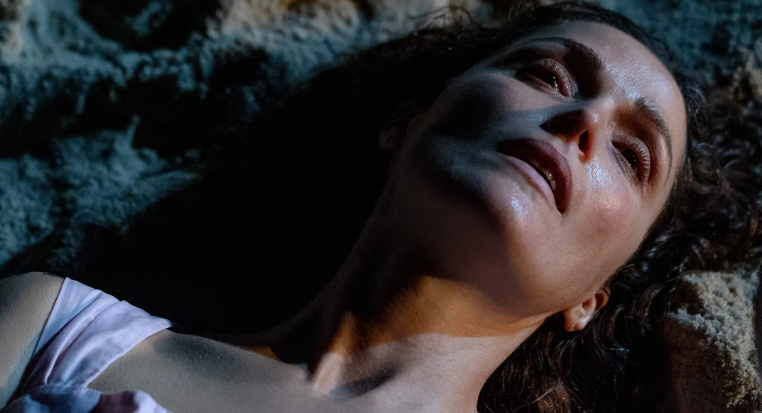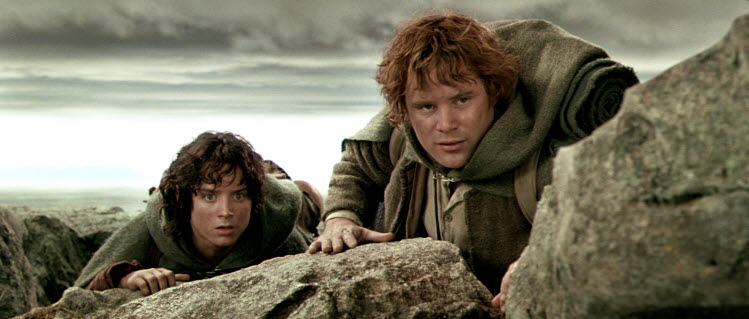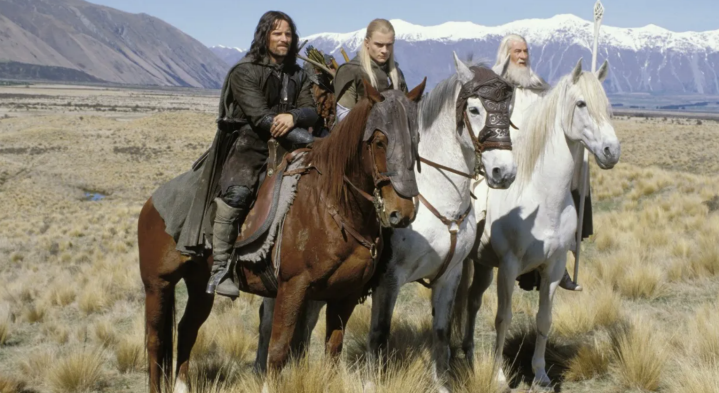
The Lord of the Rings: The Fellowship of the Ring (2001) ☆☆☆1/2(3.5/4): The beginning of an ambitious trilogy

Revisiting Peter Jackson’s 2001 film “The Lord of the Rings: The Fellowship of the Rings”, which was recently re-released in selected South Korean theaters, felt like a task to me at first. After all, more than 20 years have passed since it came out, there have been a lot of fantasy films after the enormous success of its trilogy besides the considerable advance of special effects. In fact, I was a bit afraid that the movie would look rather dated to me now.  
I am happy to report to you that the movie remains quite engaging and exciting as before. Although it inherently feels incomplete as the opening chapter of its trilogy, the movie immerses us into its memorable fantasy world full of mood and details to be appreciated in addition to providing a lot of spectacular action to behold. Above all, it also makes us care about several main characters at the center of the story.

One of them is Frodo Baggins (Elijah Wood), a young hobbit living in a small country area called Shire. As many of you know, hobbits, which are often called “halflings” for their small appearance, are one of the tribes in the Middle Earth, and the early part of the movie pays some attention to their folksy country life in Shire as everyone has been quite excited about the 111th birthday part of Frodo’s uncle Bilbo (Ian Holm).

It turns out that Bilbo has a secret plan behind his back. He is going to leave behind almost everything around the end of his birthday party, and his old wizard friend Gandalf the Grey (Ian McKellen) makes sure that Bilbo really leaves one particular thing to Frodo. On the surface, it looks like a simple magic ring which can make its wearer invisible, but, as Gandalf eventually confirms to Frodo later, the ring turns out to be a very powerful object once belonging to a certain evil figure in Mordor. Although he was supposed to be vanquished many years ago, this evil figure has been on the rise again, and he is certainly looking for that ring for regaining his absolute power over the Middle Earth.

 After coming to learn more about the ring from Gandalf, Frodo accepts a potentially dangerous task. While Gandalf is absent for a while, he must take the ring to a region belonging one of the leaders of the elves in the Middle Earth, and he is subsequently joined by three young fellow hobbits: Samwise Gamgee (Sean Astin, Peregrin Took (Billy Boyd), and Meriadoc Brandybuck (Dominic Monaghan).

While these four hobbits go through a series of dangerous moments along the story, the movie delves more into the Middle Earth, and cinematographer Andrew Lesnie, who won an Oscar for this movie (The movie also won the awards for Best Score, Best Special Effects, and Best Makeup in addition to being nominated for several other categories including Best Director and Best Picture, by the way), did a splendid job of filling the screen with more awe and wonder. Besides effectively utilizing the vast landscapes of the various wild locations in New Zealand, Jackson and his crew vividly present the fantasy world based on the rich imagination of J.R.R. Tolkien, and the result still looks awesome at times on big screen. While the sequence unfolded in a town belonging to the men in the Middle Earth is drenched in a sense of danger and anxiety along with some muddy qualities, the scenes involved with the world of the elves look as gracefully ethereal as required, and the part unfolded inside one huge cavernous space will often overwhelm you with its darkly epic scope. 

After more than 20 years, some of the special effects in the film surely look a bit dated at present, but its technical aspects remain admirable as they were at that time. Jackson and his crew skillfully mix digital and practical special effects throughout the movie, and their main performers look and feel fairly convincing even though they are surrounded by a lot of digital special effects on the screen – particularly when Frodo and his several companions confront a mighty demonic entity living inside that huge cavernous space.

In the meantime, the screenplay by Jackson and his co-writers Fran Walsh Philippa Boyens, which flexibly adapted Tolkien’s novel, stays focused on the drama of its main characters. Although most of them are more or less than archetypes, they are imbued with each own personality at least, and the main cast members of the movie ably embody their respective roles. While Elijah Wood, Sean Astin, Billy Boyd, and Dominic Monaghan are solid as the four different hobbits at the center of the story, Ian McKellen has a lot of fun with his wizard character, and he deservedly received an Oscar nomination for that. In case of several other main cast members, Viggo Mortensen, John Rhys-Davies, Orlando Bloom, Hugo Weaving, Liv Tyler, Ian Holm, Sean Bean, and Christopher Lee fill their respective spots with each own presence, and Cate Blanchett is particularly good during her brief but mesmerizing appearance later in the story.

In conclusion, “The Lord of the Rings: The Fellowship of the Rings” holds fairly well its own place well in the movie history even at this point. Along with “Harry Potter and the Philosopher’s Stone” (2001), it opened the door for more fantasy movies to come during next 24 years, and its milestone status remains same as before without being surpassed at all. Although it looks relatively less awesome to me and others now due to the passage of time, I admire it a lot despite that, and I am willing to follow its epic journey again.

Posted in Movies | Tagged , | Leave a comment

Being Eddie (2025) ☆☆1/2(2.5/4): Safely being Murphy

Netflix documentary film “Being Eddie”, which was released on last Wednesday, will not impress you that much, especially if you are familiar with all those safe celebrity documentaries during last several years. Although its titular figure seems quite ready to present a lot of himself in front of the camera, the documentary only mildly mentions and then praises his career achievements from the beginning to the end, and it eventually becomes another passable documentary product from Netflix.

The main human subject of the documentary is none other than Eddie Murphy, a legendary black American comedian who swiftly rose to his immense fame in the early 1980s. Despite being over 60 at present, he still looks like a mischievous but spirited kid to observe, and you can clearly see that he has not lost any of his star quality yet even though he is going through the later chapters of his life and career at present. 

 At first, he frankly talks about how he grew up and then came to have big ambition for his life and career. Even before he became 18, he was quite determined to become very famous and popular someday, and he was fortunate enough to get an unlikely opportunity for that. Not long after he started his stand-up comedian career in New York City in the early 1980s, he got selected as a new cast member of “Saturday Night Live”, and, what do you know, everyone came to pay more attention to him after his first season.

When he subsequently appeared along with Nick Nolte in “48 Hrs.” (1982), he wonderfully nailed down every juicy comic moment allowed to him. As many of you remember well, Murphy was quite funny and charismatic in one particular scene set in a bar full of white people, and that was pretty much like the big announcement of a new big talent to watch.

After the commercial success of “48 Hrs.”, Murphy appeared in a number of equally successful films to boost his movie acting career further. Although “Trading Places” (1983) was intended for Gene Wilder and Richard Pryor at first, Murphy eventually took the role due to a little unfortunate drug accident upon Pryor, and his another good comic performance solidified his movie star status in Hollywood. In the very next year, he appeared in “Beverly Hills Cop” (1984), and its considerable box office success confirmed again that he was indeed the next black American star on the rise.

As he frankly admitted in front of the camera, Murphy was certainly excited and dazzled by his enormous career success, but the documentary does not go that deep into whatever he went through during that peak period of his career and life. According to him, he has seldom tried on drug or alcohol unlike many of his contemporary comedians, and he reminiscences a bit about when he refused to try a bit of cocaine along with two certain famous comedians.

 In the meantime, Murphy tried to keep focusing on his stand-up comedy as before. However, despite the expected huge success from his stand-up comedy performances, he soon found himself less inclined toward stand-up comedy around the late 1980s just because he ran out of materials to write and then perform, and he does not feel any regret about that.

In my humble opinion, he feels some real regret on a series of disastrous films such as “Harlem Nights” (1989), which was incidentally also directed by him. He talks a bit about how it was fun to work along with Pryor and several other legendary black American comedians, but he and the documentary do not go into details here on how spectacularly that movie failed (The movie garnered his first Raspberry Award, by the way). As a matter of fact, he seems more ashamed of “Vampire in Brooklyn” (1995), where he played its vampire hero who is going to bite the neck of his co-star Angela Bassett.

After that low point, Murphy bounced back via several successful family comedy films such “The Nutty Professor” (1996) and “Dr. Dolittle” (1997), and he also gave wonderful voice performances in acclaimed animations films such as “Mulan” (1998) and “Shreck” (2001). When he eventually demonstrated more of his acting skill in “Dreamgirls” (2006), there was a lot of talk about his possibility of winning a Best Supporting Actor Oscar, but then his very next film “Norbit” (2007), which was incidentally regarded as one of the worst comedy movies ever in his career. That infamous turkey ruined his Oscar campaign to some degree, and he certainly looked quite disappointed when his name was not called out at the Academy Awards ceremony. 

Nevertheless, Murphy kept going as usual while having some ups and downs in his career as usual. Around the end of the 2010s, he surprised us with another splendid performance “Dolemite Is My Name” (2019), and then he made a successful guest appearance in “Saturday Night Live”, which earned him an Emmy award later. Later in the documentary, we see the archival footage clips showing Murphy enthusiastically preparing along with the cast and crew members of “Saturday Night Live”, and he is certainly happy to be joined by several notable junior black American comedians who have certainly revered him for years.

On the whole, “Being Eddie”, directed by Angus Hall, gives us a fairly jolly time along with Murphy, but, despite having many notable interviewees besides Murphy, it still feels merely mild and superficial without presenting anything particularly new about him. He is surely one of the most important and interesting American comedians at present, but he simply entertains us a bit without revealing any truly reveling stuff to interest us, and, folks, that is all as far as I can see.

Posted in Movies | Tagged , , , | Leave a comment

In Your Dreams (2025) ☆☆☆(3/4): Their little dreamy adventure

Netflix animation feature film “In Your Dreams”, which was released on last Friday, overcomes its conventional aspect via its sincere handling of story and characters. Although the overall result is still not exactly fresh, the story is fairly entertaining in addition to giving some important life lessons to its target audiences, and I appreciated that even though it does not exceed my expectation.

At the beginning, the story establishes how things have been problematic for an adolescent girl named Stevie (voiced by Jolie Hoang-Rappaport). Besides not getting along with that well with her younger brother Elliot (voiced by Elisa Janssen), she has been quite concerned about the growing strain between her parents, who once loved each other a lot but have been rather estranged from each other during last several years. While the father still tries to pursue his musician career, the mother has worked as a teacher for supporting her family, and now she considers moving to a city for a better job.

On one day, Stevie and Elliot come across an old mysterious book when they are looking for anything suitable for his book report. The book is about a mysterious entity called the “Sandman”, and it says that this entity in question will make any dream come true. While Stevie does not believe the content of the book at all, she and Elliot happen to read an incantation in the book together, and, what do you know, they later find themselves having the same dream in which they have a bit of adventure along with Elliot’s animated bed.

Once she discerns what is happening to them, Stevie becomes quite determined to meet and then make a wish to the Sandman, but, of course, there is a huge obstacle to overcome. Whenever they try to reach to where the Sandman lives, they are always blocked by a powerful entity representing nightmares, which always makes them wake up in one way or another.

As Stevie tries to find any possible way to pass through this supposedly invincible opponent, the movie also pays some attention to what is happening in her and her younger brother’s daily life. When their mother subsequently goes to that city for her job interview, Stevie becomes more concerned about whatever may happen next, even though her father keeps trying to maintain the status quo for her and Elliot. There is a brief but poignant moment when her father clumsily attempts to explain to her on the ongoing conflict between him and his wife, and that only makes her all the more anxious.

In the meantime, Stevie finds unexpected support from her younger brother. Once they come to see that their connection in their shared dream is more important than expected, they come to stick together for their common goal, and we are also amused a bit from time to time by a number of humorous moments from Elliot’s little lost doll.

Around the narrative point where Stevie and Elliot finally meet the Sandman, they surely come to learn that making a wish can be quite tricky to say the least. You will not be surprised that much if you are familiar with all those fairy stories about making a wish, but the film handles this conventional part with enough humor and style at least.

The screenplay by director/co-writer Alex Woo, who worked in a number of notable Pixar animation films such as “Ratatouille” (2007) and “Wall-E” (2008) before making a feature debut here, and Erick Benson did a fairly competent job of building the emotional drama between its two different lead characters. While she has been frequently annoyed by her younger brother, Stevie comes to accept that Elliot has indeed been a crucial part of her imperfect but precious family life, and it is touching to see how she comes to reconnect with him later in the story. In case of their parents, their little personal moments along the story are handled with thoughtful sensitivity, and that is one of the main reasons why the expected dramatic climax works.

The voice performers are solid in their respective roles. While Jolie Hoang-Rappaport and Elias Janssen effectively complement each other, Simu Liu and Christin Milioti generate some gravitas around the fringe of the story as Stevie and Elliot’s parents. Several other voice cast members including Omid Dialili, Gia Carides, SungWon Cho, and Craig Robinson are also well-cast in their substantial supporting parts, and Robinson effortlessly steals the show as Elliot’s little lost doll during several key dream scenes.

In conclusion, “In Your Dreams” is recommendable for its competent animation style and engaging storytelling, but I must tell you that it would look like a relatively subpar product if this year were not another particularly weak year for animation films. While there have been several hugely successful animation films such as “KPop Demon Hunters” (2025) and “Demon Slayer: Kimetsu No Yaiba Infinity Castle” (2025), they did not make me that enthusiastic compared to a number of recent better animation films such as “Spider-Man: Across the Spider-Verse” (2023), “Robot Dreams” (2023), and “Flow” (2024), and even Pixar Animation Studios becomes rather underwhelming as recently shown from “Elio” (2025). Although I recommend “In Your Dreams” because I was entertained enough during my viewing, I also have to remind you that there are many better choices out there, and I think you will be more entertained by any of those animation films mentioned above.

Posted in Movies | Tagged , , , | 1 Comment

Ballard of a Small Player (2025) ☆☆(2/4): Farrell sweats a lot here…

Edward Berger’s latest film “Ballard of a Small Player”, which was released on Netflix a few weeks ago, is one of the most well-made bad films of this year. While there are several top-notch technical aspects to admire to some degree, the movie itself is quite flat and insipid in terms of story and characters, and it is also really depressing to observe how the movie wastes the diligent efforts of its undeniably talented lead performer.

The story follows the plight of Brendan Reilly (Colin Farrell), an Irish gambler who has presented himself as a high-roller named “Lord Doyle” around those expensive casinos and hotels in Macau, China. He has recently been stuck in a very problematic financial situation due to his ongoing streak of bad luck, and now he is even on the verge of getting kicked out of his current staying place as he has failed to pay those amounting bills for a while.

Nevertheless, Reilly still tries to believe that things will get much better for him once he gets a chance for reversing his current status of luck, and the early part of the film shows his several pathetic attempts around those local casinos. Not so surprisingly, he only finds himself tumbling to a much worse financial status, and then he is notified that he must pay back a considerable amount of money he stole before running away to Asia.  

Meanwhile, Reilly encounters a local female credit broker named Dao-Ming (Fala Chen), who initially seems interested in making a deal with him but then comes to have some second thought on that. Not long after one shocking incident which devastates her a lot, Reilly comes to have a little private time with her outside the city, and, as believing that she has run out of her own luck, she sincerely advises him that he should quit gambling before it is too late for him.

Of course, Reilly only ends up tumbling more along the downward spiral of his gambling addiction and then getting cornered in more than one way. Later in the story, it looks like he is finally reaching to the bottom of his pathetic human condition, but then there comes an unexpected help, and that leads him to some relaxed time for self-reflection.

As its hero goes down and down, the movie drenches itself into the night life around the casinos and hotels of Macau, and cinematographer James Friends, who won an Oscar for Berger’s previous film “All Quiet on the Western Front” (2022), did a splendid job of filling the screen with a lot of nocturnal lights and shadows. As a result, Macau in the film sometimes looks like a colorfully seductive but dangerous zone which always beckons our pitiful hero to try his luck more and more, and the overblown score by Volker Bertelmann, who also won an Oscar for “All Quiet on the Western Front”, often makes a blatant point on that.

And Colin Farell, who has now been matured into one of the most dependable movie actors of our time, is fairly effective in his character’s gradual implosion along the story. While his frequent sweaty appearance may feel like an overkill at times, Farell brings some emotional intensity to the screen, and his diligent efforts compensate for the clichéd aspects of the story from time to time. 

However, the screenplay by Rowan Joffé (He is the son of Roland Joffé, by the way), which is based on Lawrence Osborne’s 2014 novel “The Ballard of a Small Player” (Osborne also incidentally participated in the production of the film as one of its executive producers), often fails to flesh out its hero and several other crucial characters in the story. Monotonously rolling its hero from one expected narrative point to another, Joffé’s screenplay does not bring much human depth or quality to its hero, and we come to observe his plight from the distance without much care or attention. Yes, there eventually comes a point where he tries his luck a lot more than before, but we remain distant to whatever is being at stake for him, and that is the main reason why a certain plot turn around the end of the story does not have much dramatic impact for us.

Furthermore, those several substantial supporting characters are too broad or bland on the whole, and the movie seriously wastes its supporting performers as much as Farrell. While she brings a bit of warmth to the film, Fala Chen is unfortunately limited by her thin supporting role, and she and Farell sadly do not generate enough chemistry to overcome the predictable relationship development between their characters. While Tilda Swinton does not have much to do except having a little fun with Farrell during the end credits, Deanie Ip and Alex Jennings are simply fill their small respective spots as required, and Anthony Wong, whom you may remember for his memorable supporting turn in “Internal Affairs” (2002), made a brief but impressive appearance later in the film.

In conclusion, “Ballard of a Small Player” is quite dissatisfying for many bad reasons, and it is surely two or three steps down from Berger’s recent Oscar-winning film “Conclave” (2024), which I incidentally liked much more than “All Quiet on the Western Front”. He and his crew and cast members cerainly took a big chance here just like the hero of the movie, but their efforts unfortunately result in a rather boring mess, and, considering their undeniable skill and talent, I am sure that they will soon move onto something better than this thoroughly forgettable dud.

Posted in Movies | Tagged , , , | Leave a comment

Come See Me in the Good Light (2025) ☆☆☆1/2(3.5/4): After a terminal diagnosis

Documentary film “Come See Me in the Good Light”, which was released on Apple TV+ a few days ago, is about one loving couple coping with the impending end of their long relationship due to a terminal illness. As following how they actively try to live together as long as possible during several years, the documentary often touches us with a number of sincere and intimate moments observed from this interesting couple, and it surely earns some tears in the end as handling their powerful love story with a lot of care and respect. 

The couple in question are poet/activist Andrea Gibson and their spouse Megan Falley, and the documentary opens with this couple working a bit on Gibson’s latest poem. As a fellow poet of theirs who is also her spouse’s editor, Falley often functions as the whetstone for Gibson’s creative process, and we are amused a bit as watching how they pull and push each other over some little details on Gibson’s latest work. As Gibson admits later, Falley is usually right in her objective assessment on her spouse’s works, and Gibson respects that even though they cannot help but feel hurt in their ego at times.

Anyway, the documentary soon goes straight into that big problem in Gibson and Falley’s daily life. In 2021, Gibson was diagnosed with malignant ovarian cancer, and they subsequently went through one surgery and two periods of chemotherapy during next several years. Alas, their cancer returned not long after that, and it is already metastasized around many parts of their body. In other words, they came to have only a few years to live even under the best condition, and that was certainly a devastating news for not only them and Falley but also many of their close friends and colleagues.

Nevertheless, Gibson and their spouse decided to try more for extending Gibson’s remaining life as long as possible. Besides paying more attention to the physical condition of their body, Gibson also tried one new therapy after another, and Falley, who was almost close to leaving Gibson for some other personal issue between them before Gibson’s terminal illness, was ready to stand by her spouse to the end. Knowing well that they did not have much time between them, Gibson and Falley came to spend more time together in their little residence in Colorado, and there is a genuinely joyful scene where they come to have a little fun dinner talk with an invited friend of theirs. 

Both Falley and Gibson are quite frank about themselves in front of the camera, and they certainly talk a lot about their respective pasts. Although they did not know much about sexual minority people during their childhood and adolescent period, Gibson became more aware that they were different from many other girls around them, and then they became interested in poetry. Although they did not know much about poetry at first, they were eventually drawn to slam poetry, and the following creative activities of theirs helped them a lot in becoming more certain and confident about their sexual identity.

As Gibson became quite prominent as an artist of slam poetry during next several years, they got romantically involved with one person after another, and then there came Falley. As they spent more time together as fellow poets, Gibson found themselves more attracted to Falley, and Falley was rather surprised mainly because she was not so confident about her body. Thanks to her following romance with Gibson, she came to have much more self-esteem than before, and she and Gibson eventually came to live together.

While often conscious of the camera observing them, Gibson and Falley do not hesitate to show more of their personal feelings and thoughts on how their relationship can be ended at any point. Whenever they are about to check the latest medical examination result on Gibson’s body, both Gibson and Falley cannot help but become quite nervous, but that makes them appreciate more of another day to live together for them. They are certainly willing to try anything for more time for them, but then they confront a serious dilemma because the latest therapy for Gibson may seriously affect their ability to speak, and both they and their spouse become conflicted about whether they can actually take this considerable risk or not. 

As going up and down along with Falley and Gibson over its free-flowing narrative, the documentary effortlessly alternates between humor and sadness, and everything in the narrative eventually culminates to when Gibson tries what turns out to be the last slam poetry performance in their life (They sadly died several months after the documentary was premiered at the Sundance Film Festival early in this year, by the way). Although their body is becoming more fragile day by day, Gibson try their best nonetheless, and we see how much their presentation of their several works moves their audiences as well as Falley.        

Overall, “Come See Me in the Good Light”, which deservedly received the Festival Favorite Award at the Sundance Film Festival, is one of the better documentaries of this year, and director/co-producer Ryan White, who previously made a number of acclaimed documentaries including “Ask Dr. Ruth” (2019) and “Good Night Oppy” (2022), did a commendable job of bringing a lot of intimacy and sensitivity to his documentary. In my inconsequential opinion, this is one of the best documentaries of this year, and I sincerely recommend you to check it out as soon as possible.

Posted in Movies | Tagged , , , , , | 1 Comment

The Desert of the Tartars (1976) ☆☆☆(3/4): Waiting for the barbarians

Valerio Zurlini’s 1976 film “The Desert of the Tartars”, which happens to be released in selected arthouse movie theaters in South Korea in this week, is interesting for its odd mix of bleak beauty and dark absurdity. While dryly and slowly illustrating its hero’s increasingly absurd plight, the movie doles out a series of awesome moments of stark beauty unfolded across the screen, and we are often mesmerized by its striking visual qualities, even while observing its hero’s plight from the distance.

The story begins with the seemingly promising status of Lieutenant Drogo (Jacques Perrin), a young officer who is about to take the first step of his military career. He has recently been assigned to an old fortress located in the middle of some remote border area of his country, and we soon see him leaving his hometown after saying goodbye to a close friend of his.

However, things do not look that optimistic to him as he enters that border area in question. When he eventually arrives in the fortress, he is welcomed by the commander of the fortress and several other officers, and then he befriends some of these officers, but it does not take much time for him to see that many of these officers have been stuck there for a long time without much hope or prospect. While they are supposed to be constantly ready for the possible attack from those barbaric Tartar folks beyond the border, there has not been any attack for years, so there is not much possibility for transfer or promotion for the officers in the fortress.

The movie phlegmatically observes how the officers of the fortress have coped with their frustrating state. While the commander simply occupies himself with maintaining the status quo of the fortress, some officers merely wait for any possible way out, and others including Major Matis (Giuliano Gemma) and Captain Ortiz (Max von Sydow) adamantly stick to their codes and rules. At one point, Major Matis coldly orders the killing of an unfortunate soldier who cannot give a password before going inside the fortress, and he is not so pleased at all when the comrades of that dead soldier do a defiant act of protest together.

While he tries his best for finding any possible way out, Lieutenant Drogo only ends up being mired in ennui and despair just like many other officers and soldiers around him. With some generous help from Surgeon Major Rovine (Jean-Louis Trintignant), he gets a chance for transfer later in the story, but then his precious chance is dashed in one way or another, and this makes him all the more despaired and frustrated than before.

Meanwhile, he and the other officers in the fortress notice a series of disturbing signs from the distance. While the commander and many of his officers are not particularly alarmed as casually going through their another uneventful day, Lieutenant Drogo becomes gradually obsessed about one particular sign which may be the prelude for a major attack, but nobody pays much attention to him as the fortress remains in stalemate as usual.

The movie, which was mostly filmed in Arg-e Bam, Iran, frequently looks around the bleakly vast landscapes surrounding the fortress. Cinematographer Luciano Tovoli did a splendid job of filling the screen with a haunting sense of existential emptiness, which is further accentuated by the terse but effective score by Ennio Morricone. While occasionally providing some lyrical touches, Morricone’s score remains as detached as the movie itself, and we become all the more distant to the story and characters as a result.

Nevertheless, we also somehow remain engaged as often amused by the sheer absurdity surrounding Lieutenant Drogo and several other main characters. When one of the officers finally gets an opportunity to leave the fortress, it turns out that he does not know what to do next after spending so many years in the fortress, and we are not so surprised by what eventually occurs next. Around the end of the story, there comes a real good chance for its hero at last, but then the movie throws a morbid irony upon him to our little dark amusement.

As watching the film, I could not help but think of J.M. Coetzee’s 1980 novel “Waiting for the Barbarians”, which is also about a hero trapped by utter absurdity in a remote border region and was incidentally inspired by Greek poet Constantine P. Cavafy’s 1898 poem “Waiting for the Barbarians”. The movie is based on Dino Buzzati’s 1940 novel “The Tartar Steppe”, and I was not so surprised to learn later that Buzzati’s novel was also inspired by Cavafy’s poem. Because I have not read Buzzati’s novel yet, I cannot tell you about how much his novel is actually overlapped with Coetzee’s novel in terms of idea and theme, but I can tell you instead that the mood and texture of the movie is not so far from what I felt as reading Coetzee’s novel a few years ago. 

 In conclusion, “The Desert of the Tartars”, which was Zurlini’s last film before his death in 1982, may require some patience from you mainly due to its dryly slow storytelling, but it is still a rewarding cinematic experience on the whole. To be frank with you, I did not know anything about the movie or its director at all, so I am glad to get a chance to watch this fascinating work at a local arthouse movie theater today, and now I am willing to explore more of Zurlini’s rather obscure filmmaking career.

Posted in Movies | Tagged , , | Leave a comment

Sprout (2013) ☆☆☆1/2(3.5/4): A little early work by Yoon Ga-eun

Yoon Ga-eun’s 2013 short film “Sprout”, which happens to be released in selected theaters in South Korean on this Wednesday, is still remarkable in many aspects. This simple but precious piece of work shows that Yoon was already quite a talented filmmaker even before drawing our attention with her excellent first feature film “The World of Us” (2016), and I was impressed again by how deftly she handles the story and characters for generating a considerable amount of emotional impact within less than 20 minutes.

The story mainly revolves around the viewpoint of a little young girl named Bo-ri (Kim Su-an), and the opening scene shows her watching her adult family members including her mother busily preparing for the ancestral offering ceremony for Bo-ri’s deceased Grandfather in the house belonging to one of the adult family members. When it turns out that they forgot to buy bean sprouts, they consider having Bo-ri go outside for buying bean sprouts from a nearby market, but then they decide not to do that because Bo-ri seems too young for the task.

Nevertheless, Bo-ri soon becomes quite serious about buying bean sprouts. She quickly gathers some pocket money, and then she goes outside the house while nobody is looking. Not so surprisingly, she soon finds herself getting lost in the surrounding area, and then she comes to have a series of small and big happenings as wandering from one spot to another.

While watching her rather aimless wandering, we naturally become concerned about this little young girl’s safety, but the overall mood of the film is sweet and tender with a lightweight sense of humor. When she comes across a dog at one point, Bo-ri is understandably afraid of that dog even though it does not look that threatening, and this reminds me of how I was sometimes afraid of dogs when I was very young. I instantly empathized with her little fear again, and I was amused by when she managed to find a way to pass by that dog.

In the middle of the story, Bo-ri gets involved with a bunch of kids around her age, and that is when the story becomes more cheerful. As hanging around with these kids more and more, Bo-ri comes to forget her task for a while, and the film vividly conveys to us her joy and excitement before something happens to make her cry a lot.     

Another funny moment comes from her accidental encounter with several middle-aged people having a little afternoon drinking time together. Not long after she has some drink by mistake, Bo-ri willingly entertains herself as well as them, and I was reminded of what my parents still remember well. When I was just a little toddler in the early 1980s, one of my uncles gave me a bit of drink just for a little amusement in the middle of a family meeting, and, according to my parents, everyone enjoyed my little drunken dancing even though my drinking was not so wholesome to say the least.

During its second half, the movie becomes a bit more serious when Bo-ri follows after one old man after noticing something from him. She eventually goes to his house, and the old man shows her some generosity even though he is a total stranger to her. Just like many other small moments in the film, this looks merely accidental, but then there comes an unexpected moment during the very last scene. The movie does not wisely explain too much as simply sticking to its heroine’s viewpoint as usual, and her little but eventful quest along the story comes to feel all the meaningful than before. 

Everything in the movie depends a lot on the direct and unpretentious acting of its young lead actress. While she is now an adult actress who has appeared in a number of notable South Korean films, Kim Su-an has never surpassed what she achieved so well under Yoon’s skillful direction here in this film, and her terrific acting reminds us again of how deft Yoon has been in case of handling child performers. Like Abbas Kiarostami or Hirokazu Kore-eda, she really knows how to draw natural performances from her young performers, and her latest film “The World of Love” (2025) shows that to us again via several key scenes involved with the little younger brother of its young heroine. 

 In conclusion, “Sprout” remains as an important early point in Yoon’s career, which has steadily advanced since “The World of Us”. When I watched it in 2016, I chose “The World of Us” as the best film of that year without any hesitation, and I was certainly delighted when Yoon impressed me and others more with “The House of Us” (2019), which was one of many wonderful works from South Korean cinema in that year besides, yes, Bong Joon-ho’s “Parasite” (2019). In case of “The World of Love”, Yoon excels herself again to our excitement, and she certainly deserves to be regarded as one of talented new local filmmakers to carry South Korean cinema after Bong and several other master South Korean directors of our time.

By the way, I have observed how many of those emerging South Korean filmmakers including Yoon are female. Considering how male-dominant South Korean cinema has been for many years, these wonderful female artists will certainly bring some fresh air to their field, and I truly believe that the future of South Korean cinema lies on their undeniable talent. Although the current situation is not so bright for them mainly due to the frequent lack of support inside their field, we must show them more support and encouragement in my humble opinion, and then they may keep South Korean cinema alive and exciting during next several decades at least. After all, girls can do anything, can’t they?

Posted in Movies | Tagged , , | Leave a comment

Left-Handed Girl (2025) ☆☆☆1/2(3.5/4): Her left hand

“Left-Handed Girl” is a little but superlative coming-of-drama to admire and cherish. Mostly sticking to the innocent viewpoint of its young heroine, the movie gradually immerses us into her small world along its free-flowing narrative, and it alternatively amuses and touches us as we get to know more about her and several figures around her.

The movie, which is set in Taipei, Taiwan, opens with the arrival of a young girl named I-Jing (Nina Ye) and her two close family members in the city. Her single mother Shu-fen (Janei Tsai) wants to have a new start for not only her but also I-Jing and her older sister I-Ann (Shih-Yuan Ma), but things do not look that optimistic for them to say the least. For example, their residence in the city looks quite stuffy and shabby, and it later turns out that Shu-fen borrows a considerable amount of money from her mother for moving into this residence. She tries to run a small restaurant in a nearby marketplace, but her and her family’s economic situation is not improved a lot despite her hard efforts.

Meanwhile, I-Ann gets a part-time job at a place where she handles an illegal drug business under some seedy dude. While her mother does not ask her too much because they need any kind of income right now, I-Ann does not tell her mother at all about having an affair with her boss behind her back, and we sense a trouble when he later hires some other young woman to assist I-Ann

Understandably, I-Jing does not know well how much her mother and older sister struggle to earn their living day by day, and the movie often observes her doing her little exploration around the marketplace. As the camera of cinematographers Ko-Chin Chen and Tzu-Hao Kao closely follows her, the movie fills the screen with a considerable amount of verisimilitude, and we often feel like a fellow explorer of our little heroine.

And then there comes a little internal conflict for I-Jing. When she is notified that her ex-husband is dying, Shu-Fen decides to see him again regardless of however she feels about him now, so I-Jing comes to spend a few days with Shu-Fen’s parents. The grandmother is fairly nice to I-Jing, but the grandfather is not so interested in befriending her, and, just because of an old superstition, he does not approve that much of her being left-handed.       

When he subsequently tells her about that superstition, I-Jing comes to regard her left hand as something evil, and that prompts her to commit a little transgression. As trying to use her left hand as little as possible, she also begins to steal small stuffs with her left hand here and there in the marketplace, and she comes to believe more of what her grandfather told her.

And we see more of how her mother and older sister are often too occupied with their respective issues to cope with. After her ex-husband eventually dies, Shu-Fen chooses to pay for his funeral just because he has been penniless, even though this choice of hers is going to bring another financial burden upon her. She asks for more financial help from her family members, but her mother and sisters are not so willing to do that just because of a petty reason associated with patriarchy.  

In case of I-Ann, she later comes to realize how unreliable her boss is, and that is followed by several intense moments including a brief but painful scene where she makes a hard choice for herself. Again, she does not tell anything to her mother, and they become more distant to each other without noticing I-Jing’s growing problem. 

While never overlooking the harsh reality surrounding its main characters, the movie also shows some sense of humor at times. In case of one particular scene involved with a pet animal given to I-Jing, some of you may wince a lot, but then you will also probably be tickled a bit by what follows next. When I-Jing decides to steal something very important later in the story, the mood becomes a little more tense, but then there comes a humorous plot turn to amuse you. 

After carefully establishing and then developing its main characters along the story, the movie throws an unexpected dramatic moment of surprise and revelation during its last act, but this does not feel jarring at all, while also making us look back more on what has been shown to us up to that point. In the end, we come to discern more of the complicated relationships among its three main characters, and that makes the very last scent of the film quite poignant.   

Director/co-writer/co-producer Shih-Ching Tsou draws stellar performances from her main cast members. While young actress Nina Ye’s unadorned natural performance holds the center, Janel Tsai and Shih-Yuan Ma have each own moment to shine around Ye, and Brando Huang provides extra warmth and humor as a vivacious shop owner who genuinely cares a lot about Shu-Fen’s economic struggle.  

On the whole, “Left-Handed Girl” is a commendable solo work from Tsou, who has been mainly known for her close collaborations with her co-writer/co-producer/editor Sean Baker in several acclaimed works including “Take Out” (2004). She demonstrates here that she is a talented filmmaker to watch just like Baker, and it will be interesting to see how much she will advance further from this impressive starting point.

Posted in Movies | Tagged , , | 1 Comment

The Crow (1994) ☆☆☆1/2(3.5/4): “It can’t rain all the time”

Alex Proyas’ 1994 film “The Crow” is a darkly compelling comic book movie full of style, mood, and details to be appreciated. While it has been mainly remembered as the last film of its ill-fated lead actor, the movie exudes its palpably moody visual power across the screen even after more than 30 years, and this is an exemplary example of how a comic book movie can be both dark and interesting.

The story is set in Detroit, Michigan, but I must say that the city in the movie looks more like a lovechild between Tim Burton’s “Batman” (1989) and David Fincher’s “Seven” (1995). Under the stark night sky, those shabby buildings in the city often look and feel quite seedy and ominous in their dark appearance, and the gloomy atmosphere surrounding them is further accentuated by the frequent rain poured from the sky.

In this rather hellish urban environment riddled with a lot of crime and poverty, there was a young couple who tragically died on the day before their wedding day, which was incidentally Halloween. Just because his fiancée stood against some unfair treatment against them and several other tenants in their apartment building, Eric Draven (Brandon Lee), who was a promising young rock band leader, was brutally murdered along with his fiancée, and their unjust death certainly shocked many of their neighbors including a young girl who was very close to them.

One year later, something unbelievable happens. Via some supernatural power associated with a mysterious crow, Draven returns from death, and we see how he gradually remembers not only who he was but also how he died along with his fiancée. Needless to say, he soon becomes quite vengeful to say the least, and then we soon see him trying a bit of white clownish makeup on his face, which surely makes him look a bit like Batman’s infamous arch-nemesis.   

His main targets are those four thugs directly responsible for his and his fiancée’s death. As he eliminates these deplorable criminals one by one thanks to his considerable superpower, Draven comes to draw the attention of Top Dollar (Michael Wincott), a powerful and ruthless crime lord who has virtually had Draven’s neighborhood under his control. It goes without saying that Top Dollar is not very amused by the trouble caused by Draven, and he is certainly quite determined to take care of the latest problem in his area.

Meanwhile, the movie provides a bit of warmth as also focusing on that young girl and Sergeant Albrecht (Ernie Hudson), a veteran police officer who also knew well Draven and his fiancée before their death. After respectively coming to learn about Draven’s miraculous return, both of them get themselves involved more with Draven’s quest for vengeance later in the story, and we come to brace for ourselves when the girl is held as a hostage later in the story (Is this a spoiler?).

As its main characters roll toward the expected climax, the movie, which is based on the comic book series of the same name by James O’Barr, gets itself more drenched in its strikingly noirish ambiance coupled with some Gothic touches, and cinematographer Dariusz Wolski, who would move onto a series of notable works including Proyas’ very next film “Dark City” (1998), provides a number of impressive moments to linger on your mind for their strong visual qualities. We get thrilled whenever that crow, which often serves as another pair of eyes for Draven along the story, sweeps around many dark buildings in the city, and the movie also provides a fair share of well-executed action scenes to excite us more (Chad Stahelski, who would be more prominent as the director of “John Wick” (2014), works as one of the stunt performers in the film, by the way). In addition, a number of rock songs are effectively utilized during several key scenes in the movie, and these songs are flawlessly mingled with Graeme Revell’s tense electronic score on the soundtrack.   

Because of Bradon Lee’s very unfortunate death on the set which occurred not long before the end of its shooting period, the movie drew a lot of attention even before it was completed. Although Proyas and his crew had to depend on stunt double and digital special effects to a considerable degree, the result still does not look that awkward on the whole, though you may sense some few gaps and holes in the overall narrative flow.
Anyway, Lee, who is incidentally the son of Bruce Lee, demonstrates here that he had enough presence and potential, and he could actually have become a solid action movie actor after this movie. He also did a good job of bringing harrowing poignancy to his character as well as the story, and his charismatic acting comes to function as the darkly pulsating heart of the story.

Just like any other stylish comic book movies, the movie depends a lot on broad but colorful archetypes for generating some humor and fun, and a number of good performers surrounding Lee ably fill their respective spots. Michael Wincott, Jon Polito, Tony Todd, Bai Ling, and Ernie Hudson are certainly dependable as expected, and Wincott, who recently delighted us in Jordan Peele’s “Nope” (2022), has some understated fun with his insidious villain character.

In conclusion, “The Crow” is one of the better comic book movies of the 1990s in addition to being one of a few highlights in Proyas’ filmmaking career. Sadly, he has never surpassed what he achieved so brilliantly in “The Crow” and “Dark City”, but both of them have endured the test of time as wonderful cult films to be savored at least. Although I think is “Dark City” is better as a great film, “The Crow” also deserves some attention, and I am glad to report to you that it becomes timeless enough instead of becoming old and dated.

Posted in Movies | Tagged , , , , | Leave a comment

Bugonia (2025) ☆☆☆(3/4): A nasty and clinical remake by Yorgos Lanthimos

Yorgos Lanthimos’ latest film “Bugonia”, the American remake of South Korean cult film “Save the Green Planet!” (2003), is as nasty and clinical as you can expect from his work. While trying to push its darkly absurd story premise as much as possible, the movie often jolts or shocks us with a fair share of disturbing violence and barbarity, and it is surely another deeply uncomfortable but undeniably distinctive genre piece from Lanthimos.

Right from the beginning, the movie does not hide at all how unhinged and unstable its hero is. Teddy Gatz (Jesse Plemons) is a young beekeeper who is also your average conspiracy theory-obsessed paranoid, and the opening part shows him planning a kidnapping plan along with his intellectually-disabled cousin Don (Aidan Delbis). Their target is the female CEO of a major pharmaceutical company, and Gatz has strongly believed that this figure is actually an alien in disguise.

After she is eventually kidnapped and then taken to the basement of Gatz’s house, Michelle Fuller (Emma Stone) soon comes to realize how impossible her situation is. No matter how much she tries to convince Gatz that she is not an alien, Gatz is quite adamant in his loony conviction, and their first conversation is naturally going nowhere, while Don becomes more uncomfortable about what is going on between his cousin and Fuller. He sincerely wants to help his cousin as much as possible, but he is still not so sure about whether his cousin is really right about Fuller.

As Gatz goes further with his crazy plan, the movie delivers a number of darkly absurd moments which are also very unnerving. For example, he gets Fuller’s head shaved just because he thinks her alien race can transmit signals via hair. In addition, he also has her body constantly covered with hand cream for lessening her psychic power somehow, and that surely makes her look as white and pale as the vampires in those Twilight flicks.

This is not so far from William Wyler’s classic thriller film “The Collector” (1965) and many other similar flicks out there, but Lanthimos and screenplay writer Will Tracy try to dial down the sexually disturbing aspects of the story setting as much as possible, and they did that with some extra black humor. Sure, it is not so pleasant to watch a woman held in captivity by two men, but Tracy’s screenplay blocks any possibility of sexual tension between Gatz and Fuller right from the start in a rather amusing way. In addition, the situation becomes more ambiguous as there comes some reasonable doubt on whether Gatz is really wrong about Fuller’s identity.

And the movie also lets us sense more of how pathetic and desperate its hero really is. He does reveal a lot about himself, but it is apparent that Gatz’s life has been quite unhappy and miserable for years, and we are not so surprised when it is revealed later that kidnapping Fuller is just his latest drastic attempt to fix his damaged life.

As Gatz’s state of mind goes up and down along its plot, the movie frequently accentuates his warped and isolated reality, and Lanthimos and his crew often have some naughty fun with that. As cinematographer Robbie Ryan’s camera steadily imbues the screen with clinical atmosphere, the score by Jerskin Fendrix sometimes becomes quite overblown as blatantly underlining Gatz’s frequent mood swings, and you may also be amused a bit by the recurring image associated with a certain nutty conspiracy theory.

I must point out that the movie stumbles more than once during its last act as heading to its eventual finale, but I appreciate how it presents the finale with a bit more edginess compared to the original South Korean version. As watching this part, I am reminded again that 1) Lanthimos is sometimes as mean and misanthropic as some other European filmmakers such as Michael Haneke and 2) our species has looked incorrigibly unpleasant and horrible for many centuries despite showing some better sides from time to time.

The movie is supported well by the solid performances from its three main cast members. Jesse Plemons, who previously won the Best Actor award at the Cannes Film Festival thanks to his good performance in Lanthimos’ previous film “Kinds of Kindness” (2023), did an effortless job of balancing his deeply troubled character between pathos and madness, and his excellent acting is matched well by another fearless work from Emma Stone, who has steadily collaborated with Lanthimos since “The Favourite” (2018) and recently won her second Best Actress Oscar for “Poor Things” (2024). Between Stone and Plemons, Aidan Delbis holds his own small spot well, and he is especially effective when Don becomes all the more conflicted about what he really should do later in the story.

In conclusion, “Bugonia” is definitely not something you can casually watch, but I recommend it mainly for its skillful direction and good performance. Although the overall result does not surpass the oddball sensibility of the original South Korean version, I admire how Lanthimos brings his own style and touch to the remake version, and I think he had a fairly productive time as giving us no less than three distinctive works in row during last three years. I heard that he is planning to have a long rest now, and I guess we can all agree that he deserves that.

Posted in Movies | Tagged , , | 1 Comment