
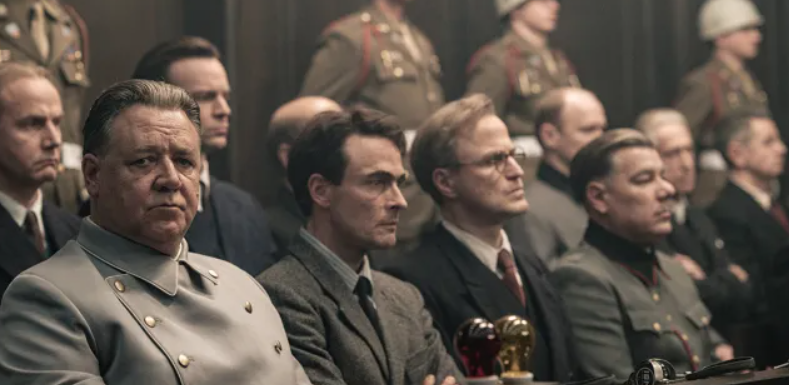
“Nuremberg” reminds me that the Nurenberg trials after the World War II were not merely perfunctory at all. This was absolutely necessary for illuminating one of the greatest atrocities ever committed against the humanity of all time, and the dramatization of these monumental trials in the film shows us how the trails could have disastrously failed in delivering the justice to all those victims of the Nazi German government.
After the opening scene showing the total surrender of Hermann Göring (Russell Crowe) in May 1945, the movie depicts the rather tricky position of Justice Robert H. Jackson (Michael Shannon), a prominent American judge willing to bring all those high-ranking Nazi German officials including Göring to a joint international military court. Although his totally unprecedented legal plan does not get much approval even from many American politicians at first, he manages to “persuade” the Pope to put some political pressures on not only the US government but also its allies, and that eventually leads to the international military trials to be held in Nurenberg, Germany, which was incidentally one of several main centers of the Nazi German government besides Berlin.
Meanwhile, the story also follows Dr. Douglas Kelley (Rami Malek), a military psychiatrist assigned to evaluate the mental conditions of those captured high-ranking Nazi Germany officials including Göring. As a young and ambitious professional, Dr. Kelly is certainly quite excited about encountering not only Göring but also many other Nazi German figures responsible for all those atrocities during the World War II, and Göring does not disappoint him at all as Dr. Kelly comes to see what a crafty narcissist Göring is. Right from their first meeting, Göring tries to charm and then manipulate him, and that certainly makes Dr. Kelly more fascinated with the man who was incidentally Adolf Hitler’s No.2 guy.

Not so surprisingly, Dr. Kelly finds himself gradually becoming closer to Göring as Göring keeps trying to use him in one way or another. At one point, he willingly functions as an unofficial messenger between Göring and his wife and daughter, even though he knows too well that Göring’s wife and daughter are more or less than accomplices to Göring’s numerous atrocities during the war.
Needless to say, Dr. Kelly becomes all the more conflicted when the trial for Göring and the other high-ranking Nazi criminals is eventually begun. As Justice Jackson, who serves as the prosecutor representing US, worried from the beginning, Göring is already quite prepared to use the trial for his political benefit as well as his survival, and Dr. Kelly is eventually asked to help a bit on cornering Göring into admitting his guilt on the record. As his psychiatrist, Dr. Kelly surely knows some buttons to be pushed on Göring’s side, but he is also reluctant about breaking one of the most important ethical rules in his profession.
Needless to say, Dr. Kelly’s conflict is soon put aside as he confronts more of all those atrocities committed under Göring and many other high-ranking Nazi German officials during the war. While naturally being quite horrified to say the least, he also observes how banal Göring and all of the other high-ranking Nazi German official at the trial really are, and he could actually think first of that famous phrase from Hannah Arendt.
However, the screenplay by director/writer/co-producer James Vanderbilt, which is based on Jack El-Hai’s nonfiction book “The Nazi and the Psychiatrist”, eventually focuses more on the righteous efforts of Justice Jackson and his British colleague Sir David Maxwell Fyfe (Richard E. Grant). As Sir Fyfe acerbically points out early in the film, they will have to get the total legal victory over those Nazi scumbags for not only those millions of victims but also the whole humanity, and we come to have more understanding on how important the Nurenberg trials really were as the final chapter of the World War II.
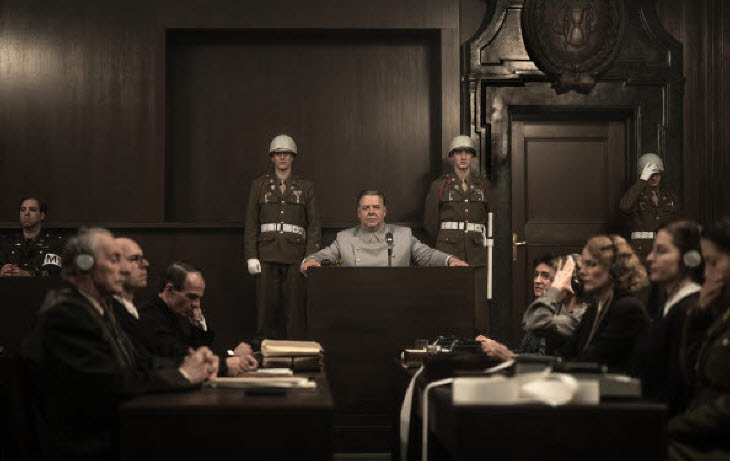
Vanderbilt assembles a bunch of notable performers for his film. While his character feels rather colorless, Rami Malek is believable as a young professional dude who gets involved in a much trickier circumstance than expected, and his low-key performance is well-matched by the showier supporting performance by Russell Crowe. While he seems to be following the footsteps of Marlon Brando during his late career years, Crowe is still a charismatic actor who can easily dominate over the screen with his presence and talent, and he does not disappoint us at all during several juicy scenes assigned to him.
On the opposite, Michael Shannon, whose distinctively intense presence cannot be possibly suppressed even in front of Crowe, comes to function as the moral center of the film, and he is also matched well with Richard E. Grant, who does a bit more than being as sardonic as we can expect from this invaluable British character actor. John Slattery, Mark O’Brien, Colin Hanks, Lydia Peckham and Wrenn Schmidt are also solid in their respective substantial supporting roles, and the special mention goes to Leo Woodall, who has his own moment to shine when his character confides to Dr. Kelly on his hidden personal connection with the World War II.
In conclusion, “Nuremberg” is a competent historical drama which will feel closer to many of us considering the rise of fascism around the world during last several years. Someday, we may have the Nuremberg trials for our era, but, folks, will we learn actually learn anything from that? Considering how we did not learn that much from the Nuremberg trials, I am rather pessimistic, but I still believe that we will absolutely need our own Nuremberg trials no matter what will happen in our near future.


 Seongyong's Private Place