
Needless to say, Werner Herzog is one of the most interesting filmmakers of our time. Besides making a number of unforgettable feature films ranging from “Aguirre, the Wrath of God” (1972) to “Bad Lieutenant: Port of Call New Orleans” (2009), this legendary German filmmaker also gave us a bunch of equally fascinating documentary films such as “Little Dieter Needs to Fly” (1997) and “Encounters at the End of the World” (2007), and he certainly does not disappoint us at all in his latest documentary film “Ghost Elephants”, which is currently available on Disney+ in South Korea.
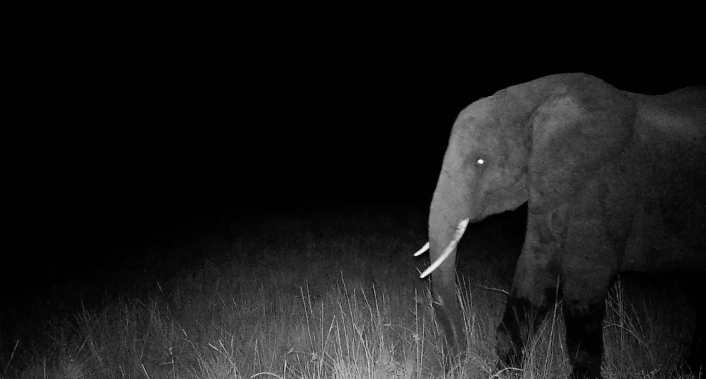
The main human focus of the documentary is Steve Boyes, a South African naturalist in the search for any opportunity to prove the existence of an undiscovered species of African elephant on the highland plateau of Angola. According to several testimonies from those elephant trackers in the past, this African elephant species in question may be considerably bigger than the biggest one ever to be hunted on the record, but these “Ghost Elephants” are not so easy to be spotted as supposedly living somewhere in their vast and remote habitat, and that was certainly a big challenge for Boyes from the very beginning.
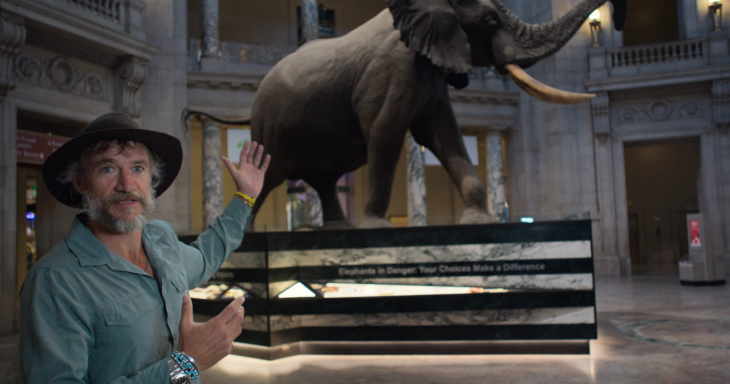
Ironically, the meticulous records on the biggest African Elephant ever to be hunted provides considerable help to Boyes. We see Boyes beholding the dead body of “Henry” exhibited at the Smithsonian Institution in Washington D.C., and then we have a close look on Henry’s big tusks and skeleton thanks to the generous corporation from the staff members of the institution. Because Henry was hunted at a spot not so far from what is assumed to be the main habitat of Ghost Elephants, it is possible that Henry can actually be genetically related to Ghost Elephants, and all Boyes needs to do is getting any suitable biological sample to be examined along with the ones from Henry.
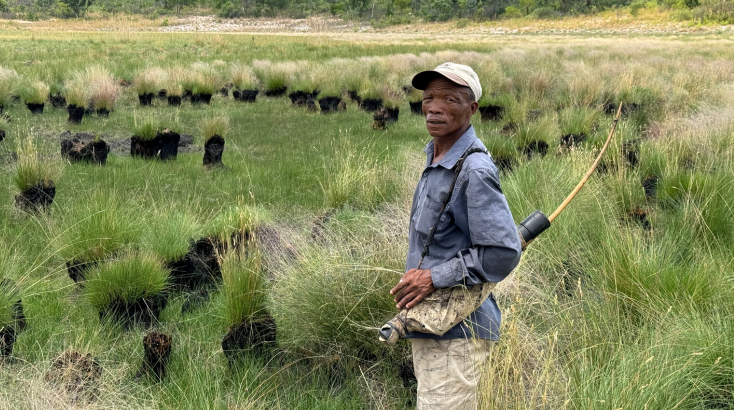
And then the documentary observes how Boyes prepares for his latest search. First, he hires a trio of San tribe trackers in Namibia, who surely interest Herzog a lot for their interesting human qualities. Instead of watching them from the distance, Herzog regards their cultural background with thoughtful curiosity and respect, and they willingly show some of their old but valuable knowledge in front of the camera. In case of a certain kind of deadly poison which they have usually used for hunting animals, it is actually from the larvae of a certain insect species, and it is fascinating to watch how they carefully prepare the poison from those tiny insect larvae dug up from the ground.
Without hurrying itself at all, the documentary sometimes takes time as Herzog reflects more on Boyes’ search and the terrible old history associated with it. After all, Henry was just one of those countless elephants killed by those greedy and heartless European colonist hunters during the 19-20th century, and, considering how African Elephant remains to be an endangered species even at this point due to the frequent poaching in Africa, the confirmation on the existence of Ghost Elephants may lead to more harm on the nature despite expanding our knowledge on it (Believe or not, more than 100 new animal species were discovered and then reported by Boyes and his search team as they searched for Ghost Elephants here and there in the highland plateau of Angola).
And there is also some serious personal question for Boyes. While quite excited by the growing possibility of attaining his longtime goal at last, he also confronts that big question on what may be next for his life and career after that point. As he frankly admits, Ghost Elephants are more or less than his own Moby Dick, and Herzog surely understands well Boyes’ rather obsessive dedication. After all, many of his notable films and documentaries such as “Fitzcarraldo” (1982) and “Grizzly Man” (2005) are about the guys relentlessly driven by their seemingly unattainable goals, and Boyes is just relatively less extreme compared to many of these rather nutty dudes.
Anyway, Boyes eventually enters the highland plateau of Angola along with his hired trackers, Herzog, and his small crew members, and the documentary closely observes their following journey with some amusing reflection on nature and people from Herzog. At one point, the documentary suddenly focuses on a female spider carrying a lot of its spawns on its back, but, mainly thanks to Herzog’s distinctive narration, this seemingly trivial moment becomes a bit more interesting than it seemed at first.
For not ruining any of your entertainment, I do not dare to tell you anything about how Boyes’ latest search will end. However, I can tell you at least that 1) it is not as bleak as the finale of “Aguirre, the Wrath of God” and 2) the following moments of academic research intrigued me to some degree due to my inconsequential academic background (Yes, I have a doctoral degree in biological science, though, as spending too much time on watching and then reviewing movies, I was a disastrously lazy graduate student who was a real pain in the ass for my long-suffering adviser professor).
In conclusion, “Ghost Elephants” is another compelling documentary from Herzog, and many of its reflective moments will linger on your mind for a long time. Although he is going to be 84 several months later, Herzog remains active as usual (He is currently working on his new feature film starring Kate and Rooney Mara, by the way), and the documentary surely demonstrates that he can still keep going at least for now. Yes, he may leave us forever at any moment, but he will never bore us to the end at least, right?


 Seongyong's Private Place