
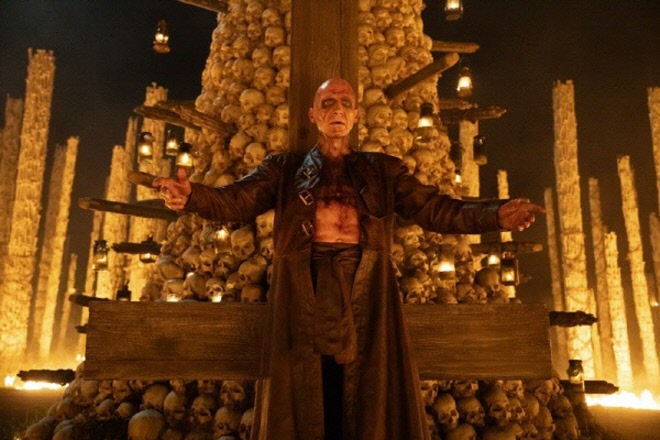
Nia DaCosta’s new film “28 Years Later: The Bone Temple”, the sequel to “28 Years Later” (2025), is a dark and brutal horror story decorated with human evil and some raging zombies. While you will surely cringe more than once for good reasons, the movie also shows a surprising amount of personality sensibility amid a lot of gore and brutality, and you will be also impressed by a number of intense dramatic moments along the story.
The story starts at the point not long after the ending of “28 Years Later”. Its young hero, Spike (Alfie Williams), starts his own personal journey despite what he went through during the precious film, and then he encounters a group of vicious gangs lead by a psychopathic lad who calls himself Sir Lord Jimmy Crystal (Jack O’Connell). The opening scene shows Spike being forced to go through the initiation ritual supervised by Sir Jimmy, and this eventually culminates to a devastating moment Spike will probably never forget for the rest of his life.
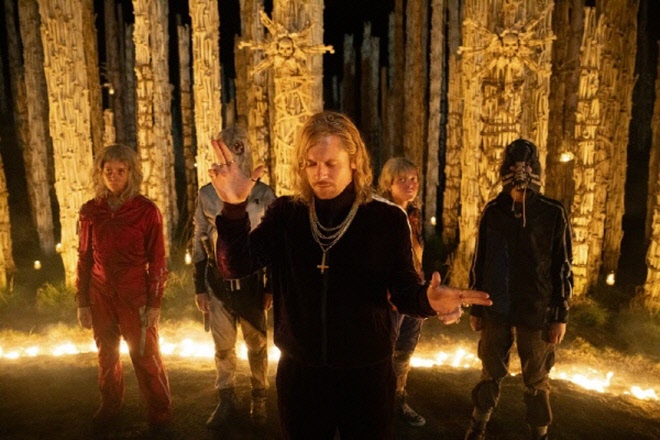
We subsequently see how Sir Jimmy drives not only Spike but also his gangs into more cruelty and brutality. He presents himself as a sort of anti-Christ to unleash more evil and violence upon the world, and his gangs, who are incidentally fashioned after the Teletubbies, are anointed as his “fingers” to follow whatever he orders. At one point, they invade a little shelter belonging to a small group of survivors, and they cruelly toy with their helpless targets a bit before eventually going all the way for a lot of pain and terror to be inflicted upon these unfortunate people.
What will be shown to us next is quite gruesome and disturbing to say the least, but this does not feel pointless or gratuitous at all as the film handles it with an aching human attitude. Although he is quite horrified and repulsed to say the least, Spike also finds himself helplessly stuck with Sir Jimmy and his gangs, and the only consolation comes from one of the gangs who turns out to be much more sensible and compassionate than others.
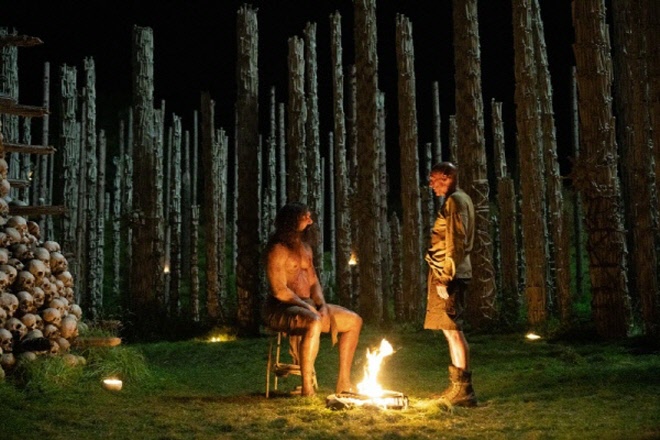
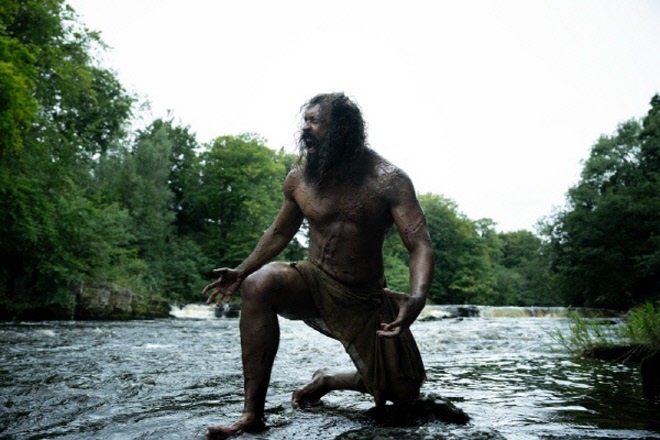
Spike’s gradual descent into a stark and brutal human condition is contrasted with the other main plot involved with Dr. Ian Kelson (Ralph Fiennes), who was quite memorable when Spike finally met him during the last act of “28 Years Later”. As continuing his solitary daily life revolving around his shelter and that huge temple built from human bones, he somehow comes to befriend “Samson” (Chi Lewis-Parry) more, the imposing Alpha leader of the infected inhabiting in the surrounding area. While he often needs to shoot a tranquilizer dart at Samson first, Dr. Kelson comes to gain some trust from Samson, and this significant breakthrough leads to a series of calm and meditative moments between them. Besides becoming less raging than before thanks to Dr. Kelson, Samson also comes to show a bit of humanity, and Dr. Kelson is certainly glad to feel less lonely than before.
However, the movie still keeps throwing a lot of gore and brutality as its two main narratives gradually converge during its second half. While we are surely served with a fair share of those raging zombies, the movie does not flinch at all in the graphic depiction of remorseless violence, and this will surely remind us again of how humans can be much more dangerous and barbaric than zombies.
The screenplay by Alex Garland, who also wrote the screenplay for “28 Years Later”, takes some time before its eventual climactic part, which does not disappoint us at all with sheer intensity coupled with a little dark sense of humor. We are quite amused by its deliberately wacky aspects, but then the mood becomes very, very, very serious, and then there comes a little but precious moment of poignancy in the end.
Under DaCosta’s competent direction, the movie is packed with a considerable amount of realism and verisimilitude. As cinematographer Sean Bobbitt, who has been mainly known for Steve McQueen’s acclaimed films including “12 Years a Slave” (2013), imbues the screen with a considerable amount of gloomy but visceral qualities, the resulting grim atmosphere on the screen is further accentuated by the moody score by Hildur Guðnadóttir, who won an Oscar for Todd Phillips’ “Joker” (2019).
The main cast members are well-cast in their respective parts. While Ralph Fiennes brings a lot of gravitas to the story as required, Jack O’Connell gleefully chews his diabolical moments in the film as he recently did in Ryan Coogler’s “Sinners” (2025), and Alfie Williams holds his own small place well between his two co-stars. In case of several supporting cast members in the movie, Erin Kellyman provides some little warmth to the story, and Chi Lewis-Parry also has his own moments to shine as doing much more than merely looking menacing.
In conclusion, “28 Years Later; The Bone Temple” is the interesting middle chapter for its planned trilogy. You may be disappointed to see that it does not have a lot of zombies compared to its predecessors, but it is still compelling for its uncompromising exploration of evil and humanity, and I enjoyed its mood, storytelling, and performance. Yes, zombies have not scared me much for years, but the movie held my attention to the end, and that is sort of achievement in my trivial opinion.


 Seongyong's Private Place