
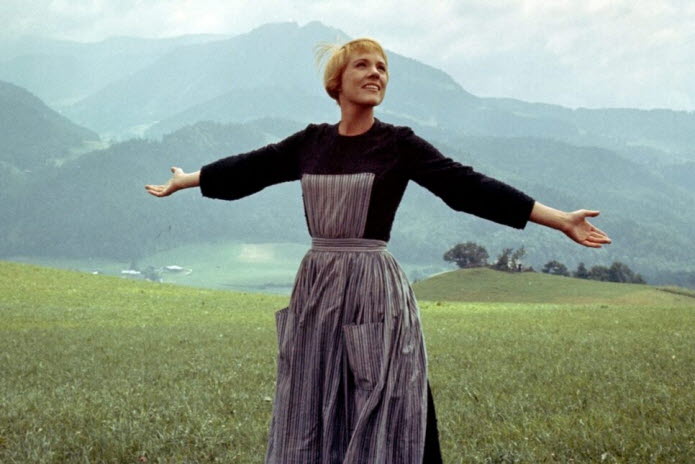
Robert Wise’s 1965 film “The Sound of Music” is a likable Hollywood classic musical movie filled with a number of catchy musical moments which will never leave you alone. Although it does not reach to the level of great musical films such as Wise’s other famous musical movie “West Side Story” (1961), it has enough charm and spirit to support its rather long running time (172 minutes) at least, and you can gladly go along with that even though being occasionally distracted by those many syrupy aspects in the dire need of a spoonful of medicine for the sugar to go down.
The movie, which is based on the 1959 Broadway musical by Richard Rodgers, Oscar Hammerstein II, Howard Lindsay, and Russel Crouse, is basically not so far from another Rodgers & Hammerstein musical adaptation “The King and I” (1956) despite their vast background differences. A pretty heroine enters an alien environment dominated by a rather stern hero, but her charm (and singing) brings brightens up his world a lot, and, yes, they surely fall in love with each other along the story.
That likable singing lady in “The Sound of Music” is Maria (Julie Andrews), a young woman who has tried to be a nun in the abbey in Salzburg, Austria in 1938. As shown from the opening musical scene whose countless variations you may encounter on the Internet in these days, she is your typical irrepressible free spirit, and that is why Mother Abbess (Peggy Wood) decides to do something about that. After discussing (and singing) with some other nuns, she sends Maria to the manor of Captain von Trapp (Christopher Plummer), a wealthy widower who needs any governess who can handle his 7 children right now.
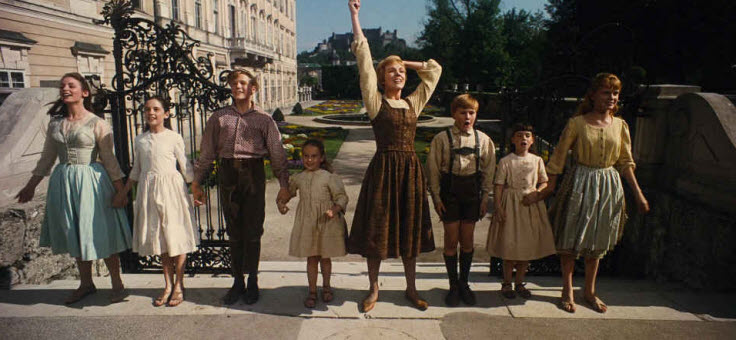
Needless to say, the first encounter between Maria and the von Trapp family is not exactly pleasant. While the captain is your average stern taskmaster who is often cold and distant to his children, his children have each own issues besides some penchant for mischief, but Maria is not daunted by this at all as spending her first day in the von Trapp manor.
Many of you surely know what follows next. It does not take much for Maria to charm and then brighten up the von Trapp children when the captain happens to be absent for a while, and she also teaches them how to sing. Although they did not know much about singing at the beginning, the von Trapp children quickly learn how to sing under Maria’s cheerful encouragement, and, what do you know, they come to sing well enough to perform in front of a lot of audiences later in the story.
Of course, the captain is not so amused to say the least at first. However, once he sees how much his children are brightened up by Maria and singing, he soon finds himself showing his heart (and singing) to Maria and his dear children, and, yes, he also comes to regard Maria with more affection even though he is expected to marry Baroness Elsa von Schraeder (Eleanor Parker), an equally wealthy socialite who does not welcome Maria much as observing how much the captain is smitten with Maria but turns out to a mere narrative roadblock just like those Nazi scumbags during the last act of the story (You all surely remember the captain furiously ripping off a Nazi flag, right?).
As the adapted screenplay by Ernest Lehman faithfully follows the narrative of the original Broadway musical, the movie presents a series of good musical moments decorated with those catchy songs such as “My Favorite Things” and, yes, “Do-re-mi”, that (in)famous song which can cheer you up or make your skin crawl a lot for the same reason. Since I watched the movie for the first time around the 1990s, these songs have never wholly left my mind for better or worse, and that says a lot about how enduring the original Broadway musical and its movie adaptation have been for more than 60 years. Personally, I like that funny song performed by a bunch of nuns around the beginning of the story, and I found myself happily nodding along its tune and lyrics again when I watched the movie yesterday.
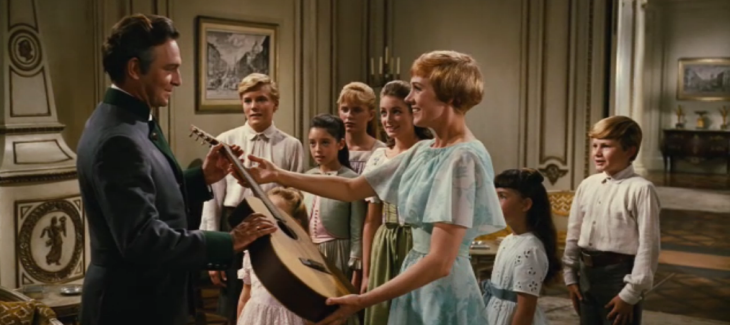
Above all, the movie is constantly buoyed by the undeniable singing talent and charming presence of Julie Andrews, who deservedly received another Oscar nomination not long after her Oscar-winning performance in “Mary Poppins” (1964). Just like Babra Streisand in “Funny Girl” (1968), she makes us willingly forgive all those artificial aspects of the film whenever she sings (We never get to know that much about her character besides her spirit and personality, for example), and it is certainly difficult to be grouchy about all those sweet and cheerful musical scenes of hers.
In case of several other main cast members in the film, they are more or less than the background details surrounding Andrews. Although he has always been remembered for this movie despite a number of memorable performances including his Oscar-winning supporting turn in “Beginners” (2011), Christopher Plummer is merely required to complement his co-star with his singing dubbed by Bill Lee, and I must point out that their eventual romantic moment is rather flat and perfunctory with the most forgettable song in the soundtrack. Peggy Wood, who received a Best Supporting Actress Oscar nomination mainly for her gentle musical scene later in the film, Eleanor Parker, and Richard Haydn dutifully fill their respective spots around the story, and those young performers playing the von Trapp children hold each own place fairly well whenever they sing together along with Andrews.
On the whole, “The Sound of Music” is still an enjoyable piece of entertainment and it deservedly won several Oscars including the ones for Best Picture and Director. Although I must admit that I occasionally rolled my eyes for being a little too sweet and sentimental for me, we can all agree that it represents the glorious era of classic Hollywood musical films during the 1960s along with “West Side Story”, “Mary Poppins”, and “My Fair Lady” (1964), and it will certainly not go away as long as cinema remains alive and well.


 Seongyong's Private Place