
South Korean film “Once We Were Us”, which is a remake of Rene Liu’s 2018 Chinese film “Us and Then”, is an engaging variation equipped with some distinctive personality. While being mostly faithful to the plot and characters of the original version on the whole, the movie still works thanks to its competent direction as well as its two good lead performers, and the result is an exemplary case of how to make a solid remake version.
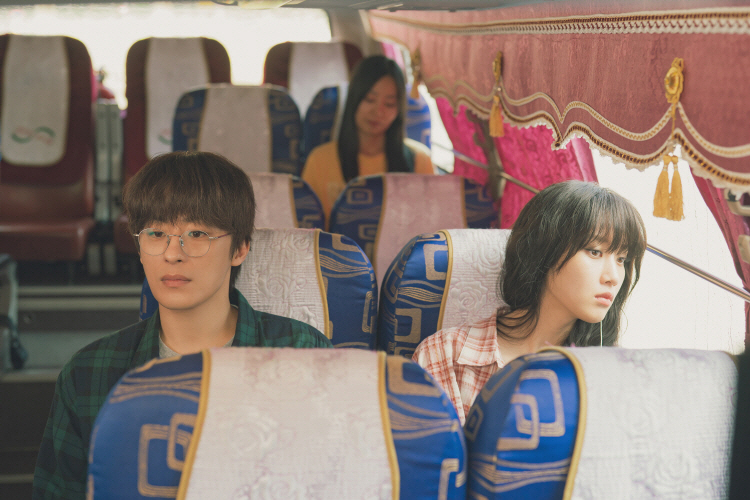
The movie opens with the accidental encounter between Lee Eun-ho (Koo Kyo-hwan) and Han Jeong-won (Moon Ga-yeong) in Ho Chi Minh City, Vietnam in 2024, and then we see how they came across each other for the first time in Seoul on one summer day of 2008. Not long after Eun-ho noticed Jeong-won at a bus terminal, both of them happened to get on a bus going to some rural town in the east coast area for their respective personal reasons, and, what do you know, they subsequently found themselves sitting right next to each other.
Anyway, when their bus later has to stop at a spot not so far from its destination due to an unexpected landslide on the road, Jeong-won gets involved more with Eun-ho thanks to Eun-ho’s father, who quickly comes to pick up his son and then suggests that Jeong-won should also get on his vehicle. In addition, he also gladly has her have a lunch along with his son at his little local restaurant, and Eun-ho and Jeong-won come to spend much more time with each other than expected.
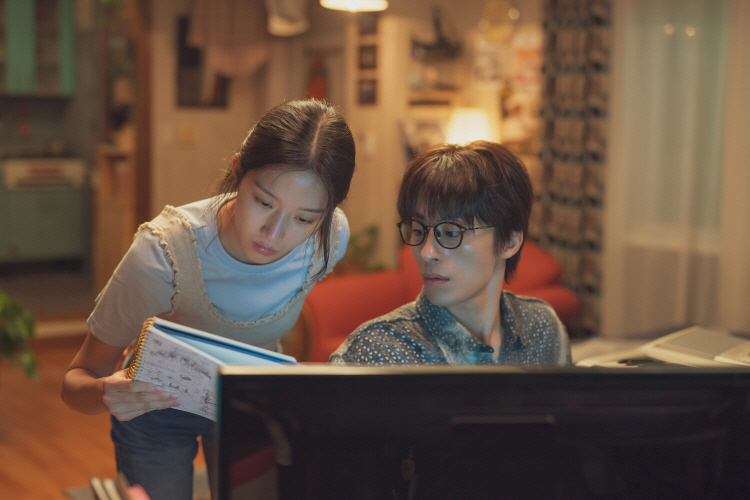
Not long after they eventually go back to Seoul later, Eun-ho tries to meet Jeong-won again, and she willingly responds to that. When she happens to need a place to stay later, he generously lets her stay in his little current residence, and she becomes his roommate/best friend as they come to rely more on each other in one way or another.
While it feels less shabby in terms of mood and details compared to the original Chinese version, the movie did a good job of bringing a fair share of realistic period elements to the story and characters. While he has aspired to be a successful game developer someday, Eun-ho has to do some menial part-time jobs for earning his meager living day by day, and so does Jeong-won, who incidentally wants to study architecture but puts aside this dream of hers for a while at least.
Nevertheless, she and Eun-ho feel happy to be together despite their continuing daily struggles, and then there eventually comes the point when they become more conscious of what has been mutually developed between them during last several months. Although Jeong-won does not feel that sure about whether she wants to be Eun-ho’s girlfriend or remains simply as his best friend, she and Eun-ho decide to become more serious about their relationship, and it looks like nothing can possibly separate them.
However, they soon come to face their harsh reality while also disappointing each other a lot at times. As he keeps going nowhere despite his efforts for realizing his dream, Eun-ho gets more exasperated and frustrated, and he often becomes quite petty and angry to Jeong-won’s disappointment. While she does try her best for maintaining their relationship, Jeong-won only finds herself becoming more distant to Eun-ho, and Eun-ho belatedly comes to realize how things have become quite bad between them.
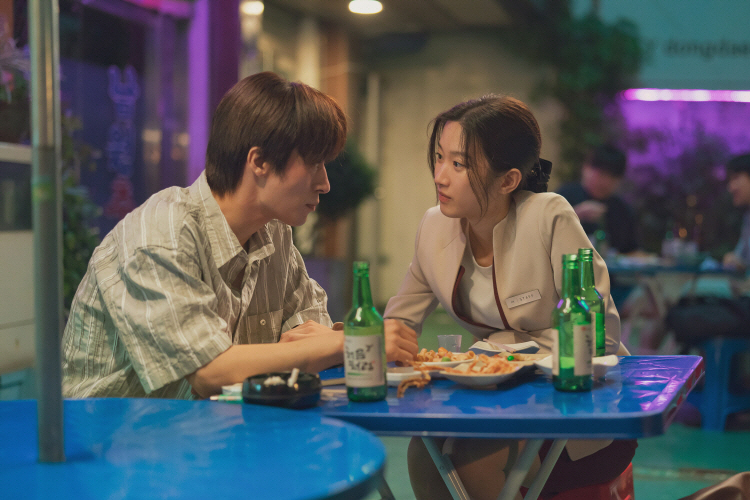
Meanwhile, the movie occasionally observes the extended encounter between Eun-ho and Jeong-won in 2024. When their flight to Seoul is canceled due to a big typhoon, they end up staying together in the same hotel room. As talking with each other for a while, they are reminded of how much they loved each other at that time, but they also see how much their respective paths have been separated from each other since that time. The more they remember, the more they become aware of what has been sadly and irrevocably lost between them.
Even as the story arrives at its predictably bittersweet ending, the movie keeps holding our attention thanks to the good chemistry between its two lead performers. Koo Kyo-hwan, who has been steadily advancing in his movie acting career since his wonderful breakthrough performance in “Jane” (2017), and Moon Ga-yeong, who started her movie acting career with her notable child performance in “To Sir, With Love” (2006), generate enough romantic vibe to support the story and characters just like Jing Boran and Zhou Dongyu in the original Chinese version, and they are also convincing in the estrangement and regret between their characters later in the story. In addition, Koo and Moon are also supported well by several good supporting performers, and Shin Jung-geun, a veteran actor who has diligently appeared here and there in a bunch of major South Korean films such as “Masquerade” (2012) for more than 20 years, brings some extra humor and gravitas to the story as Eun-ho’s caring widower father.
In conclusion, “Once We Were Us” does not surpass the original Chinese version, but it is recommendable for enough good elements to entertain us, and director Kim Do-young, who previous made a commendable feature film debut with “Kim Ji Young: Born in 1982” (2019), demonstrates here in this film that she is too good to be less active during last several years despite all the praises and acclaims given to her first feature film. At least, she is back in action with this modest but enjoyable remake, and I sincerely hope that she will soon move onto whatever she wants to make next.


 Seongyong's Private Place