
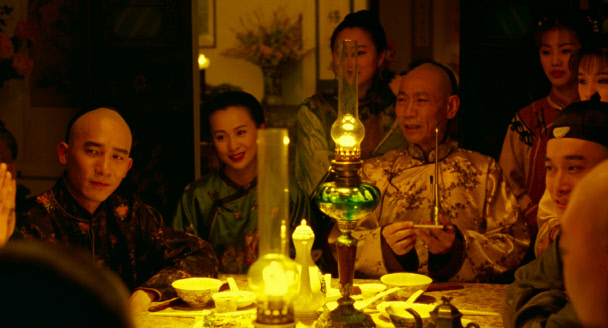
Hou Hsiao-hsien’s 1998 film “Flowers of Shanghai”, which was released in South Korean theaters in last week, often requires some patience from you for good reasons. As your average arthouse movie, it is slow, distant, and opaque in terms of story and characters, and I must confess that I sometimes struggled to understand whatever is going on among a bunch of various figures in the film. Nevertheless, I also must admit that this is one of the most exquisite movies I have ever seen, and my admiration on its mood and texture has been increasing since I watched it early in this morning.
The story, which is based on Han Bangqing’s 1892 novel “The Sing-song Girls of Shanghai”, is entirely set inside the elegant brothels of Shanghai, 1884, and the movie opens with one late drinking night among a number of prostitutes and their wealthy clients. As these figures are drinking or talking, we get to know about a bit about some of them including Crimson (Michiko Hada, who is incidentally dubbed by Pauline Chan) and her main client Master Wang (Tony Leung Chiu-wai). Crimson and Wang have been closely involved with each other during last several years, and he is supposed to marry her someday, but he does not seem that willing to do as often paying more attention to Jasmin (Vicky Wei).
This naturally causes a conflict between Crimson and Jasmin, but the movie does not show much of this conflict as mostly focusing on the aftermath. While not doing much to resolve the conflict between the two ladies around him, Wang turns out to have some remaining feelings toward Crimson, and that makes their situation all the more complicated.
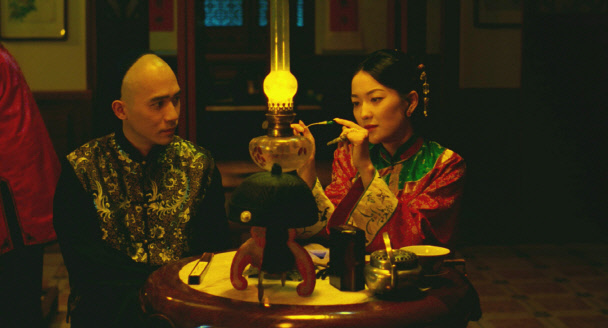
Meanwhile, the movie also observes several other prostitutes in the brothels, and we get to know more about how their system has worked. They have worked under their respective “mothers” who bought them and then groomed them for their brothel work, and these “mothers” are glad to hand them to any rich client who may later become interested in marrying any of them after paying a considerable amount of money.
This is surely a seedy business, and the movie does not overlook how things can be quite unhappy or miserable for its prostitute characters at times. No matter how angry she is, Crimson must accept that the future is not so bright for her to say the least – especially after Wang becomes quite furious at her under a rather unspecified circumstance. In case of Jasmin, she is certainly delighted to see her prospect boosted by her relationship with Wang, but then we come to gather that she is not so much in love with him compared to her rival.
Thoroughly restraining itself from the melodramatic aspects of the story, the movie gradually immerses us more into the small and closed environment surrounding its numerous main characters. Although it takes some time for us to understand who they are or how they are related to each other, the movie steadily engages us with its delicate mood and texture, and we come to feel more like an unseen observer as the camera of cinematographer Mark Lee Pin Bing subtly moves its focus around the characters without any interruption (The movie consists of fewer than forty shots in fact, by the way).
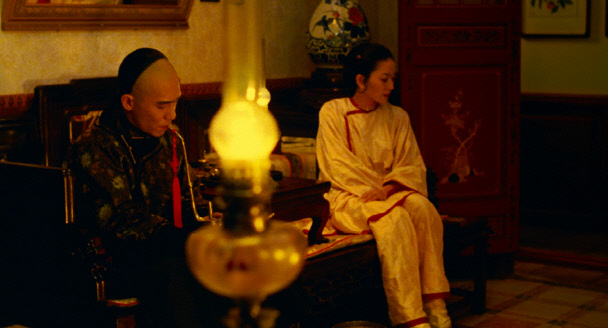
The production and costume design of the film are top-notch to say the least. As a matter of fact, Hou wanted to make the movie for creating enough production resource for Taiwanese cinema with his art director Hwarng Wern-ying, who did a fabulous job along with Tsao Chih Wei here in this film. Because the movie had to be shot in Taiwan instead of Shanghai after not being able to get the permission from the Chinese government, the movie consists entirely of indoor scenes, but the period mood and details look pretty vivid and authentic on the screen. In addition, its cinematography depended a lot on candle lights during its many nocturnal scenes, and it is no wonder that these lovely scenes frequently reminded me of that unforgettable cinematography of Stanley Kubrick’s great period drama film “Barry Lyndon” (1975), which is very famous for shooting its nocturnal scenes only with candle lights.
The main cast members in the film do not stand out much on the whole, but they all flawlessly inhabit their respective roles even though the movie usually observes them from the distance. As the most prominent cast member in the movie, Tony Leung Chiu-wai surely draws our attention right from the beginning, but he is more or less than a mere small part of the well-rounded ensemble performance, and several other main cast members including Michiko Hada, Michelle Reis, Carina Lau, Vicky Wei, Hsuan Fang, Jack Kao, Rebecca Pan, Simon Chang, and Luo Tsai-erh have each own small moment along the story without interrupting the serenely elegant atmosphere surrounding them at all.
In conclusion, “Flowers of Shanghai” is an admirable piece of cinematic art from Hou, who is sadly retired at present due to Alzheimer’s disease. Although I am still not sure about whether I fully understand all those nuances and details in the movie, I am willing to revisit it someday for more understanding and appreciation, and, just like Hou’s several other works such as “Millennium Mambo” (2001), “Three Times” (2005), and “The Assassin” (2015), it will probably grow more on my mind, while also reminding me again that he is indeed one of the most interesting filmmakers in our time.
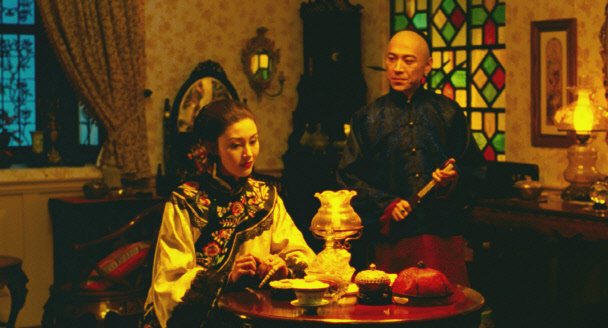


 Seongyong's Private Place