
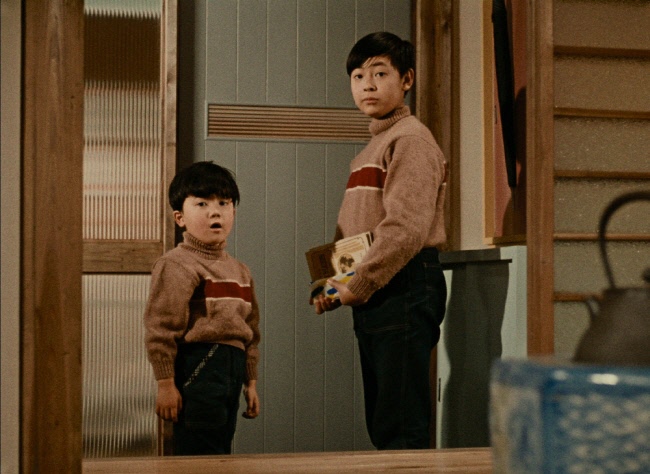
Yasujirō Ozu’s 1959 film “Good Morning”, which happens to come to South Korean theaters in this week, is often cheerfully sweet and naughty to my little amusement. While it is as gentle and humane as you can expect from Ozu, the movie has some very funny moments to tickle you for their unabashedly but innocently low-brow bathroom humor, and it is probably his most hilarious work in my humble opinion.
The story mainly revolves around a simple wish of two young brothers. Minoru (Koji Shitara) and Isamu (Masahiko Shimazu) and their family live in some suburban area outside Tokyo, and the movie opens with several neighborhood housewives talking about a little problem involved with their women’s club monthly dues. Although Mrs. Hayashi (Kuniko Miyake), the mother of Minoru and Isamu who is incidentally the treasurer of the women’s club, was supposed to give the dues to their chairwoman, but the chairwoman says that she has not received anything yet, and then we see a series of comic misunderstanding and miscommunication among these housewives.
Meanwhile, as frequently enjoying watching TV at the house of one of their neighbors, Minoru and Isamu come to wish to have a TV in their house. When they express their wish to their father, Mr. Hayashi (Chishū Ryū) sternly rejects their request just because, well, 1) TV is pretty expensive to say the least and 2) he thinks TV will have a negative effect on his boys. As watching the boys’ little argument with their father, I became a bit nostalgic about when my parents tried to steer me and my younger brother away from TV as much as possible during our childhood years, and some of you may recall childhood memories similar to that.
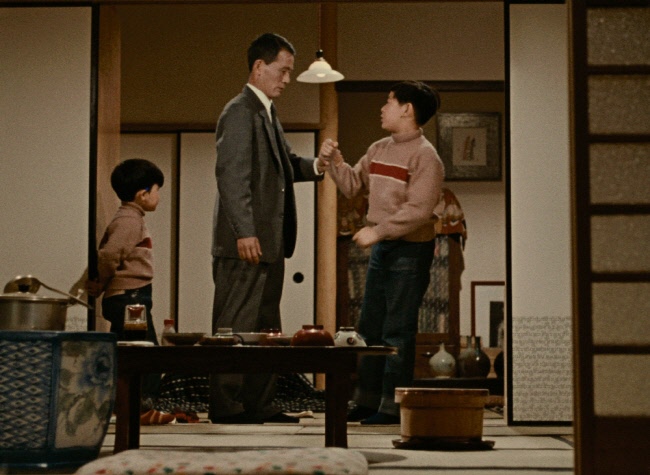
Anyway, Minoru and Isamu are not still daunted by their father’s objection at all. They impulsively decide to start a silent protest against their parents, who are certainly caught off guard at first but become rather amused about how long their boys can actually go on. As the fairly good parents who understand their boys well, they know that the boys’ protest will end sooner or later, and they simply wait for the boys to give up eventually.
Just like Minoru and Isamu’s parents, the movie, which is incidentally a loosely remake of Ozu’s 1932 film “I Was Born, But…”, takes its time as doling out a number of episodic moments tinged with humor and insight to observe and appreciate. My personal favorite moment is involved with the aging mother of the chairwoman, who is forgettable at times but turns out to be a quiet force of nature to reckon with. When a rather aggressive salesman drops by her house and attempts to force her to buy some stuffs from him, she remains unflappable as before, and then she gives one of the funniest moments in the movie.
And there is also a silly subplot involved with flatulence. Just because one of Minoru’s friends demonstrates how to fart actively, Minoru and Isamu try to do the same thing along with Minoru’s other friends. This leads to a running gag involved with the embarrassment from one of them, who tries a bit too hard whenever he attempts to fart in front of others and then has to face his mother’s anger and annoyance.
While quite tickled by many small comic moments in the film, we gradually notice the melancholic aspects of the main characters’ daily life. We observe how the chairwoman and her mother often do not get along that well with each other. We see when Mr. Hayashi, who is rather old compared to his wife, becomes a bit more pensive as reflecting on how he has been getting closer to retirement day by day. And we notice that Minoru and Isamu’s private English tutor is attracted to their young aunt but hesitates to get closer to her due to his currently unemployed status.
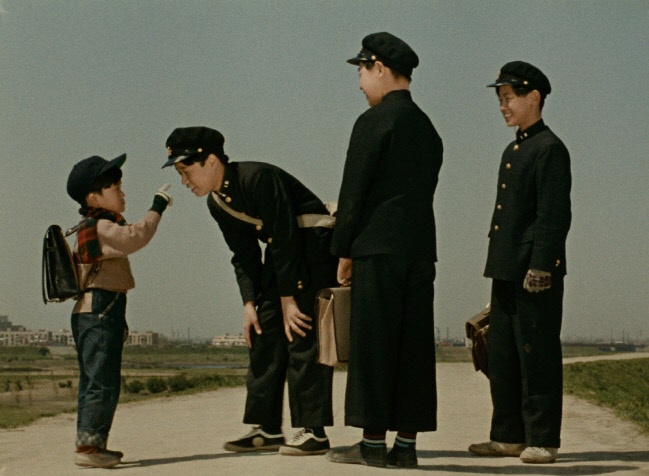
Around its last act, the movie becomes a bit more serious as Minoru and Isamu struggle to continue their silent protest which also becomes a hunger strike, but the mood remains gentle and cheerful as before. Although you will not probably be surprised that much by how the conflict at the center of the story is eventually resolved, you will also come to smile a lot, while musing a bit on all those “unnecessary” niceties exchanged among us such as “good morning”. Sure, they are usually meaningless and useless (My late mentor/friend Roger Ebert’s close colleague Gene Siskel called them “Lip Flap”, by the way), but, as one of the main characters in the movie points out, they are not totally valueless for functioning as a sort of lubricator in our daily human interaction – if we can just quickly go beyond them for conveying our real thoughts and feelings to each other.
Ozu’s several frequent performers, Chishū Ryū, Kuniko Miyake and Haruko Sugimura, are solid as usual, but they do not overshadow at all the unadorned natural performance from Koji Shitara and Masahiko Shimazu. Shitara and Shimazu are always effortless in their several key comic moments in the film, and the audiences around me laughed and chuckled a lot whenever Shimazu’s character said a certain recurring line.
On the whole, “Good Morning” is relatively lighter compared to Ozu’s great films such as “Tokyo Story” (1953) and “Floating Weeds” (1959), but its gentle charm and hilarity will linger on your mind for a long time. Since I watched it for the first time in the early 2000s, the movie always amused me whenever I revisited, and I am glad to report to you that I had a very entertaining time along with others today.


 Seongyong's Private Place