
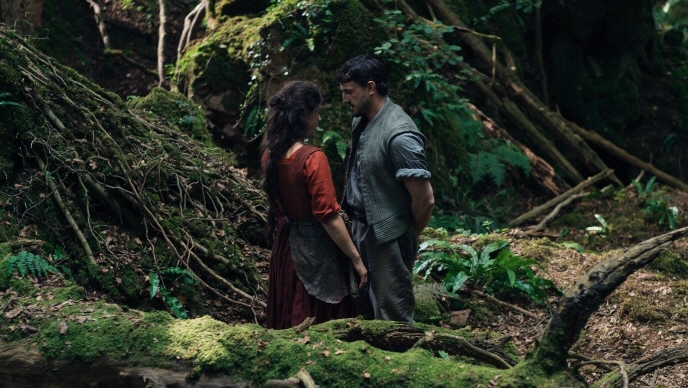
Chloé Zhao’s latest film “Hamnet”, which received the People’s Choice Award at the Toronto International Film Festival in last year and then recently garnered 8 Oscar nominations including the ones for Best Picture and Best Director, is a curious mix of blatant melodrama and restrained sensitivity. While there are occasions of raw and intense emotions beneath its calm and phlegmatic appearance, the movie also goes a bit too far for extracting tears from us especially during its second half, and the result is a rather mixed bag to admire for its strong aspects.
The story mainly revolves around Agnes Shakespeare (Jessie Buckley), who was the wife of, yes, William Shakespeare (Paul Mescal). The opening scene shows Agnes freely spending her private time along with her pet hawk in a forest near her village, and the movie somberly conveys to us her strong spirit and personality as she quietly rests at her favourite spot in the forest.
When Agnes later meets William, they are instantly drawn to each other even though he does not have much to distinguish himself as an eligible young dude to marry. While he was born to a glove-making family, this sensitive lad studied to become a scholar instead, and he meagerly earns his living as a local tutor whenever he does not assist his family business.
Nevertheless, Agnes gets closer to William, and they eventually marry once Agnes becomes pregnant, but then she comes to notice more of how he often becomes frustrated for being stuck in their village without much prospect for his writing career. In the end, she has him move to London alone by himself, where he may have much more opportunity for his writing career.
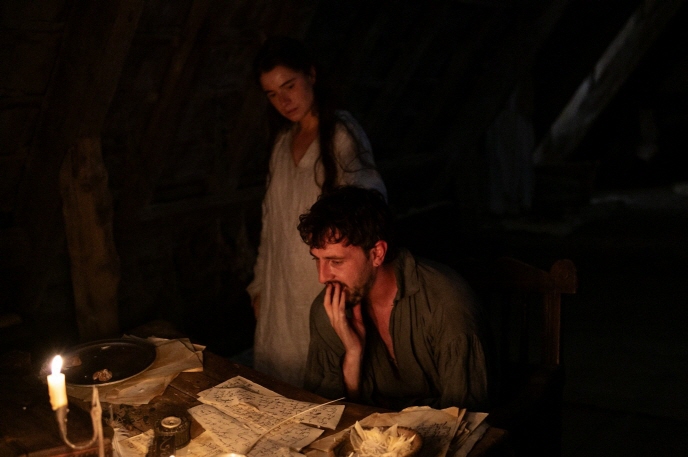
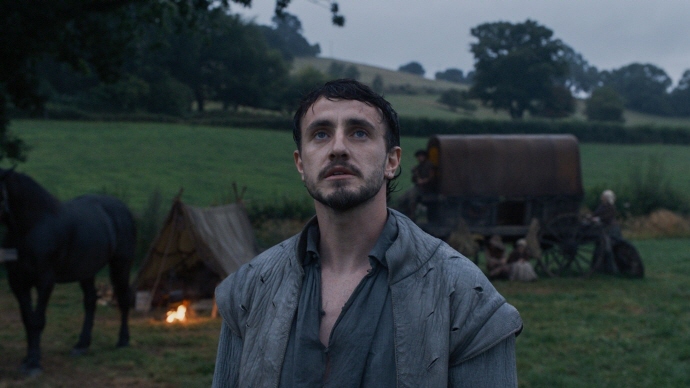
As her husband comes to have some career success in London later, Agnes is certainly happy for him, but she chooses to remain in their village while raising their three children: Susanna (Bodhi Rae Breathnach), Judith (Olivia Lynes), and Hamnet (Jacobi Jupe). Although her husband can only visit them from time to time, he is always welcomed by her and their children, and there are a couple of humorous scenes which will surely remind you of two certain famous plays written by Shakespeare.
Because of the overwhelming ordeal from giving birth to Judith and Hamnet at the same time, Agnes is often worried a lot about Judith’s rather fragile physical condition, which is the main reason why she still does not move into London along with her children. However, she and her husband lose Hamnet instead due to his sudden illness, and both of them are quite devastated to say the least.
Around that narrative point, we are supposed to be more emotionally engaged in their grief and torment, but the movie sticks to its dry and restrained attitude as before. Usually observing its two main characters from the distance, it subtly suggests whatever is churning behind their desolate appearance, and this unfortunately clashes with the heavy-handed aspects of the screenplay by Zhao and her co-writer Maggie O’Farrell, which is based on O’Farrell’s 2020 novel of the same name.
As already announced to us at the beginning of the film, the final act of the story focuses on the creation of “Hamlet”, but I doubt whether it will give you any particular new or fresh insight, if you have some vague background knowledge on that classic play just like me. Although it is rather disappointing that the movie does not show much of Shakespeare’s creative process behind “Hamlet”, I will not deny that I enjoy a gloomy scene where he creates that famous monologue as standing at the end of a pier in London at one night (Thanks to cinematographer Łukasz Żal, the city in the movie often looks as dark, gloomy, and virulent as Gotham City, by the way).
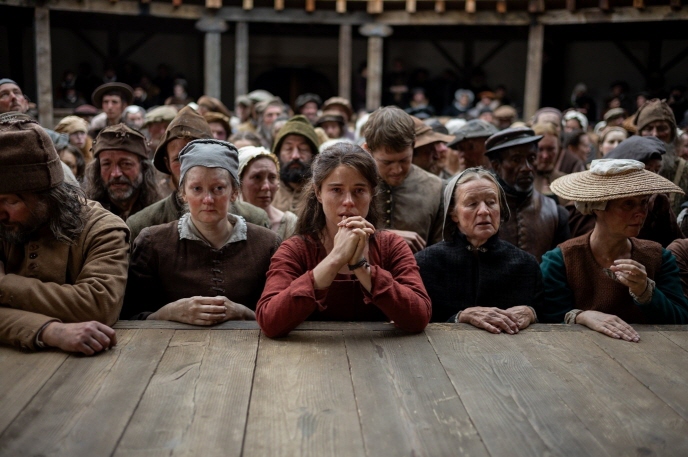
In the meantime, Agnes surely struggles a lot for processing her immense grief, and it is touching to observe how her inner struggle is eventually resolved as she watches the stage performance of “Hamlet” for herself. In my trivial opinion, this part feels rather clichéd, but it works as alternating between the earnest stage performance and the whole gamut of emotions plainly but vividly observed from Agnes’ face, and you may gladly go along with the predictable utilization of “On the Nature of Daylight” by Max Richter, who also composed the original score for the film.
Jessie Buckley, who is deservedly Oscar-nominated for her soulful acting here in this movie, deftly handles a number of intensely emotional moments along the story, and she is supported well by several other good performers surrounding her. While Paul Mescal, who has been more notable thanks to his wonderful Oscar-nominated turn in Charlotte Wells’ remarkable debut feature film “Aftersun” (2022), is also solid in his low-key acting, Emily Watson, Joe Alwyn, Bodhi Rae Breathnach, Olivia Lynes, and Jacobi Jupe dutifully fill their respective spots in the story, and Jupe’s poignant performance is smoothly connected with the brief but crucial appearance by his older brother Noah Jupe around the end of the film.
In conclusion, “Hamnet” is less compelling compared to Zhao’s previous two acclaimed films “The Rider” (2017) and “Nomadland” (2020), but it is at least better than “Eternals” (2021), where she tried something different within the world of Marvel Cinematic Universe but ultimately dissatisfied us despite some interesting stuffs to observe and enjoy. I am still not so sure about whether “Hamnet” is one of the best movies of last year, but there are enough good things to compensate for some reservation of mine, so I recommend it for now.


 Seongyong's Private Place
Pingback: My Prediction on the 98th Academy Awards | Seongyong's Private Place