
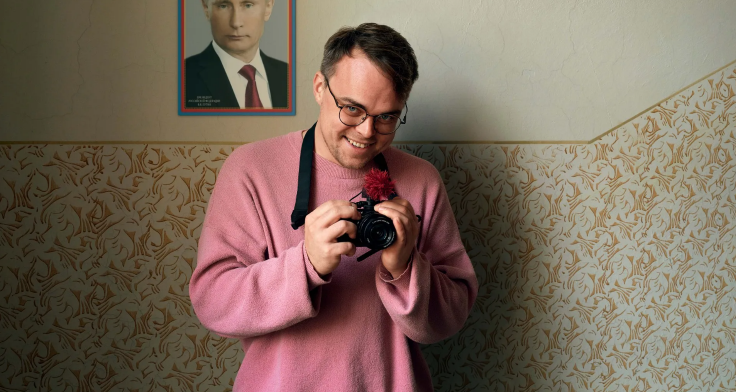
Documentary film “Mr. Nobody Against Putin”, which won the Special Jury Award when it was shown at the Sundance Film Festival early in last year and then received an Oscar nomination a few weeks ago (It was also the Danish submission to Best International Film Oscar, by the way), presents a little but defiant personal chronicle from a small Russian town. Mainly via the viewpoint of one plain local schoolteacher, the documentary observes how things became absurd and alarming around him and many others due to the ongoing Russo-Ukrainian War, and we are alternatively amused and disturbed by many of its darkly absurd moments.
That local schoolteacher in question is Pavel Talankin, and the early part of the documentary gives some background information on his hometown. While it is a rather remote town located in the middle of the Ural Mountains region of Russia, Karabash has actually been one of the most important industrial cities in Russia for many years, and, as shown from a series of YouTube clips, it has also been quite notorious due to its considerably polluted environment.
Nevertheless, life has kept going in Karabash as reflected by what Talankin recorded with his digital camera at a local primary school for many years. Besides teaching his students, he also worked as the videographer and events coordinator of the school, and he was pretty popular around many of his students and former pupils, who gladly dropped by his little office from time to time.
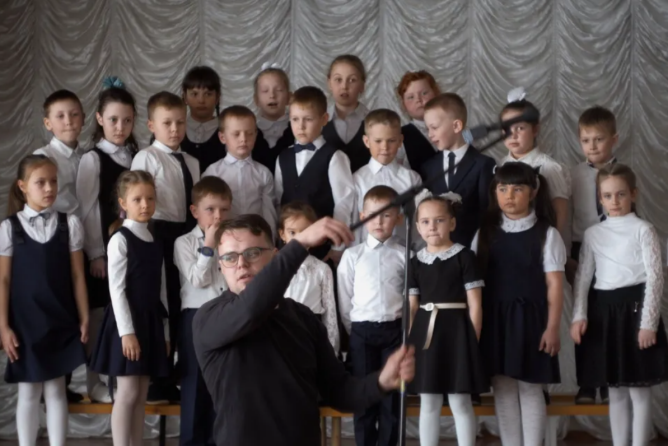
However, Talankin’s good time at the school was gradually disrupted after the Russian government and its president Vladmir Putin decided to invade Ukraine in early 2022. At first, the Putin administration simply tried to control public perception, but this eventually became all the more insidious and oppressive. As the war was continued much longer than expected, Talankin and his teachers and students were ordered to show more support and compliance by the federal government, and they had no choice but to follow whatever was demanded to them from the power that be.
Because he often recorded a lot of stuffs here and there in the school, Talankin did not have much trouble in recording how things changed among the teachers and their students bit by bit. At first, he and other teachers were instructed to emphasize more patriotism onto their students, and we see how frequently the students in the school were exposed to government propaganda day by day. In addition, they also often had to participate in numerous extracurricular activities for more patriotism and compliance, and nobody in the school administration dared to defy against this – even when it seriously affected the average grades of their students.
After getting more disgusted and frustrated with what was happening around him, Talankin decided to resign, but then there came an unexpected little news for him. He previously tried to contact anyone who might be interested in what he had been documenting from his school and its teachers and students, and that is how he got in contact with American documentary filmmaker David Borenstein, who served as the co-director of the documentary. Talankin subsequently withdrew his resignation, and he became much more motivated than before, even though he had to be a lot more careful due to this secret private project of his.
Needless to say, things only became all the more absurd and disturbing for him and many others in the town during next several months. While there were some anti-war demonstrations in big cities like Moscow, showing any opposition against the Putin demonstration in a small town like Karabash was pretty dangerous to say the least, and Talankin came to notice more of how many people in the school were far less willing to talk in front of his camera than before.
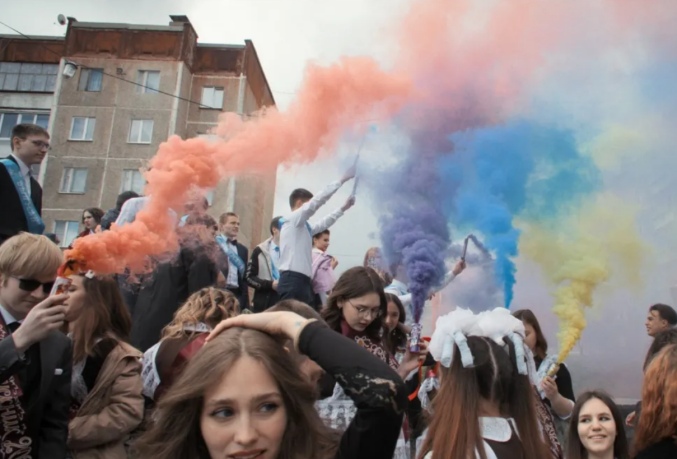
And we also observe how the school became more militarized in one way or another. Getting more brainwashed with the government propaganda as well as doing some elementary military trainings, its students became more like little soldiers ready to go to the war sooner or later, and we are quite chilled as observing many of them wearing military uniforms at one point later in the documentary.
Naturally becoming more exasperated and daunted, Talankin occasionally showed a bit of defiance, but he knew that he could not change anything at all while only making his circumstance riskier than before. After he noticed that he might have been watched by the local police, he became all the more cautious than before, and then there eventually came the point where he must escape as soon as possible.
As mostly sticking to Talankin’s personal viewpoint from the beginning to the end, the documentary is limited by its rather narrow perspective at times, but we come to sense that he really cares a lot about his town and many people living there including his librarian mother. There is a genuine sense of affection when he and his several former pupils hold a little party for one of these former students who got recently drafted for the war, and there is also a very limited but undeniably devastating moment from what Talankin secretly recorded from the funeral of one of his close friends who was also sent to the war. Even right before he escaped from his country, he tried his best for his dear students and teachers attending the graduation ceremony, and this poignant moment will make you hope that he may be able to return to Karabash someday.
Overall, “Mr. Nobody Against Putin” is another interesting documentary associated with the Russo-Ukrainian War. Yes, as Talankin phlegmatically points out, what has been happening in his hometown as well as the whole country is certainly incomparable to what Ukraine and its people have suffered everyday, but the documentary vividly illuminates another dark and disturbing side of that ongoing war, and that makes it worthwhile to watch in my humble opinion.


 Seongyong's Private Place
Pingback: My Prediction on the 98th Academy Awards | Seongyong's Private Place