
Leo Carax’s 1991 film “The Lovers on the Bridge”, whose recent 4K restoration version happened to be released in selected South Korean theaters a few days ago, is a seemingly shabby but undeniably brash tale of romance. While simply rolling along with its two main characters who happen to be thrown into their seedy but passionate love affair, the movie serves us a series of stunning visual moments mainly driven by its unabashedly romantic heart, and you may admire that even if you observe its many flaws.
During the opening part, the movie, which is mainly set in Paris during several months of 1989, gives us a gritty variation of Meet Cute. First, we meet a young street vagrant named Alex (Denis Lavant), who occasionally works as a street performer. And then we are introduced to a young female artist named Michèle Stalens (Juliette Binoche), who comes across Alex at one late night when his unconscious body is lying in the middle of a wide street. Even after he seriously gets injured in one of his legs due to some reckless driver, she does not give him much attention, and his unconscious body is eventually picked up and then sent to one of those shelters for vagrants in the city.
After spending some time there for the recovery from his physical injury, Alex returns to where he stayed before the accident, which is one of those many bridges over the Seine River. Because this bridge happens to have been under renovation for a while, he and his fellow vagrant Hans (Klaus Michael Grüber) have been able to stay there without much problem, and Alex has also depended a lot on the drug from Hans just for sleeping more easily on the bridge.
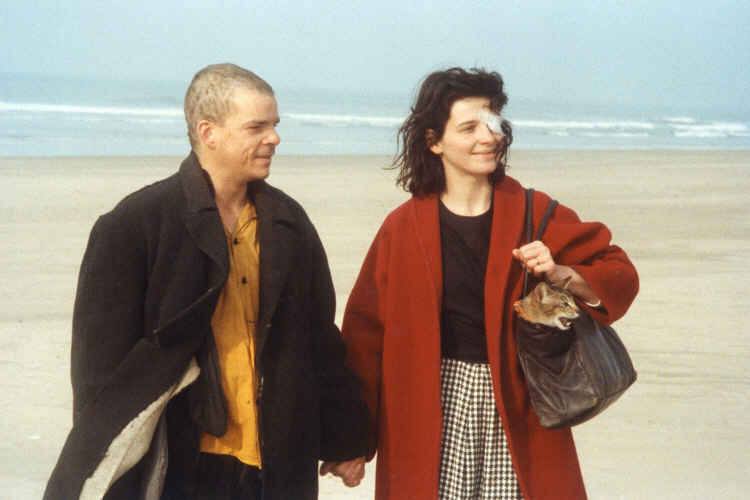
However, their daily life on the bridge is interrupted by the appearance of Michèle, who comes to the bridge for no apparent reason but decides to stay there for a while. Hans is not so pleased about this, but Alex willingly lets Michèle stay along with him just because, well, he falls in love with her after his second encounter with her, and Hans respects Alex’s choice despite being still quite annoyed about her.
As Michèle comes to spend more time with Alex, we get to know a bit more about why she became a vagrant just like Alex and Hans. Although she is from a fairly affluent family, she has been quite distraught as she began to lose her eyesight due to some unspecified illness and then her boyfriend suddenly left her, and she has desperately been looking for him just because she wants to see him for the last time before totally losing her eyesight.
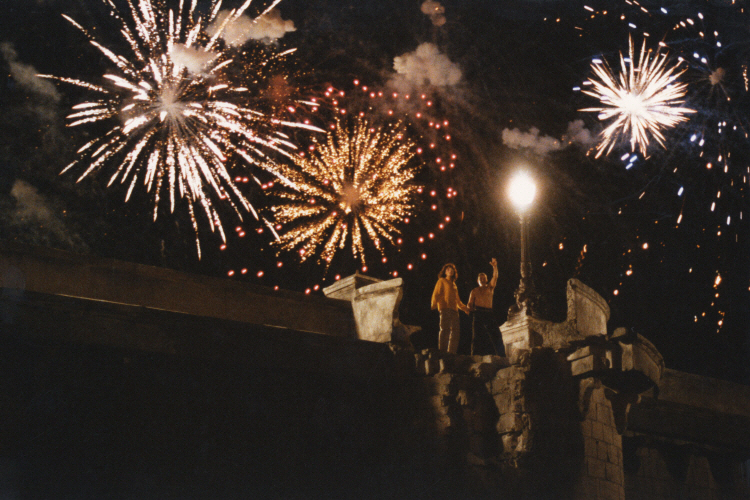
Nevertheless, Alex still yearns for getting closer to Michèle, and she comes to open herself a bit more to him as time goes by. When the city and its citizens become quite excited because of the French Bicentennial celebrations, Alex and Michèle willingly let themselves swept by the festive atmosphere surrounding the city and its people, and the movie accordingly gives us several impressive scenes including the one where its two main characters dance a lot on the bridge as the night sky over the city is filled with a lot of fireworks.
As some of you know, the production of the film was rather notorious as Carax went further than what was allowed by the initial production budget at that time. As a matter of fact, the bridge in the film is not the real one but a replica specially built for its production, and you may be amused a bit as musing on how much money and effort were actually spent on making the bridge in the film look realistically ugly and shabby on the screen.
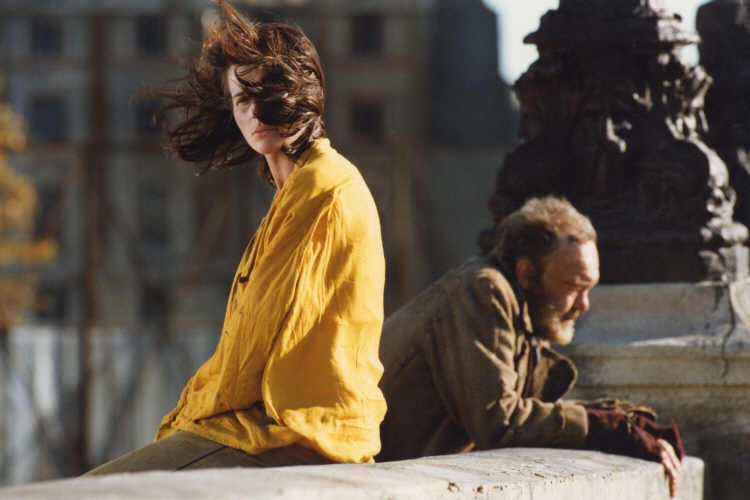
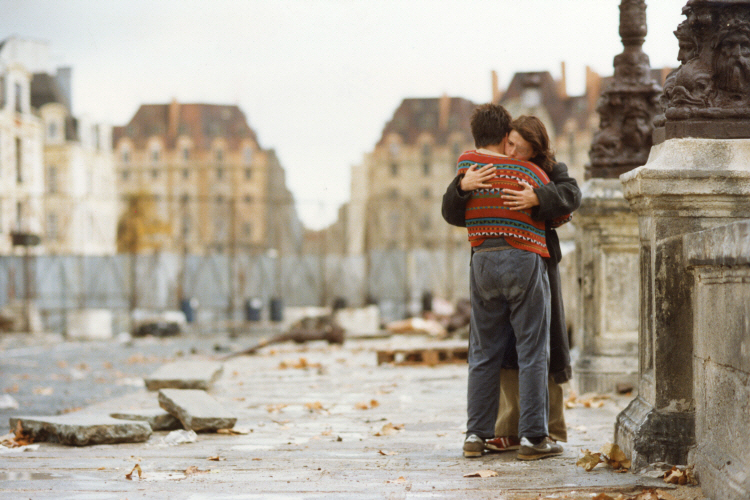
Nevertheless, the bridge in the film works fairly well as the main background of the wild and desperate romance between Alex and Michèle. Although they are more or less than archetypes, the romantic feelings developed between them along the story make a striking contrast with the bridge and some other gritty locations around them, and we come to understand more of how they cannot help but stick to each other more despite a lot of difference between them.
Around the third act, Carax’s screenplay stumbles more than once as making several contrived plot turns, but the movie keeps going with its distinctive mood and romanticism at least, and it is also supported well by the modest but precious chemistry between its two undeniably charismatic lead performers. While Juliette Binoche, who previously collaborated with Carax in his second feature film “Bad Blood” (1986), exudes her charming presence even during her seediest moments in the movie, Denis Lavant, who has frequently worked with Carax since he appeared in Carax’s debut feature film “Boy Meets Girl” (1984), ably complements his co-star, and they steadily carry the film to the end as frequently pulling or pushing each other along the story. As another crucial part of the story, Klaus Michael Grüber has his own small moments around Binoche and Lavant, and he and Binoche have a wonderful moment together when his character kindly gives Michèle a little special moment to watch and remember.
On the whole, “The Lovers on the Bridge”, whose original French title is “Les Amants du Pont-Neuf”, is not so satisfying at times due to its rather thin narrative and characterization, but I appreciated the considerable amount of skill and ambition behind it, while also reflecting a bit on Carax’s idiosyncratic career. After this film and “Pola X” (1999), Carax’s filmmaking career seemed to be hitting the bottom, but he made a superlative comeback with “Holy Motors” (2012), and his very next film “Annette” (2021) confirmed to us that he is still one of the most interesting filmmakers in our time. Although it is less impressive compared to these two aforementioned works, “The Lovers on the Bridge” has some admirable aspects to observe and enjoy, and that is enough for recommendation in my trivial opinion.


 Seongyong's Private Place