

As many of you know well, Kristen Stewart has proven a lot of her undeniable talent during last two decades. Sure, she has often been remembered for those commercially successful but utterly disposable Twilight flicks, but her acting career subsequently advanced a lot once she was totally free from them, as shown from a series of stellar performances including the Oscar-nominated turn in Pablo Larraín’s “Spencer” (2021).
In case of “The Chronology of Water”, Stewart demonstrates another surprising side of her talent. This time, she serves as a director/writer/co-producer here, and the result is often very astonishing for not only the considerable skill and competence shown from its technical aspects but also a lot of emotional power from its sensitive and thoughtful handling of the story and characters. As I gradually gathered what it is about, I was often struck hard by how it is about, and now I can gladly declare that this is definitely one of the most interesting movie experiences during this year.
Stewart’s screenplay is based on the 2011 memoir written by American writer Lidia Yuknavitch. During the first act of the story, which is unfolded in a rather non-chronological fashion as said by the occasional narration in the film, we get the random glimpses on the painful memories of abuse from its heroine’s childhood and adolescence period, and we come to interpret as the emotional reflection of how she struggles to examine and then process all those pains and traumas remaining inside her rather messy adult mind.
The main source of pain and trauma in Yuknavitch’s childhood and adolescent years was none other than her parents. Her father was not only harshly stern but also quite abusive to his two daughters, and her mother did not do anything at all for her daughters, though she probably knew about what her truly deplorable husband did to them behind his back.
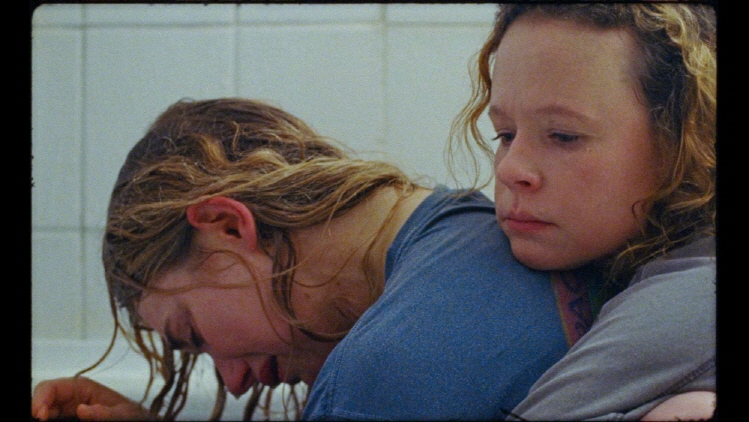
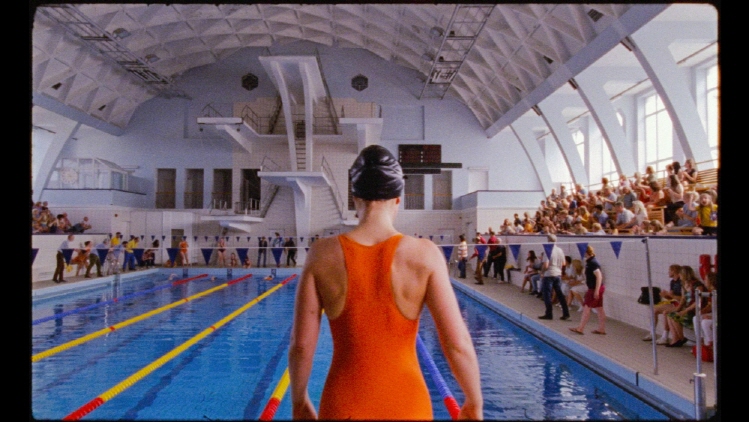
At least, young Yuknavitch, who is played by Anna Wittowsky and then Angelika Mihailova, found some solace and comfort from swimming, though that did not always make her happy. As shown from several brief flashbacks, she was often physically abused along with several other members of her female swimming team by their unforgiving male coach, and this certainly added another trauma to her abused mind.
While never overlooking the traumatic effects of physical/emotional abuse on its heroine’s mind, the movie thankfully prevents itself from becoming too blatant or exploitative, and Stewart and her crew did a superlative job of immersing us more into the heroine’s psychologically damaged state of mind. Shooting the film with Arriflex 416 camera on the Super 16mm format, Stewart and her cinematographer Corey C. Waters deliberately add grainy and tarnished visual texture to the screen, and the movie feels more like a disjointed but somehow coherent stream of consciousness swirling inside its heroine’s mind.
After establishing its heroine’s background so well during its first act, the movie observes her bumpy struggle toward emotional stability during next several chapters. Thanks to her swimming skill, adult Yuknavitch, played by Imogen Poots, leaves her parents and then goes to a university in Texas, but, alas, she subsequently gets herself expelled as wildly enjoying her sudden freedom too much. In addition, she also comes to develop a serious addiction problem, and this certainly pushes her down further to the bottom.
Fortunately, after a period of eventual recovery and the heartbreaking end of her first marriage, Yuknavitch becomes interested in writing. Thanks to a close friend of hers, she comes to study and write along with several young aspirating writers under Ken Kesey (Jim Belushi), an acclaimed novelist mainly known for “Sometimes Great a Nation” and, yes, “The One Who Flew Over the Cuckoo’s Nest”. Although Kesey seems to become more interested in getting a bit closer to her, he gives Yuknavitch a lot of advice as well as some emotional support, and this helps her a bit in not only writing but also processing her old pains and traumas associated with her father.
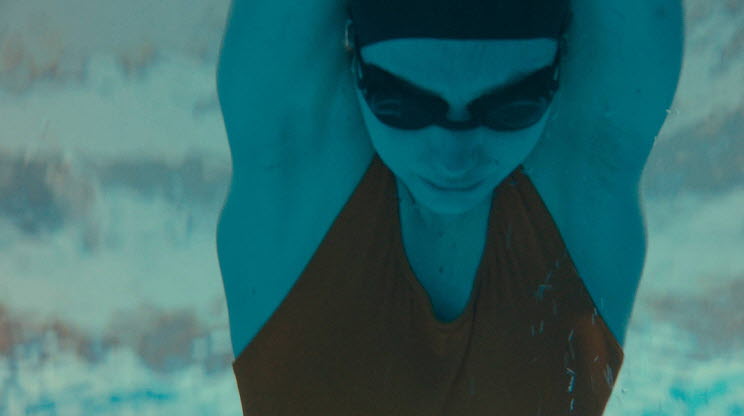
Nevertheless, Yuknavitch’s road toward emotional stability remains messy and confusing as before, and the movie wildly bounces along with her as she recklessly throws herself into a lot of experiments with drug and sex. As before, the movie firmly sticks to its heroin’s frequently wandering emotional status, and we come to feel more of the cri de coeur from her deeply conflicted mind.
Yes, this is surely not something easy to watch, but the movie keeps us engaged while never losing any of its deep compassion and empathy on its heroine, and it is also supported well by the strong lead performance by Imogen Poots. Besides deftly handling a number of emotionally intense moments in the film, Poots presents her character as a flawed but complex human figure to observe and empathize with, and she is also flawlessly connected with Wittowsky and Mihailova. In case of several main cast members in the film, Thora Birch, Susannah Flood, Tom Sturridge, Esmé Creed-Miles, and Charlie Carrick are well-cast in their respective supporting parts, and the special mention goes to Jim Belushi, who steals every minute of his brief but crucial appearance as ably supporting Poots.
In conclusion, “The Chronology of Water” is a harrowingly powerful female drama film to be admired for many good reasons, and Steward made quite an impressive start for her nascent directorial career. I do not know whether she will advance further, but I will certainly have some expectation on what she will make next after this significant cinematic achievement.


 Seongyong's Private Place