
Hayao Miyazaki’s 1986 animation feature film “Castle in the Sky”, which was re-released in South Korean theaters in last week, still soars high even after 40 years. When I walked into the screening room on last evening, I did not expect much because I already saw it in 2010, and I was actually rather tired at that time, but my mind soon became quite energized as appreciating its vivid animation style full of charm, spirit, and imagination.
The film is actually the first official animation film from Studio Ghibli, which was founded by Miyazaki and producer Isao Takahata, who also would be known for his several notable Ghibli animation films such as “Grave of the Fireflies” (1988), not long after the considerable commercial success of Miyazaki’s previous animation film “Nausicaä of the Valley of the Wind” (1984). As a matter of fact, you can recognize a lot of common elements shared between “Nausicaä of the Valley of the Wind” and “Castle in the Sky” such as aviation, retro-futuristic style, and ecological philosophy, and you can also see how Miyazaki advanced further with his own style in “Castle in the Sky”.
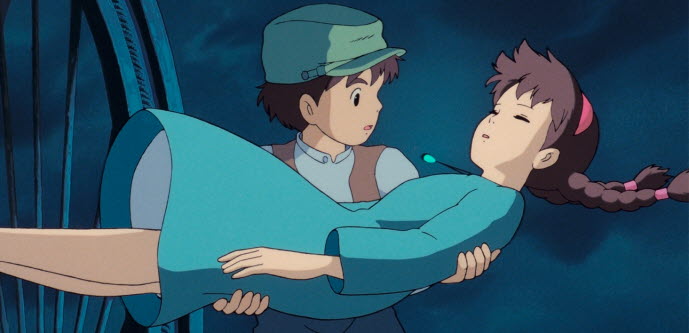
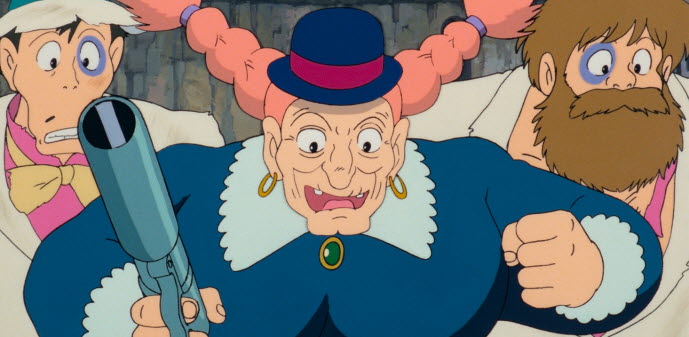
The film, which is mainly set in what can be regarded as a fantasy version of European country around the early 20th century, opens with a thrilling action scene in which a little orphan girl named Shita (voiced by Keiko Yokozawa) escapes from shady government agents when their airship is suddenly attacked by the pirates led by an old lady named Dola (voiced by Kotoe Hatsui). Thanks to a mysterious stone in her possession, Shita manages to survive even though she falls from the sky, but she becomes unconscious, and then her unconscious body happens to fall right in front of Pazu (voiced by Mayumi Tanaka), a young orphan boy working in a shabby mining village.
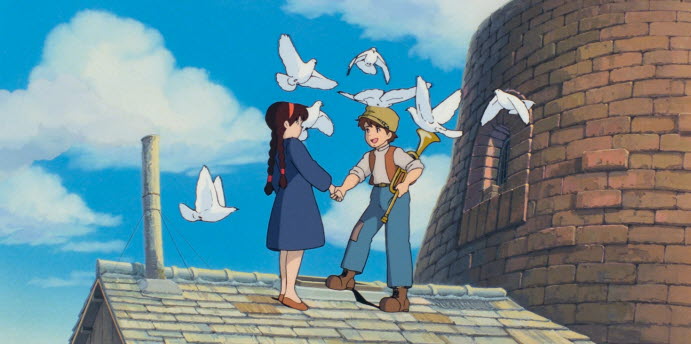
Not long after Pazu takes her to his little residence, Shita regains her consciousness, and they instantly befriend each other as two orphan kids, but, of course, the situation soon becomes quite perilous for both of them. Not only those government agents but also the pirates are already searching for Shita, and Pazu, who comes to like her a lot, willingly tries to protect her from anyone trying to take her away. What follows next is the action sequence which is as exciting as that memorable chase sequence in Miyazaki’s first feature film “The Castle of Cagliostro” (1979), and you will also get some good laughs from how this sequence can be as funny and daring as those Buster Keaton films. At one point, our two orphan kids hurriedly try to get away from their two opponents via a little steam locomotive along a very tricky railway, and we come to brace ourselves more as Miyazaki gleefully adds more wit and action into this impressive action sequence.
Meanwhile, we come to know more about why the government agents keep pursuing after Shita. She turns out to be the last member of a kingdom named Laputa, which was once quite powerful for its highly advanced technology but now seems to be lost forever along with its floating castle (Yes, this will definitely remind you of that famous classic novel by Jonathan Swift). That mysterious stone of hers can actually show where Luputa is, and the government agents are very interested in getting something quite valuable in Laputa.
Because his father told him about his accidental encounter with Laputa, Pazu gets himself more involved into Shita’s ongoing circumstance, even after Shita tries to distance herself from him for protecting him from any danger. Fortunately, he and Shita subsequently get unexpected help from Dora and her merry band of pirates most of whom are actually her sons, and they all certainly encounter a lot of danger and adventure along the story.
The last act of the story eventually culminates to the point where its main characters finally arrive in Laputa, but the film takes its time as letting us behold a heap of enchanting details observed here and there from the screen. While still fully functional due to its advanced technology, the floating castle of Laputa is also covered with a lot of greenery and flower, and there is also a big robot reminiscent of not only that giant robot in “Nausicaä of the Valley of the Wind” but also the robot characters in Brad Bird’s “The Iron Giant” (1999) and Chris Sanders’ “The Wild Robot” (2024).
Of course, when it shifts itself onto action mode during its expected climactic part, the film does not disappoint us at all as deftly balancing itself between humor and thrill. While Dora and her pirates provide some comic relief, Pazu comes to take a lot more risk than expected for saving his dear friend, and you will be alternatively amused and thrilled by how he goes through a series of very risky actions which may even impress Tom Cruise. In addition, there is some real precious poignancy from when Pazu and Shita stick together as making a big decision for not only themselves but also many others out there, and the ecological message of the film surely feels all the more relevant, considering how many of us have let ourselves detached from the world and the nature due to the rapidly advancing technology during last several decades.
On the whole, “Castle in the Sky” remains quite charming and entertaining thanks to Miyazaki’s skillful handling of style and substance. While it does not reach to the greatness of his next work “My Neighbor Totoro” (1988), the film is still a quintessential work from Miyazaki nonetheless, and that is more than enough for recommendation in in my inconsequential opinion.


 Seongyong's Private Place