
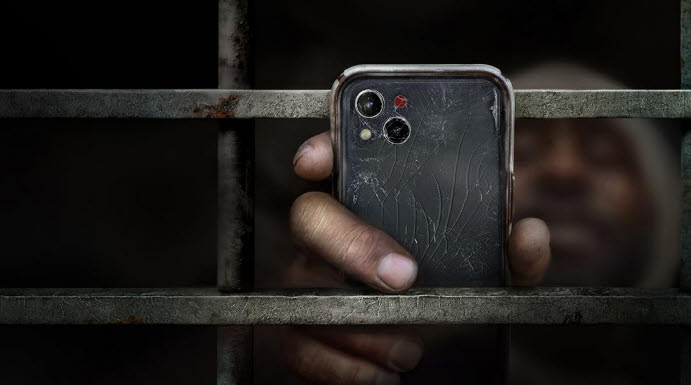
HBO documentary film “The Alabama Solution” is often sobering as presenting the alarming failures of the prison system of the state of Alabama in US. It may not surprise you much if you have ever heard about how problematic the American prison system has been for many years, but the documentary is still captivating on the whole, and we come to care more about the stories of several defiant inmates still struggling under their oppressive system even at this point.
The documentary begins with when directors/co-writers/producers Andrew Jarecki, who has been mainly known for his Oscar-nominated HBO documentary film “Capturing the Friedmans” (2003), and Charlotte Kaufman came to Easterling Correctional Facility in Alabama in 2019. The purpose of theirs was simply shooting a religious revival meeting among a bunch of inmates in the prison, but then a number of inmates approached them off-camera in the middle of the shooting, and what these inmates told them led them to more investigation during next several years. Via contraband cellular phones, Jareki and Kaufman could subsequently correspond with several prison inmates, who surely had a lot of things to show and tell them.
Among these prison inmates willing to step forward for the human rights of theirs and many other fellow inmates, the documentary comes to pay more attention to two of them: Robert Earl Council and Melvin Ray. Both of them are smart and articulate dudes who have learned and experienced a lot as being stuck in prison for many years, and they are certainly very determined to get the stories of them and their fellow inmates known more in public, though they may never be free for the rest of their life.
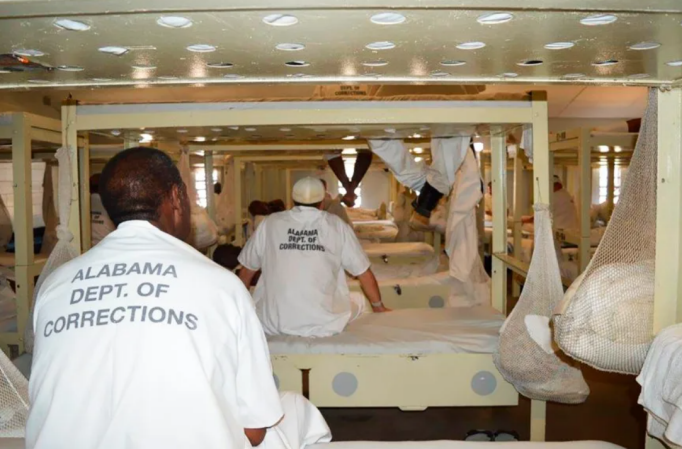
As they and some other inmates show and talk about many serious problems of their prison system, the documentary presents more facts on why their system really needs to be changed from the top to the bottom. For example, many of the state prisons in Alabama have dreadfully understaffed while the number of inmates has been way beyond their maximum capacity, and it is often horrifying to see how poor the life conditions inside these state prisons really are. Not so surprisingly, things can often become very stressful for many of those inmates incarcerated there, and violence has naturally become a usual part of their daily prison life, but those authorities in the state department of correction have ignored this and many other problems in their prison system.
In addition, there have also been countless incidents of abuse committed by prison guards and wardens. In case of a lad named Steven Davis, he was beaten by his several prison guards so severely that he was quickly taken to a local hospital, but he died a few days later, and this certainly devastated his family a lot. Still grieving over her son’s unjust death, Davis’s mother tried to find what exactly happened to her son, but the state department of correction was more occupied with covering up everything as much as possible, and that certainly exasperated and frustrated her.
At least, her son’s cellmate could be a possible witness to testify, but Davis’s mother and her lawyer were only reminded again that how things were disadvantageous for their possible lawsuit. While the state of correction kept blocking them from getting more information as before, Davis’s cellmate understandably declined to tell more mainly because he could be released within a few months, though, as he saw almost everything at that time, he promised to see and talk with her once he felt safe enough outside.
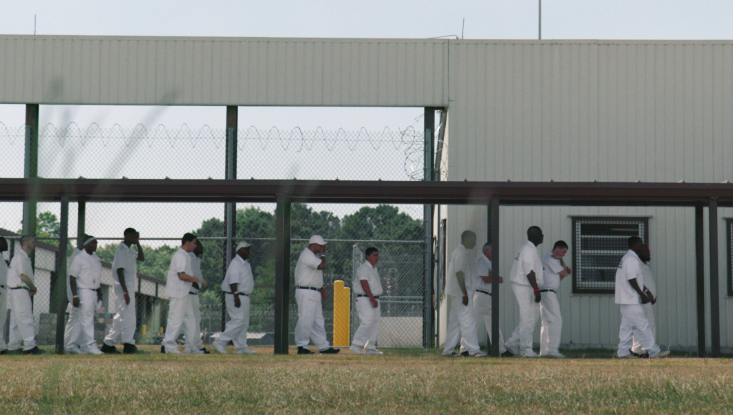
Meanwhile, we also see more of how Council and Ray kept struggling day by day. As a little human rights movement of theirs got known more on the Internet, the systemic failures of the Alabama state prison eventually got a lot more attention than before, but, again, the state government led by Governor Kay Ivey, who is still occupying her position even at this point, was determined to block any reformation or progress. When the federal government attempted to intervene, Ivey, who is your average conservative Southern politician, insisted that it was just a state problem to be handled and then solved by her state government itself, but, of course, her state government only came to start building three bigger prisons to replace the old ones.
And we see more of what has motivated Governor Ivey and many other powerful political figures in Alabama: money and profit. As already shown from Ava Duvernay’s Oscar-nominated Netflix documentary “13th” (2016), the American prison system has virtually a modern slavery exploiting the labor force of millions of inmates for almost free, and the prison system of Alabama is no exception at all. Council and Ray eventually organized a massive statewide strike along with many inmates of the state prisons, and that surely caused a headache for the state government as well as its department of correction, though they were soon cruelly and systemically punished for their brave act of defiance.
In conclusion, “The Alabama Solution”, which was recently included in the shortlist for Best Documentary Oscar, handles its main subject with enough care and thoughtfulness. Vividly presenting the long history of human damage and devastation caused by a very flawed system, the documentary will leave you a lot of things to muse on after you watch it, and it is definitely one of the better documentaries of last year in my trivial opinion.


 Seongyong's Private Place
Pingback: My Prediction on the 98th Academy Awards | Seongyong's Private Place