
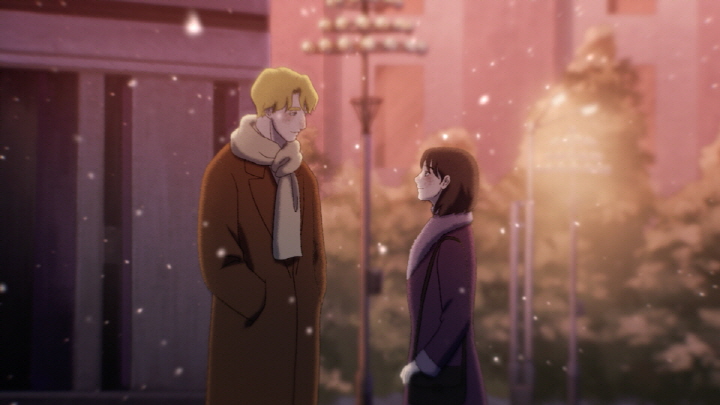
South Korean independent animation film “The Square” is an earnest melodrama about two very different people who cannot help but love each other despite an oppressive society surrounding them. While it is another typical tale of star-crossed lovers, the film draws our attention with its interesting specific background first, and then we come to care more about the couple at the center of the story as observing more of their desperate love.
At first, we get to know Isaac Bori (voiced by Lee Chan-yong), a young Swedish diplomat who has worked in the Swedish embassy in Pyeongyang, North Korea for a fairly long time. Because his grandmother is a Korean immigrant, Bori speaks Korean mostly well, but his foreign appearance still stands out whenever he goes outside, and that is the main reason why he has to be very careful about meeting Bok-joo (voiced by Lee Ga-yeong), a pretty young traffic officer he has been secretly dating for some time.
Not long after another clandestine date with Bok-joo, Bori requests the extension of his stay in the embassy, just because he simply wants to be with Bok-joo as long as possible. After all, most of his fellow young diplomats are not particularly willing to work in North Korea, so it seems that he can continue to occupy his position in the embassy as before.
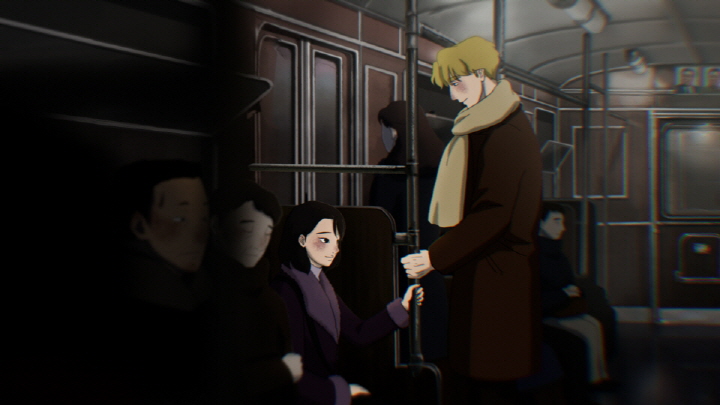
However, his request is unexpectedly denied, and now Bori has to leave North Korean within a few days. Naturally, he protests, but there is nothing he can do about this changed circumstance. Besides, marrying Bok-joo or taking her out of the country is impossible to say the least, and Bok-joo, who has been more clear-eyed on their romance, is willing to accept their upcoming separation even though it will be very painful for both of them.
Meanwhile, not so surprisingly, their relationship is closely monitored by Myeong-joon (voiced by Jeong Woon-jong), who works as a local translator at the embassy. Having been around Bori for a long time, Myeong-joon knows a lot about what Bori and Bok-joo have been doing in private, and he also comes to care about Bori a lot behind his flatly phlegmatic attitude. Nevertheless, he must routinely report to his direct superior about whatever is going on between Bori and Bok-joo, and he becomes all the more conflicted when his direct superior considers investigating more on Bok-joo.
Although there is not much surprise for us as the story becomes expectedly melodramatic, the movie keeps engaging us via its modest but haunting presentation of Pyeongyang on icy winter days. The streets and alleys of the city often feel barren and oppressive with all those drab buildings and aggressive slogans, and the resulting stark atmosphere is often accentuated by the occasional electricity shortage in the city.
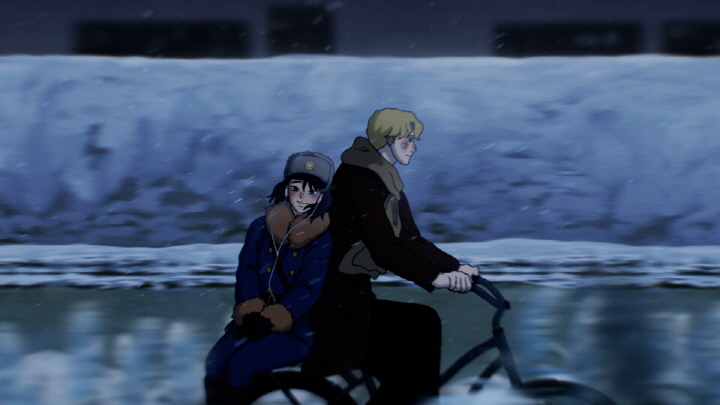
In such a cold and bleak world like that, Bori and Bok-joo’s romance comes to feel more desperate and poignant to us. Although he is unbelievably naïve in handling his increasingly problematic circumstance, it is touching to observe how Bori keeps trying just for his love, and the movie does earn its weepy finale along with him. The finale is rather contrived at first, but it still works due to the earnest emotions beneath it, and we are moved more by the following last scene, which feels somber and restrained but will linger on your mind for a while.
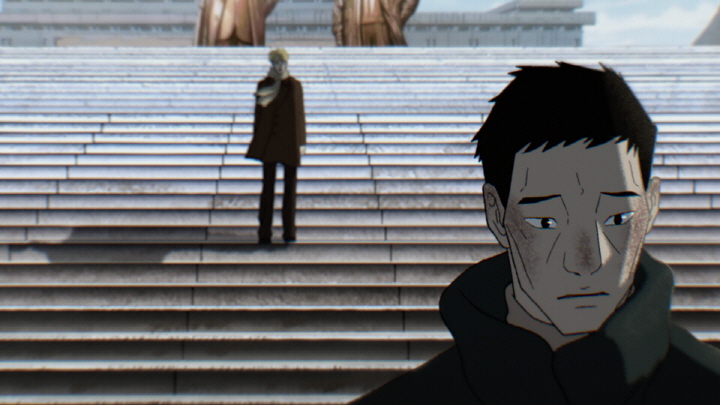
This is the first animation feature film by director/writer Kim Bo-sol, who demonstrates here that she is a good animation director with considerable talent and potential. Although the story and characters are pretty simple to say the least, the film is filled with enough mood and personality on the whole, and it does not waste any second of its rather short running time (73 minutes). In case of one intense chase sequence unfolded inside a subway station, Kim and her crew did a commendable job of generating some thrill and suspense on the screen, and I particularly enjoyed how this compelling sequence evokes the similar scene in William Friedkin’s “The French Connection” (1971).
The main voice cast members of the film are solid, though I must point out that it is a bit awkward for me to see both of the Swedish and North Korean characters in the film speaking in Korean. While Lee Chan-yong and Lee Ga-yeong generate a little but precious chemistry between their lead characters, Jeon Woon-jong holds his own small place as his character comes to show more heart and conscience along the story, and Lee Yoo-joon is also effective as Myeong-joon’s direct superior.
In conclusion, “The Square” is a promising start for its director’s burgeoning career, and it also reminds me of how South Korean animation made a small but significant leap during last year via a number of notable works. Although I did not like “Exorcism Chronicles: The Beginning” (2024) and “Mr. Robot” (2024) enough for recommendation, their technical qualities impressed me to a considerable degree nonetheless, and then there came “Your Letter” (2025), which is the best in the bunch in my humble opinion. Just like these three recent South Korean animation films, “The Square” gives another good sign of the ongoing progress in South Korean animation, and I sincerely hope that they will lead to the production of more local animation feature films to come in the future.


 Seongyong's Private Place