

Mikhaël Hers’ 2022 film “The Passengers of the Night”, which was belatedly released in South Korea around the end of the last year, is a mild but engaging drama mainly driven by mood and emotion. Simply rolling with its several main characters along its rather loose narrative, the movie generates a series of small but touching human moments, and we get more involved in their emotional journeys along the story.
The movie, which is set in Paris during the 1980s, begins with the prologue set in 1981, and then we see how things become difficult for a plain ordinary woman named Élisabeth (Charlotte Gainsbourg) in 1984, She recently divorced after her husband left her and her two adolescent kids for some unspecified reason, and now she has to find any job to support her and her two children. Because she has been a housewife for many years, she understandably feels uncertain and confused, and she becomes daunted as she fails more than once in her attempt to get employed.
Nevertheless, the situation is not that bad for Élisabeth. Her ex-husband, who is incidentally never shown in the film, allows her to stay with their two children in their apartment technically belonging to him, though he does not pay his alimony that well. In addition, her daughter Judith (Megan Northam) will soon leave for her college education, so Élisabeth can pay more attention to her younger son Matthias (Quito Rayon-Richter), who still seems indecisive about his future while getting more interested in poetry.
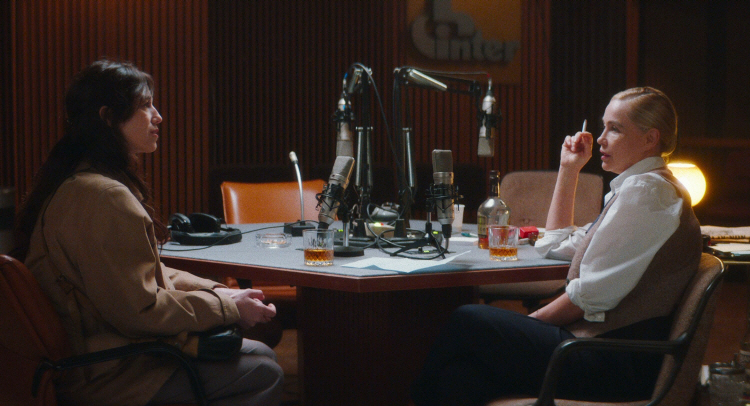
Above all, Élisabeth finally gets stably employed. She applies for a rather menial job in some night radio program, and she is instantly hired after her brief interview with Vanda Dorval (Emmanuelle Béart), the host of that night radio program. She is not so sure about whether she can do the job well at first, but all she has to do is tactfully handling those numerous callers for her boss, and she soon gets accustomed to that, though she also has to work as a librarian during daytime for earning more for supporting herself and her son.
Vanda sometimes invites a random guest to be interviewed for her night radio program. On one day, a young woman named Talulah (Noée Abita) comes to the studio of the night radio program, and Élisabeth comes to care about her as Talulah talks a bit about how she became homeless after having a lot of difficulty due to her parents. In the end, Élisabeth approaches to Talulah later, and she suggests that Talulah should stay in her apartment for a while at least. After all, there is a spare room in Élisabeth’s apartment, and Talulah does not mind accepting the kindness of a stranger.
While Matthias also does not mind this sudden change at all, we gradually sense that he becomes interested in getting closer to Talulah. He comes to spend more time with her, and we are not so surprised when they eventually get quite intimate with each other at one point, but then she makes a sudden decision to his bafflement on the very next day.
And then the movie moves forward to four years later. While she still has to do two jobs, Élisabeth’s daily life has been more stable than before, and she even comes to have another chance for love via a handsome guy who has often visited her library just because of her. In addition, she has become the more crucial part of that night radio program, and we observe how confident she is now compared to her first days at the studio.

When Talulah comes back into her life, Élisabeth is naturally surprised, but she lets Talulah stay in the apartment again, though her ex-husband is now going to sell it sooner or later. Not so surprisingly, Matthias, who has struggled to start his artistic career for a while, finds himself drawn to Talulah again, but we come to sense that she prefers to remain as a friend to him.
Instead of pushing its main characters into unnecessary conflicts, the screenplay by Hers and his co-writers Maude Aeline and Mariette Désert lets them follow common sense and decency. When Talulah turns out to be more troubled than she seemed at first, Élisabeth shows more concern and compassion to her, and that leads to one of the most moving moments in the film. After that, Talulah becomes more decisive about what should be done about her rather complicated relationship with Matthias, who understands and respects her decision without any bad feeling at all.
I personally wish the movie delved a bit deeper into the story and characters, but I also enjoyed its casual mood and free-flowing narrative at least, and I also appreciated its solid main cast members. As showing a lighter side of her acting talents compared to her intense performances in several works of Lars von Trier such as “Antichrist” (2009), Charlotte Gainsbourg duly holds the center as required, and several other cast members including Quito Rayon-Richter, Noée Abita, Megan Northam, Thibault Vinçon, and Emmanuelle Béart have each own moment to shine around her.
Overall, “The Passengers of the Night” compensates for its rather thin narrative via its enjoyable mood, storytelling, and performance. You may feel a bit impatient with its leisurely narrative pacing at first, but it will be a fairly rewarding experience on the whole once you give it a chance, and you will come to care about its main characters more than expected.


 Seongyong's Private Place